
Quick answer: At a typical Korean jjimjilbang, you pay at the entrance, receive a locker key and sometimes towels and sauna clothes, then enter the gender-separated changing and bathing area. Shower before using the baths. After bathing, put on the provided T-shirt and shorts before entering the shared jjimjilbang lounge and heated rooms. Keep your locker key with you, check whether extra purchases are charged to it, drink water, and leave any hot room if you feel uncomfortable or unwell.
A Korean jjimjilbang can look confusing on your first visit because several different experiences are often combined in one building: a public bath, heated sauna rooms, a relaxation lounge, food, massage chairs, games, and sometimes sleeping or entertainment areas.
The important thing is that you do not need to understand everything before entering.
The basic flow is usually:
entrance → locker room → shower and bath → change into sauna clothes → shared jjimjilbang area → food or relaxation → checkout
The exact layout and rules vary by facility, but understanding this sequence solves most first-time confusion.
Jjimjilbang at a glance
| Area | Who uses it | What you wear | What happens there |
|---|---|---|---|
| Entrance | Everyone | Normal clothes | Pay admission and receive your key, towels, and sauna clothes if included |
| Changing room | Usually separated by gender | You change here | Store shoes, clothes, and belongings |
| Bath and shower area | Usually separated by gender | Normally no clothing | Wash thoroughly, then use the baths and wet-sauna facilities |
| Shared jjimjilbang area | Usually mixed | Provided T-shirt and shorts | Use heated rooms, cool rooms, lounges, snack areas, and other facilities |
| Food and entertainment areas | Usually mixed | Sauna clothes | Buy food or drinks and use paid facilities where available |
First: understand the difference between a bathhouse and a jjimjilbang
You may see Korean facilities described as sauna, 목욕탕 (bathhouse), or 찜질방 (jjimjilbang).
They are not always identical.
A small neighborhood bathhouse may mainly contain gender-separated changing rooms, showers, hot and cold baths, and wet or dry sauna facilities.
A larger jjimjilbang usually adds a separate shared relaxation area where visitors wear provided clothes and can use heated rooms, lounges, food facilities, massage chairs, or entertainment areas.
Do not assume that every place with a “sauna” sign has a large shared jjimjilbang area.
Step 1: Check the facility before you go
Do not assume that every jjimjilbang is open 24 hours.
Some large facilities operate around the clock, while others close in the evening. Current official Seoul tourism listings show both types.
Before leaving your accommodation, check:
- opening hours;
- last admission time;
- admission price;
- whether sauna clothes are included or rented separately;
- whether the shared jjimjilbang area is operating;
- overnight rules if you plan to stay late;
- age restrictions if visiting with children;
- the facility’s accepted payment methods;
- scheduled closing or maintenance days.
A facility can also operate different hours for its bath, water park, jjimjilbang, restaurant, or other sections.
For example, a large complex may keep its bath open later than the shared jjimjilbang rooms.
Step 2: What should you bring?
You usually do not need much.
Many jjimjilbangs provide some combination of:
- a locker;
- a locker key or wristband;
- small towels;
- a T-shirt and shorts for the shared area.
What is included varies by facility.
Useful things to bring include your normal payment method, basic toiletries if you prefer your own products, and any essential personal items.
Do not assume that shampoo, conditioner, toothbrushes, razors, skincare products, or larger towels are included for free. Some facilities provide them, while others sell them separately.
If you carry valuables such as your passport or a large amount of cash, keep them secured in the appropriate locker rather than leaving them unattended.
Step 3: Pay at the entrance
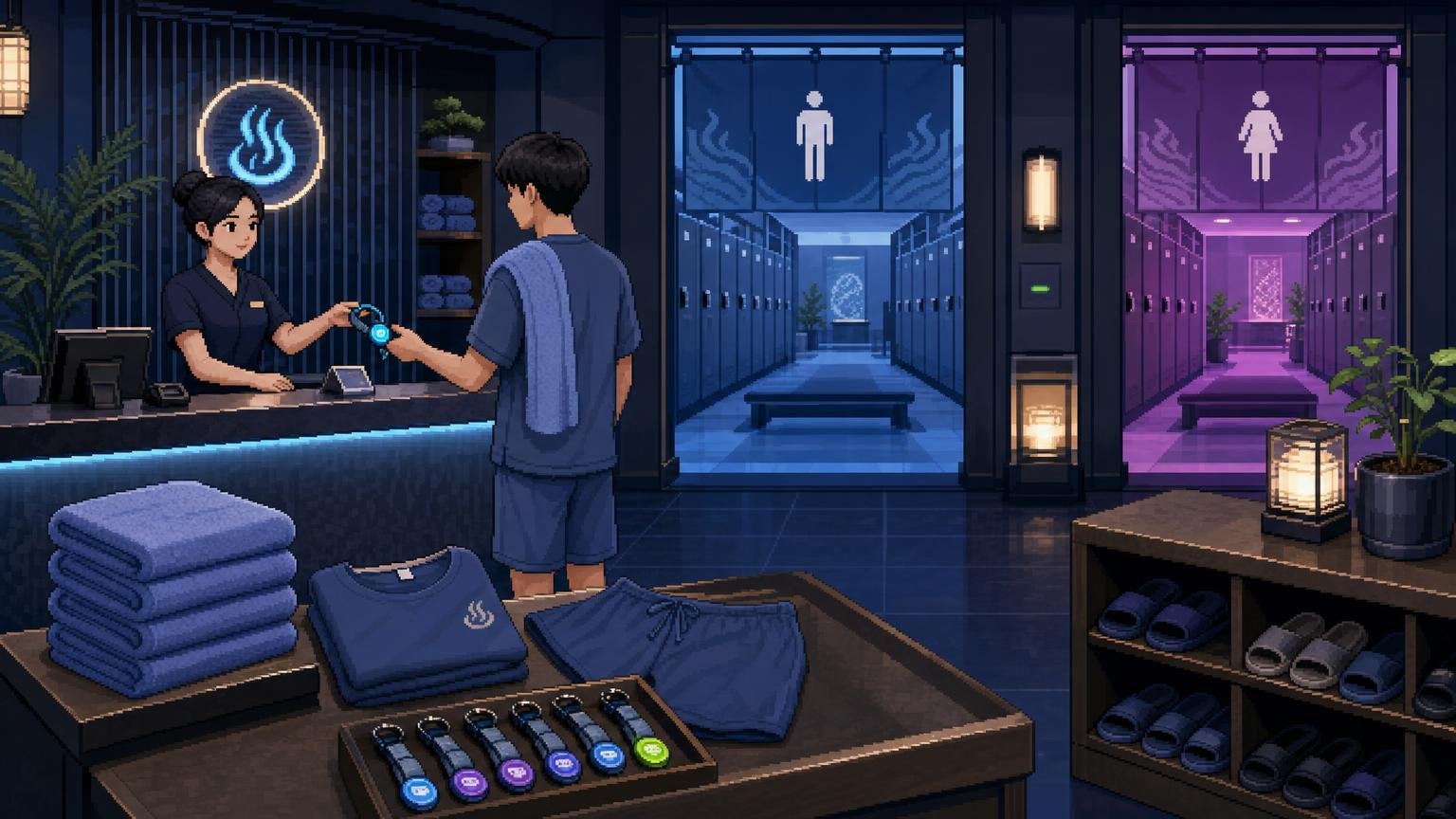
At the front counter, tell the staff that you want to use the jjimjilbang.
A typical entrance process looks like this:
- Pay the admission fee.
- Receive a locker number or electronic key.
- Receive towels if they are included.
- Receive or collect the jjimjilbang clothes.
- Follow the sign to the correct changing area.
Useful Korean phrases:
| English | Korean |
|---|---|
| I would like to use the jjimjilbang. | 찜질방 이용하고 싶어요. |
| How much is admission? | 입장료 얼마예요? |
| Are the clothes included? | 찜질복 포함돼요? |
| Are towels included? | 수건 포함돼요? |
| Can I pay by card? | 카드 돼요? |
| Where is the locker room? | 탈의실 어디예요? |
How the locker key works
Many jjimjilbangs use a waterproof key or electronic wristband that you keep with you.
According to current Korea Tourism Organization guidance, the key is commonly worn on the wrist or ankle.
At some facilities, the same key can also be used for purchases such as:
- food;
- drinks;
- massage chairs;
- games;
- other paid facilities.
The charges may then be settled when you leave.
However, this is not universal. Some facilities require immediate payment instead.
Step 4: Store your clothes and belongings
Inside the changing area, find the locker that matches your key or assigned number.
Store your:
- outdoor clothes;
- wallet;
- bag;
- other valuables.
Lock the locker before going to the bath area.
If the facility has a separate shoe locker, follow the instructions at the entrance.
Step 5: Shower before using the baths
This is one of the most important etiquette points.
In a typical Korean public bath area, guests wash their body thoroughly before entering the shared tubs.
You will usually find individual washing stations with a shower head, mirror, and small stool.
Wash first, then enter the bath.
Do not enter a shared bath directly after changing clothes without washing.
Do you have to be naked?
In the gender-separated bath and shower area, nudity is normally the standard.
This can feel unfamiliar if public bathing is not common in your country.
The important distinction is:
Bath area = normally no clothes
Shared jjimjilbang area = provided T-shirt and shorts
Do not wear the provided jjimjilbang uniform inside the bath unless the facility specifically instructs otherwise.
If communal bathing makes you very uncomfortable, check the facility before visiting to see whether it offers a separate dry-sauna, spa, private bath, or other alternative.
Phones and photography
Do not take photographs or video in changing rooms, shower areas, or public bath areas.
These are private spaces.
It is also better to keep your phone secured in your locker while bathing unless the facility clearly provides another safe arrangement.
Photography rules in shared lounges can vary, so avoid including other guests in photographs without permission.
Step 6: Change into the jjimjilbang clothes
After you finish bathing, dry yourself and return to the changing room.
Put on the T-shirt and shorts provided by the facility.
These are the clothes you normally wear in the mixed shared area.
If you cannot find them, ask:
찜질복 어디 있어요?
“Where are the jjimjilbang clothes?”
Step 7: Enter the shared jjimjilbang area
This is the area many travelers recognize from Korean dramas and variety shows.
Depending on the facility, you may find:
- heated rooms;
- cool rooms;
- charcoal rooms;
- salt rooms;
- clay rooms;
- stone rooms;
- large floor lounges;
- reclining chairs;
- restaurants or snack bars;
- massage chairs;
- arcades;
- coin karaoke;
- children’s areas.
The exact combination varies enormously.
How to use the heated rooms safely
You do not need to start with the hottest room.
Current Korea Tourism Organization advice for first-time visitors recommends beginning with cooler rooms and gradually trying warmer rooms as you become comfortable.
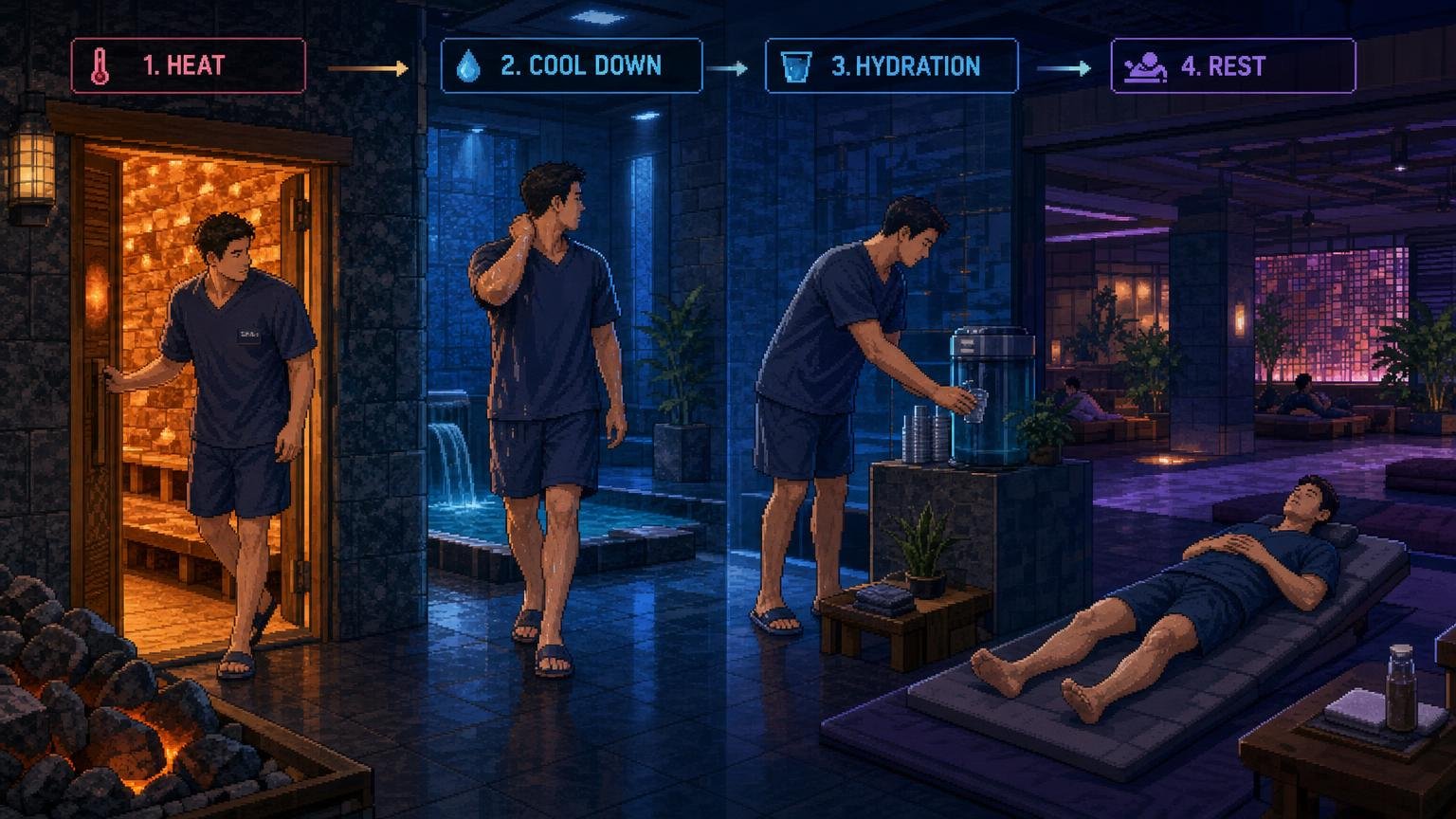
A sensible first visit is:
- Spend a few minutes in the main lounge.
- Try a lower-temperature room.
- Leave when you feel hot enough.
- Cool down and drink water.
- Try another room only if you still feel comfortable.
Do not treat heat tolerance as a competition.
If you feel dizzy, weak, nauseated, confused, unusually short of breath, or simply uncomfortable, leave the hot room and cool down.
Follow any temperature, age, health, or usage warnings posted by the facility.
The famous jjimjilbang towel
You may see people folding a small towel into the famous Korean “sheep head” shape.
It is a popular jjimjilbang image from Korean television and entertainment, but it is completely optional.
You do not need to wear your towel this way to use the facility.
What should you eat?
Food is part of the jjimjilbang experience at many large facilities.
Two famous choices are:
- 식혜 (sikhye) — a sweet rice drink;
- 구운 계란 / 맥반석 계란 — baked or roasted-style eggs.
Korea Tourism Organization’s current jjimjilbang content also highlights sikhye and eggs as familiar parts of the experience.
Larger facilities may also sell:
- ramyeon;
- rice dishes;
- dumplings;
- snacks;
- coffee;
- soft drinks.
Menus and payment systems vary.
Do not assume you need cash
Payment systems vary by facility.
Some modern jjimjilbangs use an electronic locker key for purchases and settle everything at checkout. Others accept cards directly at restaurants or vending areas, while some smaller services may use different payment arrangements.
For example, current Visit Seoul information for Park Habio Water Kingdom states that almost all payments after admission use a locker-key post-payment system.
The safest approach is to check the facility’s current payment information rather than assuming every jjimjilbang is cash-only or card-only.
Can you sleep overnight?
Sometimes, but never assume that you can.
Some jjimjilbangs are open 24 hours and provide resting areas where guests stay late or sleep.
Others close at night.
Some facilities also:
- charge a different nighttime rate;
- limit the number of hours you can stay;
- have no dedicated sleeping room;
- provide no blankets or pillows;
- close certain areas overnight.
If your travel plan depends on sleeping there, confirm the policy before arriving.
Visiting with children
Family rules vary by facility.
Check:
- minimum or maximum ages for certain areas;
- guardian requirements;
- rules for gender-separated bathing areas;
- access to high-temperature rooms;
- children’s pricing;
- availability of family or kids facilities.
Do not assume the policy from one jjimjilbang applies to another.
What about tattoos?
Tattoo policies are facility-specific.
Do not assume that every Korean jjimjilbang has the same rule.
If you have a large or highly visible tattoo and entry is important to your plans, contact the facility directly before traveling there.
The facility’s own current policy should take priority over advice from an old blog or online comment.
Which jjimjilbang style suits you?
| Your situation | What to look for |
|---|---|
| First jjimjilbang visit | A large modern facility with clear photos, recent operating information, and several shared areas |
| You want a traditional neighborhood experience | A smaller local bathhouse or jjimjilbang, but expect less English information |
| You dislike communal bathing | A spa complex with clearly described dry-sauna or alternative facilities |
| You want to stay late | A facility whose official information specifically confirms late-night or 24-hour operation |
| You are traveling with children | A family-oriented complex with published child and guardian rules |
| You want food and entertainment | A larger complex with restaurants, massage chairs, games, or relaxation facilities |
Common first-time mistakes
Assuming every sauna is a full jjimjilbang
A small public bath may not have the large mixed relaxation area you expect.
Assuming every jjimjilbang is open 24 hours
Operating hours vary widely. Check before visiting.
Skipping the shower before entering the bath
Wash your body before using shared baths.
Wearing jjimjilbang clothes into the bath
The provided clothes are normally for the shared dry area, not the bathing area.
Taking photographs in the changing or bathing area
Do not photograph private areas or other guests.
Losing your locker key
Keep it attached to your wrist or ankle.
Assuming every extra service is included
Food, massage chairs, entertainment, premium rooms, and other services may cost extra.
Staying in a hot room because everyone else is still inside
Heat tolerance is personal. Leave when you feel uncomfortable.
Planning to sleep there without checking first
Some facilities close at night or have specific overnight restrictions.
Assuming payment works the same everywhere
Admission, food, locker-key charges, cards, and cash arrangements differ between facilities.
A simple first-timer routine
If you do not know where to start, use this:
- Pay admission.
- Store your shoes and belongings.
- Enter the appropriate changing room.
- Shower thoroughly.
- Try one or two baths if you want to.
- Dry off.
- Put on the provided T-shirt and shorts.
- Enter the shared jjimjilbang area.
- Start with a cooler sauna room.
- Rest and drink water.
- Try sikhye or another snack.
- Return to the locker room.
- Change into your normal clothes.
- Return the key and settle any extra charges.
What happens when you leave?
Before checkout:
- return to your changing room;
- collect all belongings;
- check the locker carefully;
- change back into your normal clothes;
- return the locker key or wristband as instructed.
If the key was used for food or other paid services, the facility may calculate those charges at checkout.
Do not leave without confirming that your account is settled and you have your phone, wallet, passport, and other valuables.
What may be different from one jjimjilbang to another?
Opening hours: Some facilities operate 24 hours, while others close at night.
Admission price: Prices may differ by time of day, weekday, weekend, age, or facility zone.
Clothing: Sauna clothes may be included, rented separately, or handled differently.
Towels and toiletries: What is supplied varies.
Payment: Some facilities use locker-key post-payment systems, while others use normal card or other payment methods.
Facilities: Food, massage chairs, sleeping rooms, game areas, children’s facilities, and themed sauna rooms are not guaranteed.
Overnight access: A facility being called a jjimjilbang does not guarantee overnight stays.
Age and family rules: These depend on the facility.
Tattoo policies: Ask the facility directly when relevant.
Language support: English support varies by staff member and location.
FAQ
Do I have to be naked in a Korean jjimjilbang?
In the typical gender-separated shower and bathing area, nudity is normally expected. In the shared jjimjilbang lounge and dry-sauna area, you normally wear the provided T-shirt and shorts.
Are men and women together?
Bathing and changing areas are generally separated by gender. Shared relaxation and dry-sauna areas are commonly mixed, but facility layouts can vary.
Do I shower before or after the bath?
Shower before entering the shared baths. You can wash or rinse again afterward if you want to.
Do I need to bring a towel?
Many jjimjilbangs provide towels, but what is included varies. Check the facility information or ask at the entrance.
Do I have to wear the jjimjilbang clothes?
The provided T-shirt and shorts are normally worn in the shared jjimjilbang area. They are not normally worn inside the public bath.
Can foreigners use a jjimjilbang?
Yes. Jjimjilbangs are public leisure facilities, but English-language support varies. Saving the facility’s Korean name and address on your phone can make the visit easier.
Can I sleep overnight?
Only at facilities that allow it. Some jjimjilbangs are open 24 hours, while others close at night. Confirm the overnight rules before depending on one for accommodation.
Can I pay with a foreign credit card?
Payment systems vary. Many modern facilities accept cards, while individual services inside the building may use a locker-key system or another method. Check the specific facility rather than assuming.
Can I use my phone inside?
Do not take your phone into changing rooms or bathing areas for photography. Rules in shared lounges vary, and you should avoid photographing other guests.
What should I do if the sauna feels too hot?
Leave immediately, cool down, and drink water. You do not need to stay for a fixed amount of time or copy other guests.
What is sikhye?
Sikhye is a sweet Korean rice drink commonly associated with jjimjilbang visits. Many facilities also sell baked eggs and other snacks.
What if I lose my locker key?
Tell staff immediately. Replacement procedures and charges vary by facility.
Official information
-
VISITKOREA: How to Enjoy a Korean Jjimjilbang
— Korea Tourism Organization guidance on locker keys, sauna rooms, relaxation, and jjimjilbang food. -
Visit Seoul: Venue G Aqua 24
— a current example of a 24-hour Seoul jjimjilbang and its published facilities and fees. -
Visit Seoul: Park Habio Water Kingdom & Jjimjil Spa
— a current example showing separate jjimjilbang hours and a locker-key post-payment system. -
1330 Korea Travel Helpline & Complaint Center
— multilingual tourism information, real-time chat, online call, and travel assistance.