
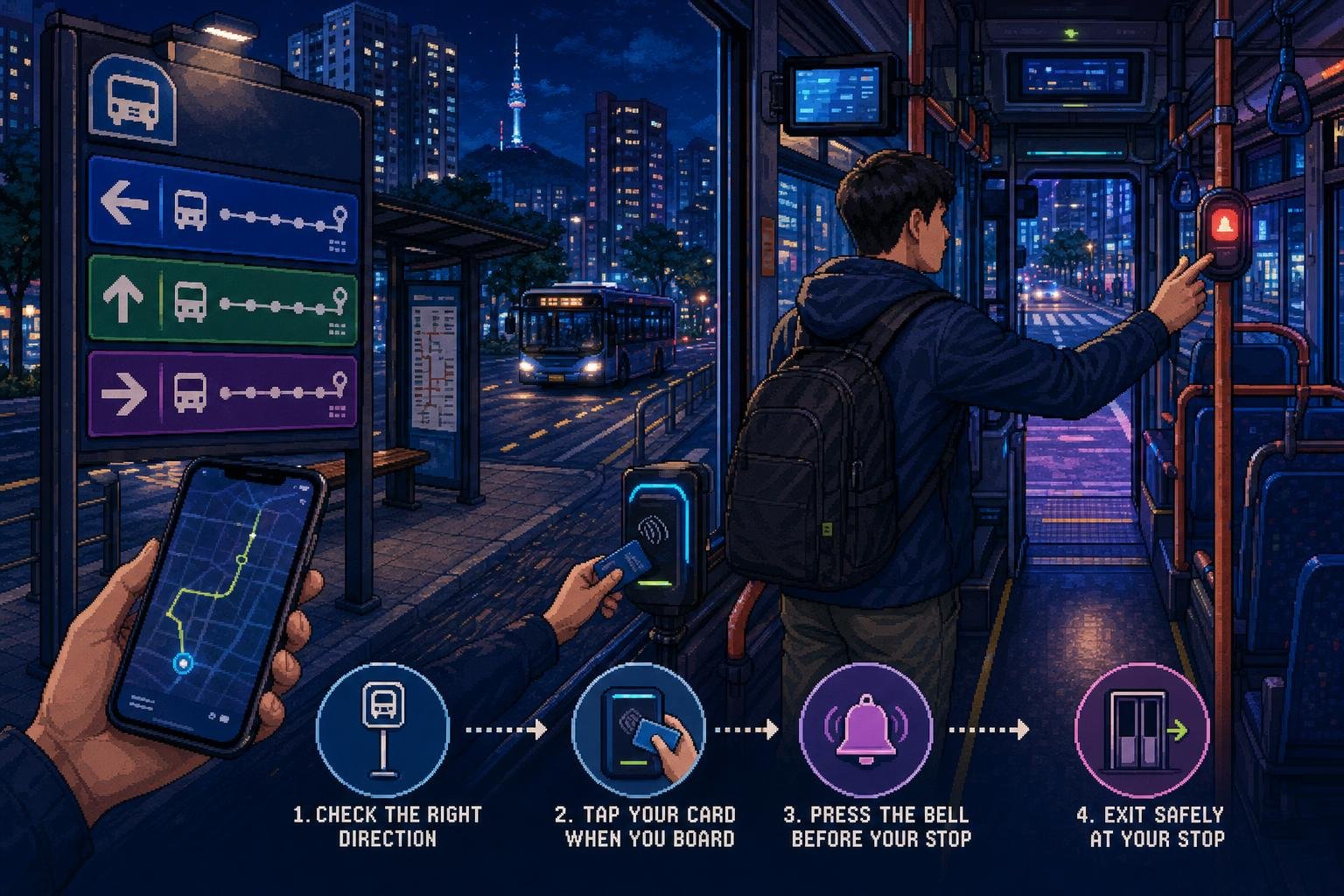
Korean city buses are often the most direct way to reach a neighborhood, market, hotel, or attraction that is not close to a subway station. The difficult part for first-time visitors is usually not the ride itself. It is identifying the correct stop, choosing the correct side of the road, understanding how payment works, and knowing when to get off.
The details vary between Seoul, Busan, Daegu, Jeju, and other cities, so this guide explains the common system and uses Seoul’s current rules as the clearest example. Always check the local fare and route information for the city you are visiting.
At a glance
| Question | Practical answer |
|---|---|
| What should I use to pay? | A rechargeable transportation card such as Tmoney or EZL is the safest choice for visitors. |
| Can I tap a foreign Visa or Mastercard? | Do not assume so. Foreign-issued cards generally cannot be used for direct tap payment on ordinary city buses; selected services may be different. |
| Where do I board? | Usually through the front door. Wait near the stop and let passengers get off first. |
| Where do I get off? | Usually through the rear door. Press the stop bell before your destination and tap your card when exiting. |
| How do I transfer? | Tap off, then board the next bus or subway within the applicable time limit. Seoul allows up to four transfers under its integrated fare rules. |
| Is cash always accepted? | No. Cashless-bus services are expanding, and some buses no longer accept cash. Carry a transportation card instead. |

1. Find the correct bus stop and direction
Start with a route search rather than walking to the nearest visible bus stop. Search your destination in Naver Map or Kakao Map, select public transportation, and check all of the following before leaving:
- the bus number;
- the exact stop name;
- the walking route to the stop;
- whether the stop is on the correct side of the road;
- the direction of travel;
- the number of stops before your destination; and
- the estimated arrival time.
Seoul’s official public transportation information also provides bus arrival and location information through bus information terminals, TOPIS, and map services. If two nearby stops have similar names, compare the stop location on the map rather than relying only on the English translation.
How to recognize the right side of the road
A bus stop may serve buses going in opposite directions. The same stop name may appear on both sides of a wide road, but the route list will be different. Before you wait, compare the bus number and the direction shown in your route search with the information displayed at the stop.
When the bus approaches, check the route number on the front display. If several buses stop there, do not board simply because the bus number looks similar. Seoul uses different route types and colors, and a bus with a related-looking number may not follow the route you need.
2. Pay with a transportation card
Buy a rechargeable transportation card at a participating convenience store, subway information center, or other authorized location. Tmoney and EZL cards are commonly used for buses and other public transportation across Korea. Ask the staff to help you purchase and load the card if you are unsure how much balance to add.
For a normal city-bus journey, hold the card over the reader as you board. A beep or display response normally confirms the payment. Keep the card separate from other contactless cards and electronic wallets so the reader does not detect the wrong card.
Why a foreign bank card is not the same as a transportation card
A foreign-issued credit or debit card may work at shops, taxis, or selected transport services, but you should not treat it as a guaranteed bus payment method. Current visitor guidance identifies foreign-issued cards as unavailable for direct tap payment on ordinary city-bus card readers, with some selected services as exceptions. A Tmoney or EZL card is the more dependable option for regular city buses.
Can you pay for two people with one card?
In Seoul, tell the driver how many passengers are boarding before tapping if you want to pay for multiple people with one card. Multi-passenger transfer rules are limited: the number of passengers boarding and transferring must match, and multi-passenger boarding does not receive the same subway-transfer treatment. Separate cards are simpler when people will split up or transfer separately.
3. Get on, ride, and prepare to get off
Boarding steps
- Stand where the bus driver can see you and raise your hand if necessary.
- Let passengers exit before you board.
- Enter through the front door unless the bus or staff directs you differently.
- Tap your transportation card on the reader near the driver.
- Move away from the doorway so other passengers can board.
Bus stops can be busy, and the bus may not remain stopped for long. Have your card ready before the bus arrives. If you are carrying a large suitcase, avoid blocking the entrance and move to a safe position as soon as possible.
How to know when your stop is coming
Use the route screen in your map app, but also watch the bus display and announcements. Names may be shown in Korean and English, and the order of stops can help you confirm that you are still on the correct route.
Press the stop bell before the bus reaches your destination. Do not wait until the bus has already stopped at the previous location. If you are unsure, keep your map open and prepare to exit one stop before the destination shown in the app.
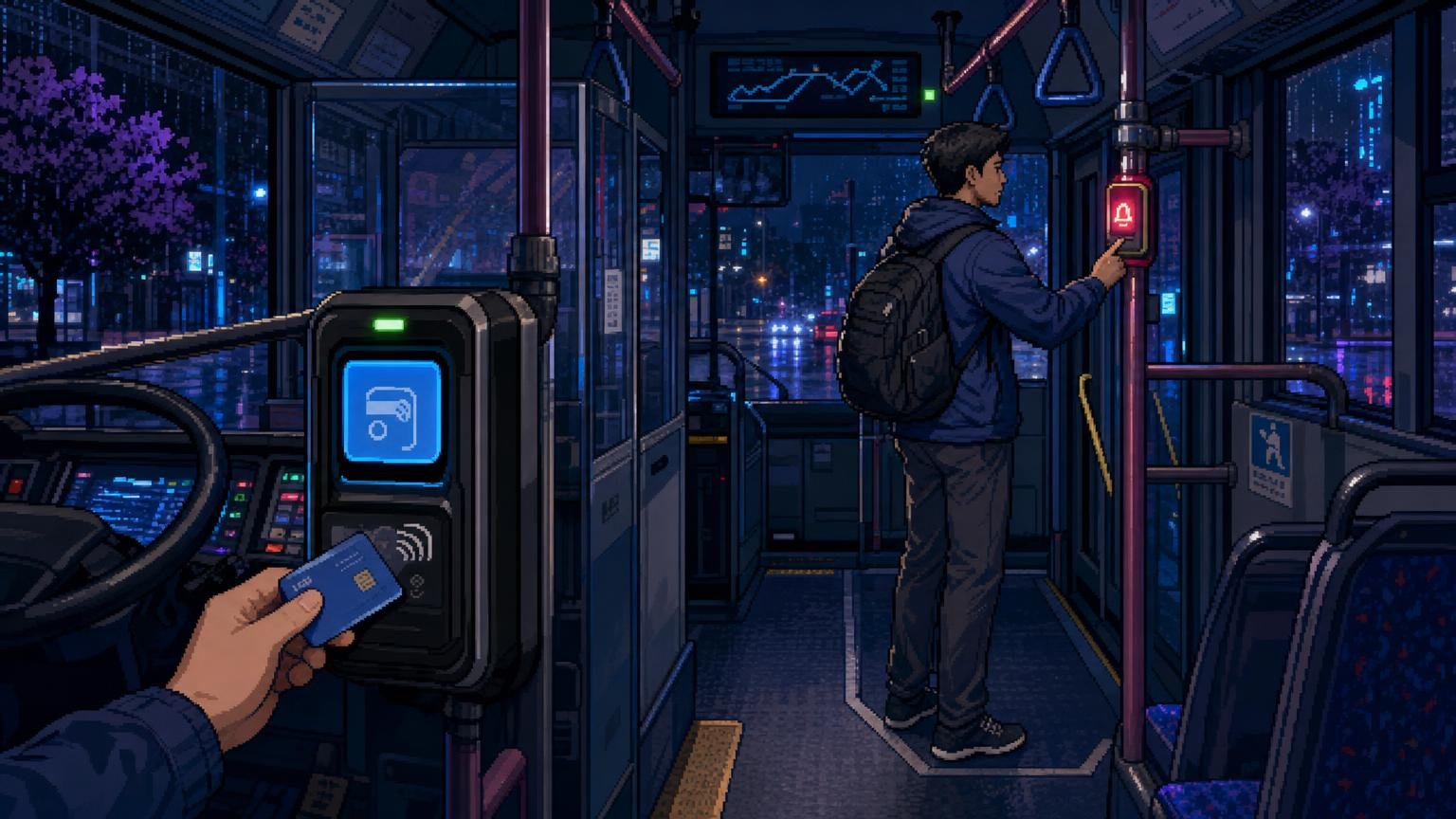
Exit through the rear door when possible. On Seoul buses, tap the same transportation card on the reader as you leave. This records the end of the ride and is required for the integrated transfer discount.
4. Transfer between buses or to the subway
Transfers are handled through the transportation card system. The basic routine is:
- Tap your card when getting off the first bus.
- Walk to the next bus stop or subway entrance.
- Board the next vehicle within the allowed time window.
- Tap the same card when boarding.
In Seoul, the standard transfer window is 30 minutes after tapping off. The window extends to 60 minutes for transfers made between 9 p.m. and 7 a.m. Seoul’s integrated fare system permits up to four transfers, or five boardings in total, when the conditions are met.
The transfer discount does not apply when you reboard the same bus route. A transfer may also fail if you forget to tap off, use a different card, wait too long, or travel under a local rule that differs from Seoul’s system.
What if the transfer reader charges you again?
A new charge does not always mean the system is wrong. Longer journeys, a different fare category, distance-based charges, or a failed transfer condition can produce an additional fare. Keep your card on the reader until the display or beep confirms the transaction, and ask staff at a subway information center or convenience store if you need help checking the card.
5. Bus etiquette that helps everyone
- Queue near the stop: Do not stand directly in front of the doors while passengers are exiting.
- Let people off first: This is especially important during commuting hours.
- Keep the aisle clear: Move farther inside instead of stopping beside the driver or doorway.
- Use priority seats appropriately: Leave designated seats available for people who need them.
- Keep your voice low: Phone calls and conversations are usually kept relatively quiet.
- Do not eat messy food: Drinks with secure lids are more practical than open food.
- Hold luggage securely: A suitcase or backpack should not block another passenger’s path.
- Press the bell in good time: One press is enough; repeated pressing is unnecessary.
Which approach suits your trip?
Use a transportation card if you will ride more than once
This is the easiest option for most visitors. It avoids searching for exact cash, works for repeated bus rides, and allows Seoul’s integrated transfer rules to apply when you tap on and off correctly.
Use cash only as a backup
Cash may still be accepted on some services, but cashless-bus operations mean it is not a dependable primary plan. If you must use cash, check the fare and whether that particular bus accepts it before boarding. Exact change may be more practical than large notes.
Choose the subway instead when the bus route is confusing
A bus is not automatically the better choice. If the route requires several unclear stops, crosses a large interchange, or arrives late at night, the subway or taxi may be easier to follow. Use the bus when it provides a direct route or saves a long walk from a station.
Common mistakes and quick fixes
The bus passed without stopping
You may have been standing too far from the stop sign or the driver may not have recognized that you wanted to board. Stand visibly near the designated boarding area and raise your hand as the bus approaches.
I boarded the bus on the wrong side of the road
Check the route direction before boarding. If the bus has just started moving, tell the driver or get off safely at the next stop and plan the return route from the opposite side.
The map says I arrived, but I cannot see the attraction
Korean addresses and attractions often cover a large block or complex. Check the walking route from the bus stop, not only the bus route. The stop name may refer to a nearby main road rather than the entrance you need.
I forgot to tap off
If you are still on the bus, tap when you leave. If you already walked away, you may lose the transfer discount or receive an incorrect fare calculation. Use the same card for the rest of the journey and ask a transport information center if the problem is significant.
The bus is full
During peak hours, a driver may not be able to accept more passengers. Wait for the next bus shown in the live arrival information or use the alternative route suggested by your map app.
FAQ
Do I need a Korean phone number to ride a city bus?
No. You can ride with a physical transportation card. A Korean phone number may be useful for some app registrations or mobile payment services, but it is not required to tap a standard physical card on the bus.
Can I use one Tmoney card for several rides?
Yes. A rechargeable transportation card can be used repeatedly as long as it has sufficient balance. Use a separate card for each traveler if you need independent transfers or may separate during the journey.
Do I tap when getting off every bus?
For Seoul, yes. Tap off even when you are not planning to transfer. It records the end of the trip and helps the integrated fare system calculate the correct charge.
Are Seoul bus fares the same for every bus?
No. Seoul’s current fare table differs by bus type. The official table currently lists adult card fares of ₩1,500 for trunk and branch buses, ₩1,200 for local buses, ₩1,400 for the listed circulation or differential category, ₩3,000 for rapid buses, and ₩2,500 for owl buses. Confirm the current fare before travel because fares and classifications can change.
Can I buy a bus ticket like a subway single-journey ticket?
No. Seoul’s single-journey subway tickets are for the subway and cannot be used for ordinary bus rides. Use a transportation card or the payment method accepted by that bus.
What should I say if I am unsure where to get off?
You can show the driver the destination on your phone and say, “여기서 내려요?” which means “Do I get off here?” Drivers may be busy, so keep your route open and use the stop display as your main guide.