
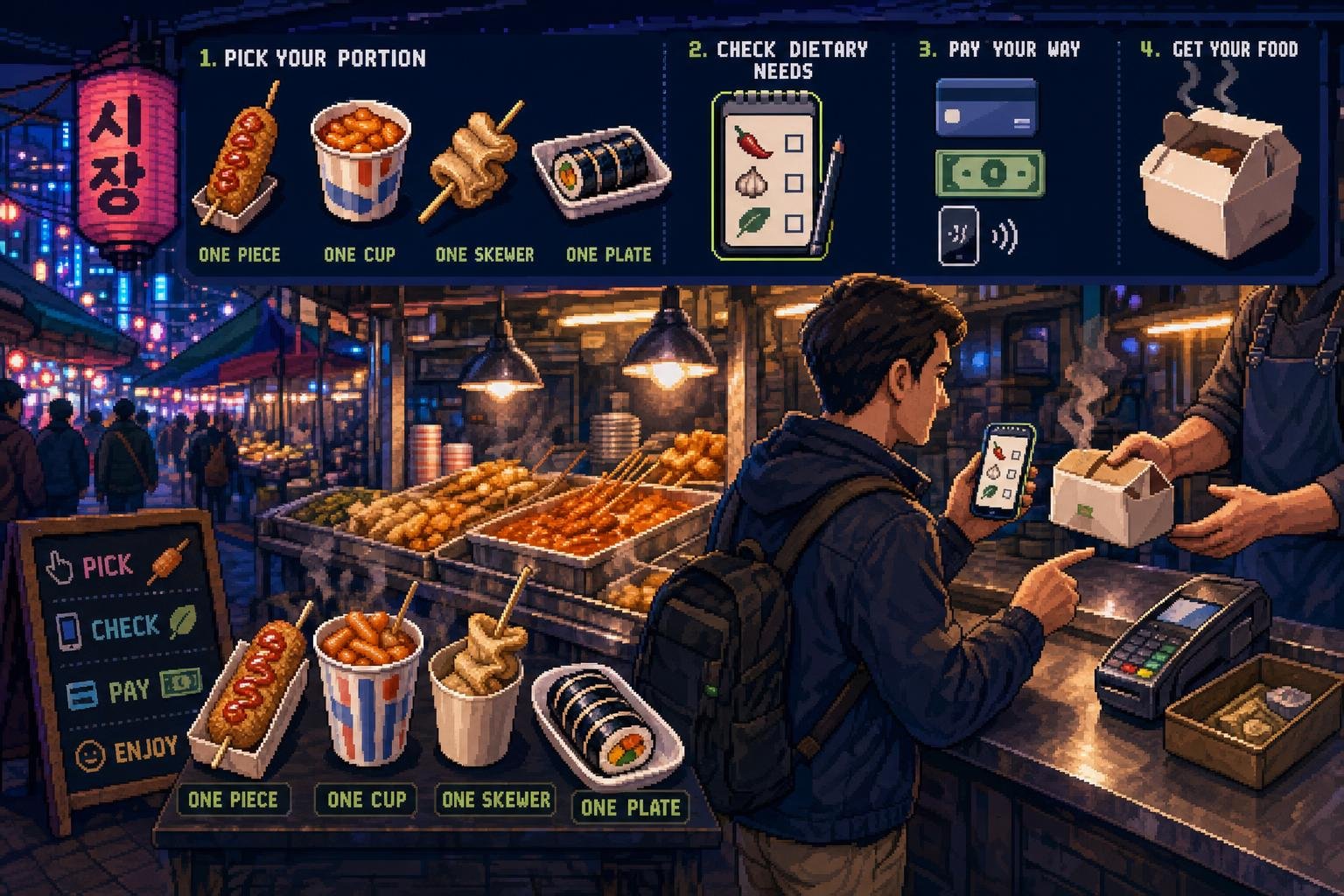
At a Korean traditional market or night market, first point to the food and say “Igeo hana juseyo” (“One of this, please”). Ask “Eolmayeyo?” (“How much is it?”) before ordering several items. Carry some Korean won in small bills because card acceptance varies by stall, even though many market businesses now accept cards. If you have allergies or dietary restrictions, ask about specific ingredients and shared cooking equipment rather than relying only on the words “vegetarian” or “vegan.”
Ordering market food in Korea is usually informal: choose a stall, look at the food on display, order a portion, pay, and either eat nearby or take it away. The difficult part for many visitors is not the food itself. It is knowing whether the price is per piece or per serving, whether an overseas card will work, and how to explain dietary restrictions clearly in a busy environment.
This guide focuses on that moment at the stall, especially at traditional markets and evening food markets where several vendors may use different ordering and payment systems.
At a glance
| Situation | What to do |
|---|---|
| You see one food you want | Point and say “Igeo hana juseyo” — one of this, please. |
| You cannot see a price | Ask “Eolmayeyo?” before confirming the order. |
| You want to pay by card | Ask “Card dwaeyo?” and wait for the vendor to confirm. |
| You want takeaway | Say “Pojang haejuseyo” — please pack it. |
| You have an allergy | Name the exact ingredient and ask before ordering; shared fryers and sauces may still be an issue. |
How to order street food step by step
1. Watch the queue before stepping up
At a busy stall, check where customers are waiting and whether people order directly from the cook or from a separate counter. Avoid blocking the display while deciding. If you need time, step aside and return when you know what you want.
2. Point to the item and order one portion
Pointing is completely practical when a menu is difficult to read. Say “Igeo hana juseyo” for one item, or use your fingers to show the number of pieces you want. If you are unsure about the portion size, start with one and order more later.
Useful variations include:
- “Igeo juseyo” — Please give me this.
- “Du gae juseyo” — Two pieces, please.
- “Hana-man juseyo” — Just one, please.
3. Confirm the price and portion
Prices may be shown on a board, tray, menu card, or small sign. If the price is unclear, ask “Eolmayeyo?” before the food is prepared. This is especially useful for skewers, pancakes, dumplings, fried snacks, and foods sold by weight or by a mixed box.
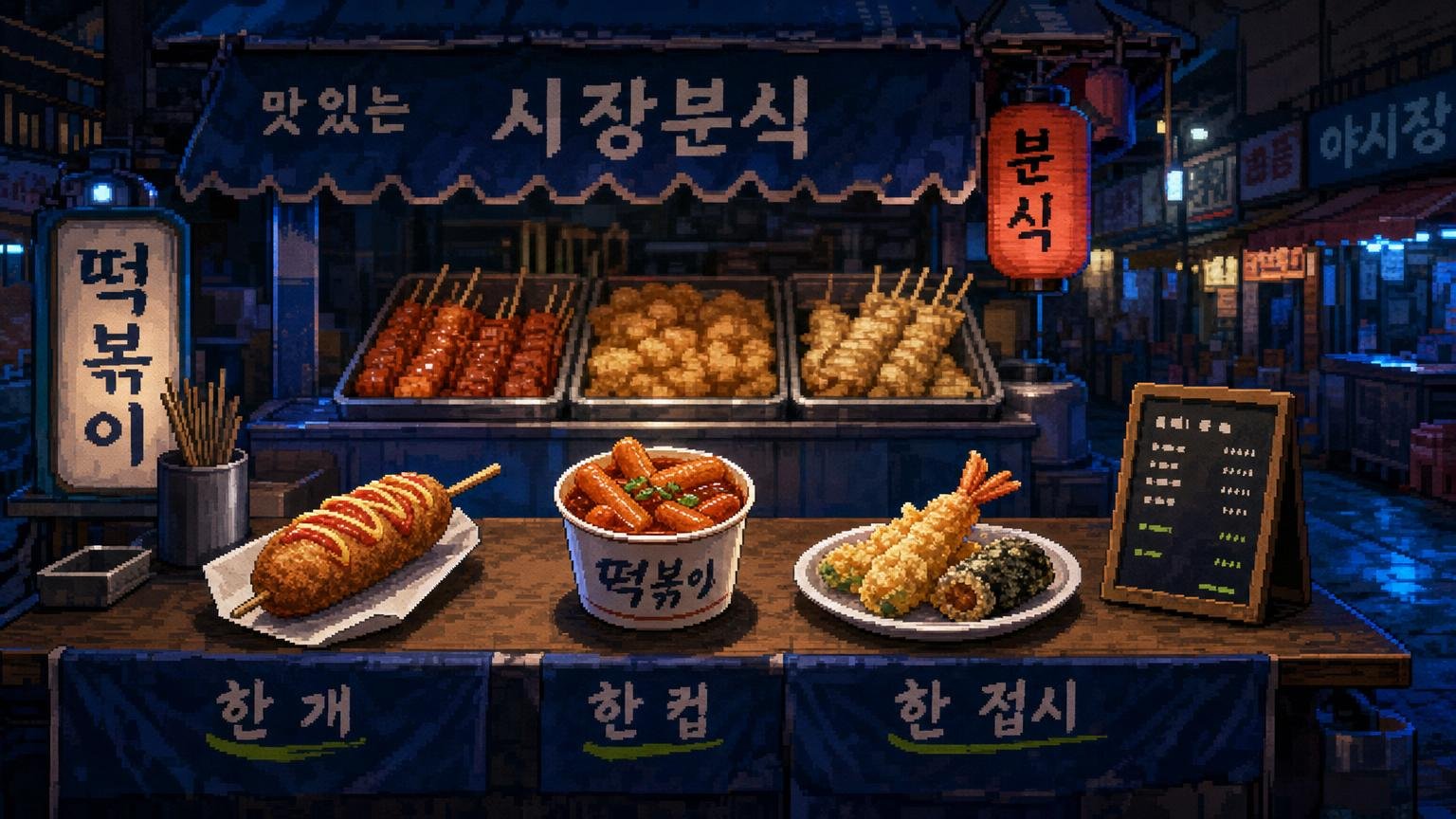
Do not assume that one scoop, one skewer, or one paper cup means the same portion at every stall. A serving can mean one piece, several pieces, one cup, or one plate depending on the vendor.
4. Choose dine-in or takeaway
Many stalls expect customers to eat standing nearby, while others have a counter or shared seating. If you want to take the food with you, say “Pojang haejuseyo”. For food that may spill, you can also point to your bag and repeat “pojang,” meaning packaging or takeaway wrapping.
5. Pay after the vendor confirms the total
Some stalls ask for payment immediately; others prepare the food first and then tell you the total. Wait for the amount rather than placing money on the counter without confirmation.
For cash, hand over Korean won and wait for your change. For a card, ask “Card dwaeyo?” (“Can I pay by card?”) before the transaction. If the vendor indicates cash only, do not treat that as unusual. Korea Tourism Organization guidance specifically warns that some traditional-market and street-food businesses accept cash only, while market payment policies can differ from one vendor to another.
Paying at Korean markets: cash, cards, and mobile payment
Bring a small amount of Korean cash even if you normally pay by card. Many Korean stores accept international credit cards, but traditional markets and street stalls do not have one universal payment rule. A market may contain card-ready shops beside small stalls that accept only cash.
- Cash: The safest backup for small purchases. Keep low-value notes available so the transaction is quick.
- International card: Ask first. A card terminal may be present, but acceptance can still vary by stall and by card issuer.
- Mobile or QR payment: Some markets participate in specific payment programs, but these are not a reliable universal option for every foreign visitor or every stall.
- Transportation cards: Do not assume that a T-money or other transportation card can be used for food. Any such option is location- and merchant-specific.
The current VISITKOREA shopping guidance recommends carrying petty cash for traditional markets and street shops. Its newer traditional-market information also highlights selected markets that are working toward fixed pricing and card acceptance, but that does not mean every stall nationwide follows the same system.
How to understand portions
Market food is often best approached as small shared orders rather than a fixed restaurant meal. A practical strategy is to buy one portion first, see its size, and then decide whether to order more.
Foods commonly sold by piece or small unit
Skewers, hotteok, dumplings, egg bread, fish cakes, and some fried snacks may be sold one at a time or in a small set. Point to the item and show the number you want. If the vendor is preparing a large batch, confirm whether the displayed amount is for one piece or a set.
Foods commonly sold by cup, plate, or container
Tteokbokki, sundae, mixed fried foods, fruit, and seafood snacks may be served in a cup, paper tray, bowl, or takeaway box. The container size can differ between vendors. If you are eating alone, say “Hana-man” (“just one”) and ask the price before the order is finalized.
Foods sold by weight or mixed selection
For foods displayed in piles or trays, the price may depend on weight, quantity, or the vendor’s chosen mix. Ask the vendor to show the amount before cutting or boxing it. If you want a small trial portion, say “Jogeum-man juseyo” (“Just a little, please”), although the vendor may still have a minimum order.
Jin’s Tip: For a first market stop, order one item from two or three different stalls instead of buying a large box from the first vendor. This makes it easier to compare portions, manage spice levels, and avoid wasting food if an ingredient does not suit you.
Dietary tips: allergies, vegetarian food, and religious restrictions
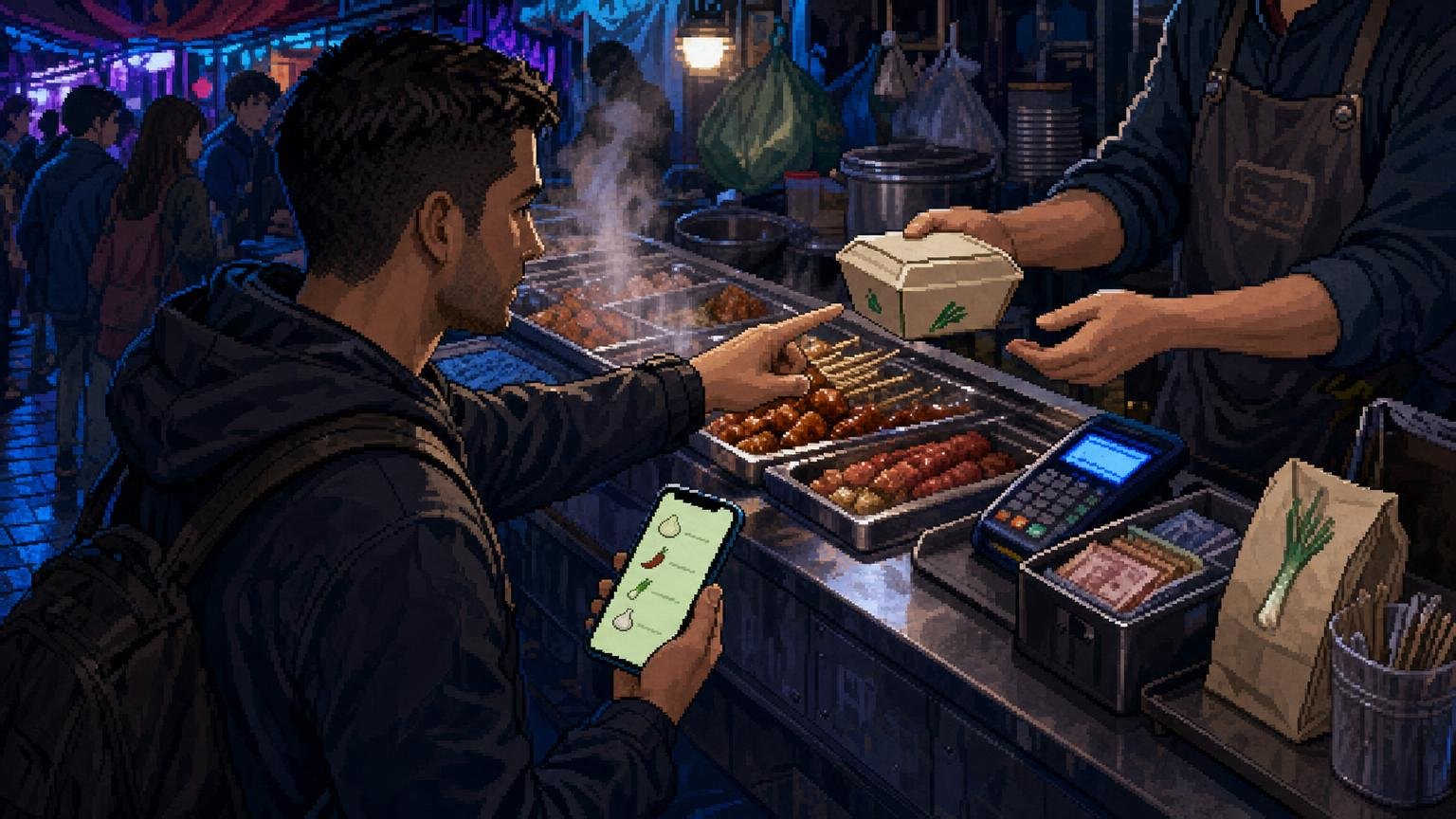
Do not rely only on the appearance of street food. Red sauce does not always mean the same ingredients, and a fried snack may share oil with seafood or meat products. Ask before ordering, especially if your restriction is medical.
Use specific ingredients
“Vegetarian” and “vegan” may not be understood consistently at a busy stall. Name the ingredient you must avoid:
- “Dwaeji gogi eopseo-yo?” — Does it contain pork?
- “Sogogi eopseo-yo?” — Does it contain beef?
- “Sae-u eopseo-yo?” — Does it contain shrimp?
- “Gogi eopseo-yo?” — Does it contain meat?
- “Gyelan eopseo-yo?” — Does it contain egg?
- “Uyu eopseo-yo?” — Does it contain milk or dairy?
For a severe allergy, show the ingredient written in Korean if possible. The Korea Tourism Organization’s food-translation material includes practical allergy phrases, including warnings about nuts, shrimp, and shared fryers.
Watch for hidden ingredients
Foods that look simple may include stock, seasoning, sauce, or toppings that are not obvious. Tteokbokki sauce may include fish-based ingredients depending on the recipe. Fish cakes and dumpling fillings may contain seafood, meat, or both. Pancakes and fried foods may contain egg or wheat, and different foods may be cooked in the same fryer.
Know when to skip a stall
If the vendor cannot understand the restriction, cannot identify the ingredients, or uses a shared cooking surface that creates a problem for you, choose another item or stall. A polite “Gwaenchanayo, gamsahamnida” (“That is okay, thank you”) is enough to leave the order.
Which payment and ordering approach suits you?
- First-time visitor with no dietary restrictions: Carry cash, order one portion, and use pointing plus “Igeo hana juseyo.”
- Solo traveler: Ask for one piece, one cup, or a small portion first. This prevents buying more food than you can finish.
- Traveling with a group: Confirm whether the price is per piece or per plate before ordering several portions. One person can handle payment while another collects napkins and utensils.
- Strict vegetarian, vegan, halal, or allergy-sensitive traveler: Prepare Korean ingredient names in advance, ask specific questions, and avoid stalls that cannot give a clear answer.
- Traveler relying on cards: Use a market with clearly advertised card acceptance when possible, but still carry cash as a backup.
Common mistakes and what to do
You ordered more than expected
Ask the vendor to stop before preparing the rest and clarify the total. If the food has already been cooked, cancellation may not be possible, so confirm portions before the order is finalized.
Your foreign card is declined
Ask whether cash is accepted, then use Korean won if available. Do not assume that a nearby stall has the same card policy. If you are short on cash, move to a larger market shop or food counter that displays card payment information.
You cannot understand the total
Use the calculator on your phone and ask the vendor to show the amount. You can also point to the price board or repeat the number you think you heard for confirmation.
You need takeaway but receive food for immediate eating
Say “Pojang haejuseyo” before the food is served. If you need utensils, point to the food and ask for a spoon or chopsticks; availability varies by stall.
The food is too spicy
Ask about spice before ordering by saying “Maewoyo?” (“Is it spicy?”). “An maepge haejuseyo” means “Please make it not spicy,” but a prepared sauce may not be adjustable. When in doubt, order a small portion first.
What may be different: Payment methods, minimum orders, portion sizes, seating, takeaway packaging, opening hours, and menu translations can vary by market, stall, day, and season. Official market listings may describe a market generally, but they do not guarantee that every individual vendor accepts foreign cards or can accommodate every dietary request.
FAQ
Do I need Korean cash to buy street food?
Not always, but you should carry some. Many businesses accept cards, while some traditional-market and street-food stalls remain cash only. Cash is the simplest backup for small purchases.
Can I pay by Visa or Mastercard?
Some stalls accept international cards, but acceptance is not universal. Ask “Card dwaeyo?” before ordering and keep cash available in case the terminal or your card does not work.
How do I ask for one serving?
Point to the food and say “Igeo hana juseyo,” meaning “One of this, please.” For several pieces, show the number with your fingers or say the number in Korean.
Are street-food portions fixed?
No. A serving may be one piece, several pieces, a cup, a plate, or a box depending on the food and vendor. Ask the price and portion before confirming a large order.
Can I find vegan or halal street food easily?
You may find suitable options, but do not assume that a dish is suitable from its appearance or name. Ask about meat, seafood, stock, egg, dairy, and shared cooking equipment. If the vendor cannot answer clearly, choose another item.
What should I do if I have a serious food allergy?
Prepare the allergy written in Korean, show it before ordering, and ask about shared fryers and preparation surfaces. If the vendor cannot confirm the ingredients or cooking method, do not order that item.
Official Information
- VISITKOREA: Shopping in Korea — payment guidance and cash advice
- VISITKOREA: Traditional Markets — current market listings and food-market information
- VISITKOREA: K-tourism and traditional markets — selected markets with service improvements
- VISITKOREA: A Guide to Translating Korean Food — allergy and ingredient phrases