

Booking a domestic flight in Korea is straightforward, but the airport process is slightly different from an international departure. The main points that surprise foreign travelers are the need to show identification for a domestic flight, the differences between airline payment screens, and the fact that the airline operating the flight—not just the website where you bought the ticket—controls check-in, baggage, changes, and refunds.
At a glance
| Traveler question | Practical answer |
|---|---|
| Can a foreigner book a domestic flight? | Yes. Book through an airline website, app, or reputable booking provider that sells the route. |
| What ID should you bring? | Bring your original passport. It is the simplest identification document for a short-term visitor. |
| Do you need a Korean phone number? | Not always. Booking forms normally require contact details, but phone verification and payment authentication depend on the airline and payment method. |
| Can you use a foreign card? | Sometimes. Choose an international or foreign-currency payment option when available. Korean won payment pages may favor Korean-issued cards or local payment services. |
| How early should you arrive? | Arrive with enough time for check-in, baggage drop, identity checks, and security screening. A staffed counter is the safer choice if you have checked baggage or a passport-related issue. |
| Is a mobile boarding pass enough? | It may be, but carry your passport and keep the booking details available. Airline and airport procedures can differ. |

1. Choose how to book the flight
Book directly with the airline
Direct booking is usually the clearest option when you may need to change the flight, check baggage rules, or contact the airline about a passport-name problem. Korean domestic routes are served by several airlines, and the available carrier depends on the airport pair and travel date.
On the airline website or app, search by the Korean airport names as well as the city. For example, Seoul-area travelers may need to compare Gimpo Airport with Incheon Airport, while flights to Jeju normally use Jeju International Airport. Check the airport code and terminal information before paying.
A typical airline booking flow is:
- Choose the departure airport, arrival airport, date, and number of passengers.
- Compare the fare types, baggage allowance, seat-selection conditions, and change or refund rules.
- Enter each passenger’s name exactly as shown on the passport.
- Add an email address and a phone number that you can access during the trip.
- Choose a payment method that your card issuer can approve.
- Save the booking reference, e-ticket receipt, and fare conditions.
Use a flight booking website
A booking website can be useful when you are comparing several airlines or building a multi-city itinerary. Before paying, check who is responsible for changes and refunds. If the booking provider issues the ticket, you may need to contact that provider rather than the airline for a refund or rebooking.
2. Prepare the passenger information correctly
Use the passport spelling
Enter the passenger’s name in the same order and spelling shown in the passport’s machine-readable information. Do not use a nickname, middle name variation, or a different romanization unless the airline specifically instructs you to do so.
Small name errors can create problems at check-in. Korean Air’s booking guidance states that passenger changes are generally not allowed after purchase, although limited name corrections may be possible in specific circumstances. Other airlines may apply different rules, so check before completing payment.
Use reachable contact details
A Korean mobile number is not automatically required for every domestic booking. However, airlines may use the phone number or email address for booking notices, schedule changes, payment authentication, or customer contact. Use an email address you check regularly and make sure your phone can receive messages while traveling.
If a Korean payment page asks for local identity verification, a Korean mobile number, or a Korean-issued card, do not enter random information. Try the airline’s English or international payment page, select payment in a supported foreign currency, or use a different airline or booking channel.
3. Pay for the ticket with a foreign card
Foreign-card support is not identical across Korean airlines or booking pages. Some international payment pages accept major card networks, while a Korean-language KRW checkout may direct customers toward Korean-issued cards or local payment services. The fact that a card works in a hotel or restaurant does not guarantee that it will pass an airline’s online verification process.
When paying from outside Korea:
- Look for an English or international booking page.
- Check whether the payment currency can be changed from KRW to a supported foreign currency.
- Use a card in the traveler’s own name when possible.
- Allow 3-D Secure or bank-app approval if your card issuer requests it.
- Keep the payment confirmation even if the booking page appears to time out.
- Check your email and the airline’s reservation lookup page before trying to buy the same ticket again.
Korean Air’s official payment guidance lists Visa, Mastercard, and American Express for certain overseas-currency payments, but this should not be treated as a guarantee for every airline or every KRW transaction. Payment acceptance can depend on the card issuer, currency, browser, fraud screening, and the airline’s current payment setup.
4. Save the booking documents
After payment, save the following information offline:
- Booking reference or reservation number
- Passenger name as entered in the reservation
- Flight number, date, and departure time
- Airline name and operating carrier
- E-ticket receipt or confirmation email
- Baggage allowance and fare conditions
A screenshot is useful if your phone loses reception, but it is not a replacement for your passport. If you booked through an online travel agency, also save its customer-service contact and the airline’s own reservation number if one was issued.
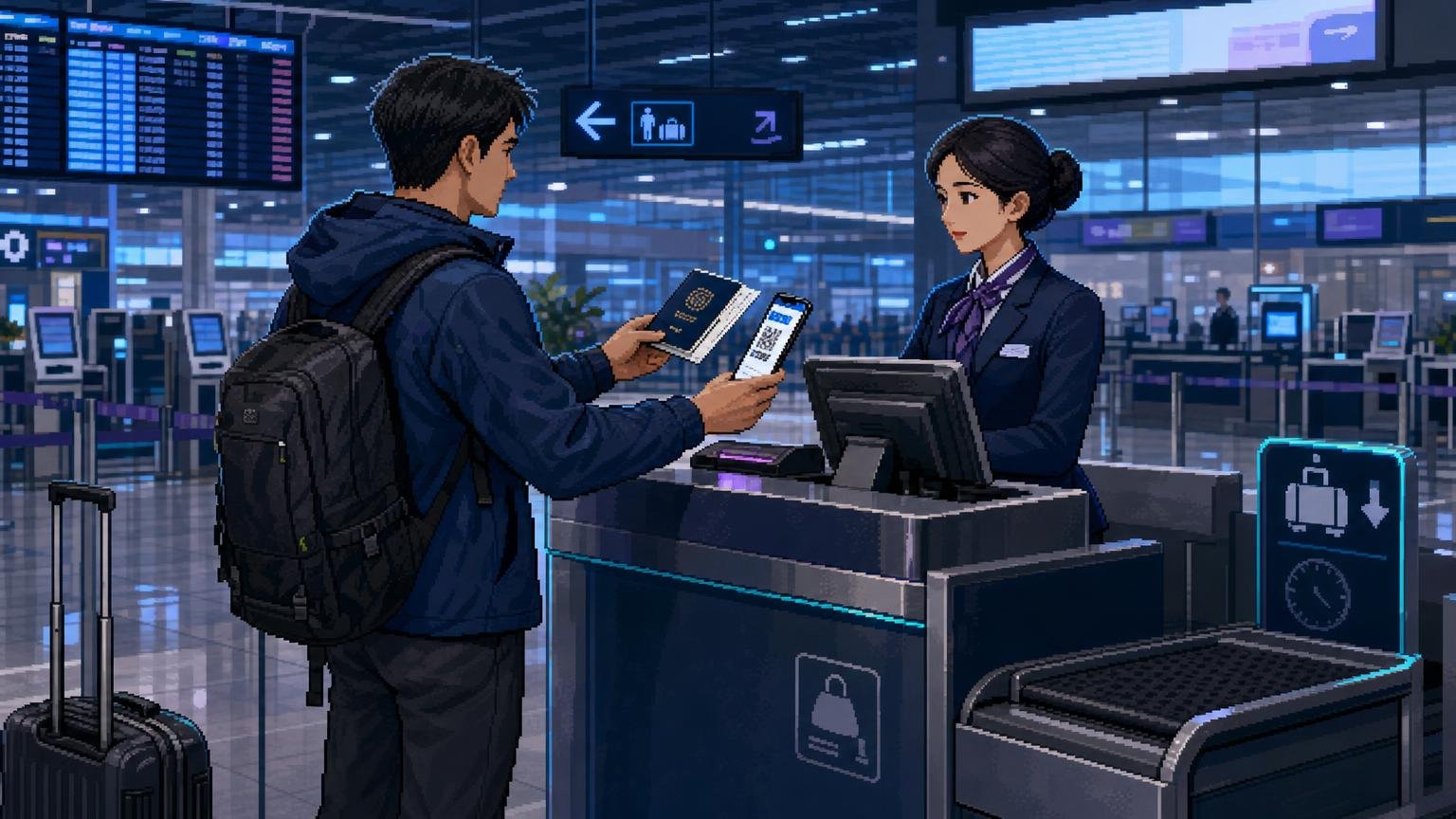
5. Use the airport on the day of the flight
Go to the correct terminal
Domestic and international terminals are not always in the same building. At Seoul’s Gimpo Airport, domestic flights use the domestic terminal. At other airports, follow the departure signs and confirm the terminal in your booking or the airport’s flight information.
Check in at the airline counter or kiosk
If you have checked baggage, go to the airline’s baggage-drop or check-in counter. If you have no checked baggage and the airline provides online check-in, you may be able to proceed with a mobile boarding pass.
Self-service kiosks can search for a reservation using details such as a booking number or QR code, but availability varies by airline and airport. A kiosk may also require staff assistance when a passport cannot be read, the passenger information does not match, or the reservation needs additional verification.
For a first domestic flight in Korea, use the staffed counter if:
- Your passport name differs from the reservation.
- You booked through a third party and are unsure which number to enter.
- You have checked baggage or special baggage.
- You cannot obtain a mobile boarding pass.
- Your foreign card payment was completed but the ticket confirmation is unclear.
- You have a separate international flight and need to confirm baggage or airport details.
Show your passport for identity checks
Domestic passengers still pass through an identity check and security screening. Korean Air’s domestic boarding guidance lists a passport as an accepted form of identification for foreign passengers. For a short-term visitor, carrying the original passport is the most practical choice even if another document might also be accepted.
Keep the passport available from check-in until boarding. A photocopy or photograph of the passport should not be treated as a substitute for the original identification document.
Pass security screening and find the gate
After the identity check, follow the domestic departure signs to security screening. Remove items as instructed by the screening staff and then check the departure screens for your gate. Korean domestic airports can be compact, but gates and boarding areas may still change.
Airlines may begin boarding before the scheduled departure time and close boarding before departure. Do not use the flight departure time as the time to arrive at the gate.
6. Collect your baggage after landing
On arrival, follow signs for baggage claim if you checked a bag. For a domestic flight, you normally collect the bag and leave the airport without an immigration procedure. If your baggage is missing or damaged, report it to the airline’s baggage desk before leaving the airport and keep the baggage tag.
If you are connecting from a domestic flight to an international flight, allow extra time to transfer between terminals when necessary. Confirm the onward airport and terminal before booking the domestic leg; a domestic flight arriving at Gimpo does not mean you are already at Incheon International Airport.
Which booking method suits you?
| Your situation | Most practical approach |
|---|---|
| You want the simplest changes or refund process | Book directly with the operating airline. |
| Your foreign card fails on a Korean payment page | Try the airline’s English or international payment page, a different supported currency, or a reputable booking provider. |
| You have checked baggage | Review the fare’s baggage allowance and use the staffed counter at the airport. |
| You are traveling close to a holiday or weekend | Book earlier and check the exact airport, departure time, and change conditions carefully. |
| You have a connection to an international flight | Leave a generous buffer and verify whether the connection requires a transfer between Gimpo and Incheon. |
| You are unsure about a name or passport issue | Contact the ticketing provider before travel and carry the original passport. |
Common mistakes and how to avoid them
Booking the wrong Seoul airport
Seoul-area flights may use Gimpo or Incheon depending on the route. Check the airport code before paying, especially if the flight is part of an international itinerary.
Entering a nickname or different name order
Use the passport spelling. If you notice an error after payment, contact the airline or booking provider immediately instead of waiting until the airport.
Assuming every foreign card will work
Payment approval can fail because of currency, issuer security, authentication, or the airline’s local checkout system. Use an international payment route when available and confirm whether a ticket was actually issued before attempting a second purchase.
Arriving without the original passport
A domestic flight is still an identity-controlled service. Keep the passport with you, not in checked luggage.
Checking only the departure time
Check-in, baggage drop, identity verification, security screening, and boarding all happen before the scheduled departure time. Give yourself more time if you are unfamiliar with the airport or need counter assistance.
Ignoring fare restrictions
The cheapest fare may have stricter change, cancellation, seat-selection, or baggage conditions. Read the conditions before payment rather than comparing only the headline price.
FAQ
Can I fly domestically in Korea with only my passport?
For most short-term visitors, the original passport is the safest identification document to carry. Airlines may recognize other forms of ID in specific cases, but do not rely on a photocopy or phone photograph.
Do domestic flights in Korea require immigration?
Ordinary domestic flights do not normally require international immigration. You still need airline check-in, an identity check, security screening, and boarding.
Can I book a Korean domestic flight without a Korean phone number?
Often, yes, but the exact booking and payment forms vary. Use an accessible email address and do not enter false local information if a form requests Korean verification.
Why was my foreign card declined?
Possible reasons include the payment currency, card issuer security, 3-D Secure authentication, browser settings, or a checkout page intended for Korean-issued cards. Try the airline’s international payment page or another legitimate booking channel.
Should I book directly with the airline or use an online travel agency?
Direct booking is usually easier when you need a change, refund, baggage clarification, or name correction. A booking agency can be useful for comparing airlines, but its own support and conditions apply after purchase.
What happens if my passport name does not match the ticket?
Contact the ticket issuer before going to the airport. Name correction rules vary, and changing the passenger to another person is generally not allowed.
How early should I arrive for a domestic flight?
Allow enough time for the airline’s check-in deadline, baggage drop, identity checks, and security screening. Arrive earlier if you need a staffed counter, are unfamiliar with the airport, or are connecting to an international flight.
Official Information
- Korean Air: How to Book a Flight — booking steps, passenger information, ticket purchase, and reservation lookup.
- Korean Air: Overseas Payment Methods — payment options and supported international card networks for overseas-currency payments.
- Korean Air: Domestic Flight Boarding — check-in timing, identity documents, security screening, and boarding procedure.
- Gimpo International Airport: Fast Check-in — domestic check-in, kiosk, boarding pass, and airport procedure information.
- Gimpo International Airport — official airport information, flight information, and domestic terminal guidance.