

Charging your phone in Korea is usually straightforward, but there are two separate problems to solve: fitting your plug into the wall and making sure your device can safely use Korean electricity. The first is a plug-shape issue. The second is a voltage issue.
You may also need a backup plan when your battery is low outside your hotel. Airports have designated charging facilities, while cafés, restaurants, libraries, shopping centres, and some public facilities may have outlets. Availability and access can differ by location, so do not assume that every seat or table has a usable socket.
At a glance
| Traveler situation | What you need | Practical solution |
|---|---|---|
| Your charger says Input 100–240V | Plug adapter for Korean outlets | Use the adapter with your normal charger |
| Your charger supports only 110–120V | Voltage converter or a compatible replacement charger | Do not connect it directly to a Korean outlet |
| You forgot an adapter | Temporary access to a compatible outlet or a new adapter | Ask the hotel front desk or check the airport and nearby shops |
| Your phone is nearly empty while travelling | Power bank, cable, or public charging point | Use a power bank or look for an official charging station |
1. Check your charger before you travel
Look at the small writing on your phone charger, laptop power brick, camera charger, or USB charging plug. Find the line marked Input.
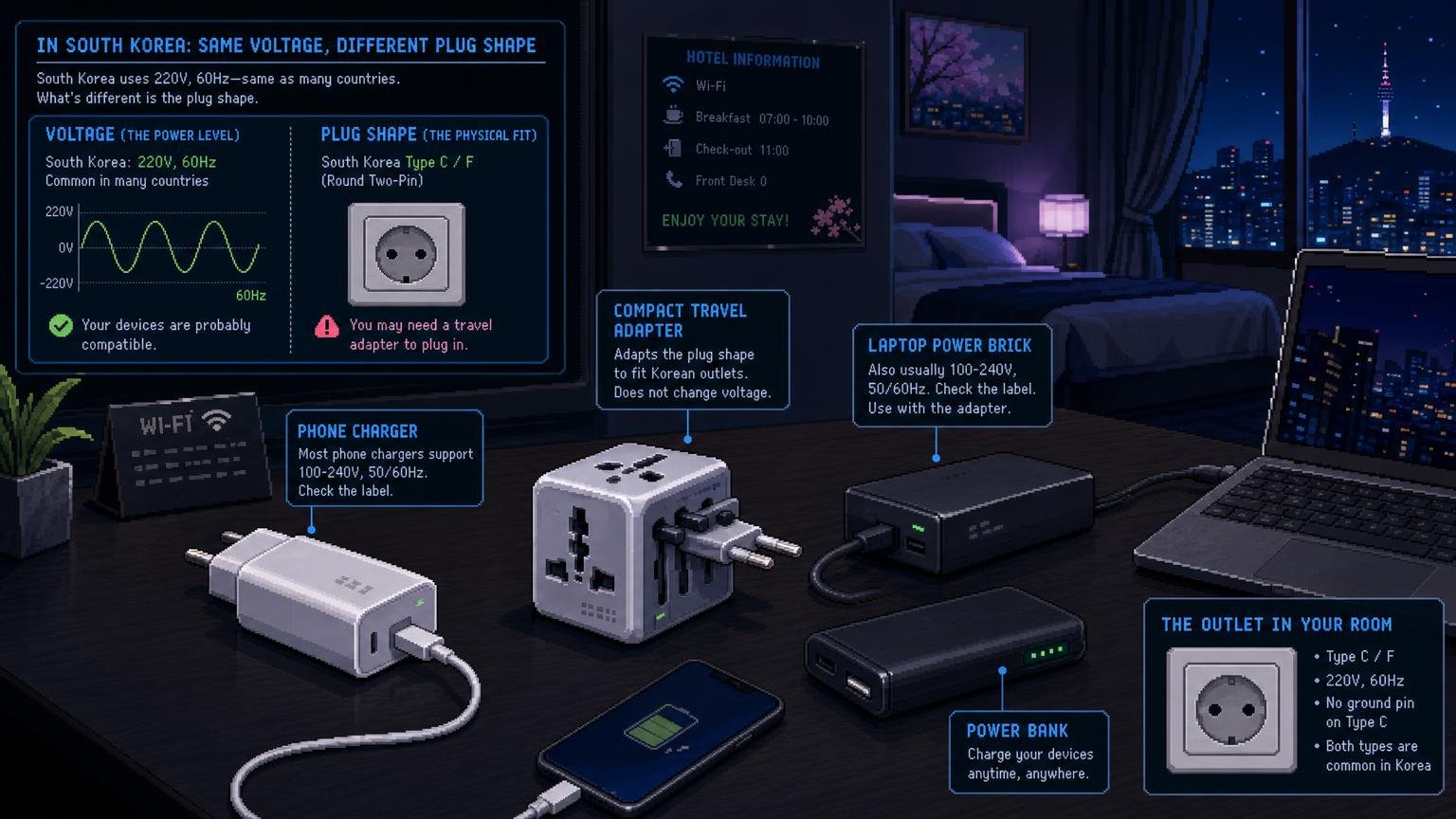
- 100–240V, 50/60Hz: the charger is designed for a wide range of electrical systems. You normally need only a plug adapter.
- 110–120V only: do not plug it directly into a Korean wall outlet. Ask the manufacturer or your accommodation about a suitable voltage converter, or use a charger designed for 220V.
- Unclear label: check the manufacturer’s instructions before use rather than guessing.
A plug adapter changes the shape of the connection. It does not change the electricity’s voltage. A voltage converter is a different product and is not automatically needed for modern USB chargers.
2. Bring the right plug adapter
Korean wall outlets generally have two round holes. A compact travel adapter that accepts your home-country plug and fits a European-style round-pin outlet is the simplest option for most visitors.
Pack at least one adapter in your carry-on rather than placing it in checked luggage. If you are travelling with a phone, watch, camera, laptop, and power bank, a multi-port USB charger can reduce the number of adapters you need, provided the charger supports 220V.
What to buy if you forgot yours
The Korea Tourism Organization says travel adapters can be borrowed or purchased through accommodation front desks and can also be found at airports, duty-free shops, convenience stores, and other retail locations. Stock is not guaranteed at every branch, so ask before depending on a particular shop.
At a hotel, you can ask:
- “Do you have a travel adapter I can borrow?”
- “Can I buy a plug adapter here?”
Useful Korean words include 여행용 어댑터 (travel adapter) and 변환 플러그 (plug converter). Showing the plug you brought is often easier than trying to describe it.
3. Charge at your hotel
Your hotel room is usually the most reliable place to charge several devices at once. Check near the bedside table, desk, television area, and bathroom counter. Some rooms may have USB ports or universal sockets, but the presence, location, and charging speed vary by property and room type.
If the outlet is difficult to reach, ask reception for an extension lead or adapter. Do not unplug hotel equipment that appears to support safety, heating, refrigeration, or room operations. If you leave devices charging while you go out, follow the hotel’s safety instructions and avoid covering chargers or power banks.
4. Use airport charging stations when you arrive or depart
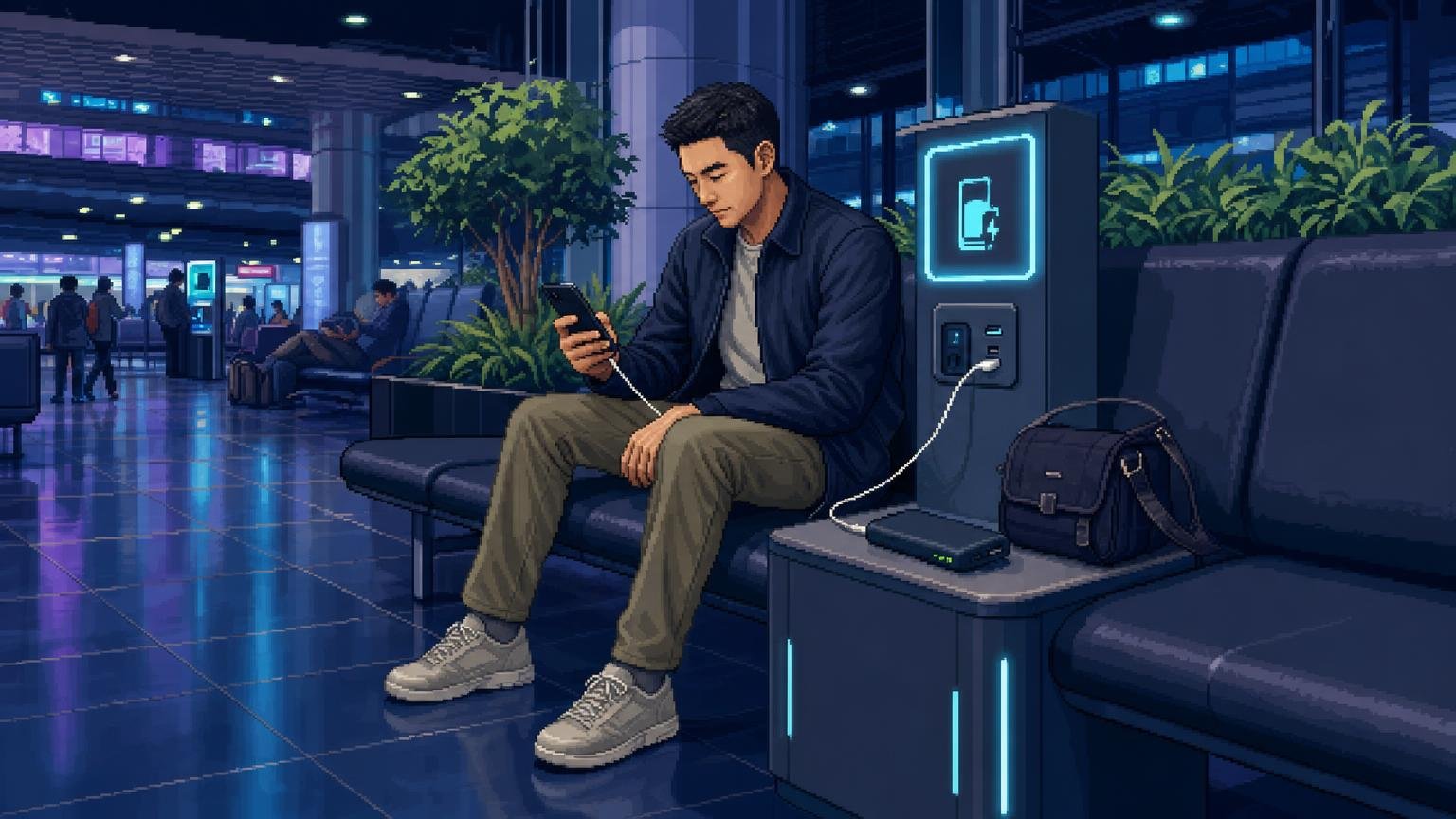
Incheon International Airport states that it provides charging facilities for 110V, 220V, and USB charging in passenger areas. Its official information lists charging locations in areas including the Terminal 1 and Terminal 2 departure halls, arrival areas, and the Concourse. The exact equipment and availability can change, so follow the airport signs or ask an information desk.
For a short connection, charge the device you need first rather than trying to charge every item. Keep your passport, wallet, and other valuables with you while using a public charging point.
5. Charging in cafés, restaurants, and public places
Many cafés and casual restaurants have wall outlets, counter outlets, or charging areas, but they are not a guaranteed public service. Some outlets may be reserved for staff, blocked for safety, or already occupied. Ask before moving furniture or using a socket.
A simple request is:
- “충전해도 될까요?” — May I charge my device?
- “콘센트가 어디에 있어요?” — Where is the power outlet?
Do not leave a phone or laptop unattended at a café table. If you only need a small amount of power, a power bank is often more convenient than searching for a free seat near an outlet.
6. Use a power bank as your mobile backup
A power bank is useful for navigation, translation, mobile tickets, reservations, and emergency calls when you are away from your accommodation. Carry the correct cable and check the power bank’s remaining charge before leaving in the morning.
For flights, keep power banks in your cabin baggage and check your airline’s current rules for battery capacity and packing. Do not place a power bank in checked luggage unless your airline specifically permits it. Airline restrictions can differ, particularly for larger-capacity batteries.
Which charging option suits you?
- Hotel-based traveller: bring one reliable plug adapter and a multi-port charger. This is usually the simplest setup.
- Day-long city traveller: carry a charged power bank and cable so you are not dependent on finding a public socket.
- Business or remote-work traveller: bring an adapter, laptop charger, and a spare charging cable. Confirm your accommodation has a suitable desk outlet before relying on it for work.
- Short airport transfer: use an airport charging point if needed, but keep enough battery for maps, transport information, and communication.
- Traveller with specialist equipment: check every device separately. Hair tools, medical equipment, camera batteries, and older chargers may have different voltage requirements from a phone charger.
Common charging mistakes in Korea
- Confusing an adapter with a converter: an adapter changes the plug shape; it does not reduce 220V to 110V.
- Checking only the phone: the phone may accept multiple voltages, but an older charger or accessory may not.
- Relying on USB ports alone: some public USB ports may charge slowly or may not provide the cable or power level you need.
- Bringing one adapter for a group: one adapter can become a bottleneck when several people need to charge overnight.
- Leaving devices unattended: public charging points are not secure storage.
- Buying before checking the plug: adapters differ. Confirm that the adapter accepts your home-country plug and fits a Korean round-pin outlet.
FAQ
Can I use my phone charger in Korea?
Usually, yes, if the charger label says Input 100–240V. You will normally need a plug adapter if your home-country plug does not fit Korean outlets.
Do I need a voltage converter in Korea?
Not for a charger that supports 100–240V. If a device is marked only for 110–120V, do not connect it directly to a Korean outlet. Check the manufacturer’s instructions for a suitable converter or replacement charger.
What type of outlet does Korea use?
Korea generally uses outlets with two round holes. Bring an adapter designed for Korean or compatible European-style round-pin outlets.
Can I buy a travel adapter after arriving in Korea?
Yes. The Korea Tourism Organization says adapters may be available at airports, duty-free shops, convenience stores, retail stores, and hotel front desks. Availability and models differ by location.
Can I charge my phone at Incheon Airport?
Yes. Incheon International Airport officially lists charging facilities for 110V, 220V, and USB in passenger areas. Check the airport’s current facility information or ask an information desk for the nearest point.
Is it safe to use a public USB charging port?
Use your own cable and, where possible, your own charger or power bank. Avoid leaving your device unattended, and stop using equipment that appears damaged or overheated.
Official Information
- VISITKOREA: Electricity and Communications — Korean voltage, outlet type, and where visitors may find travel adapters.
- Incheon International Airport: Frequently Asked Questions — airport charging facilities and listed charging locations.
- Gimpo International Airport: Useful Travel Tips — official information about free mobile-phone charging stands at the airport.