
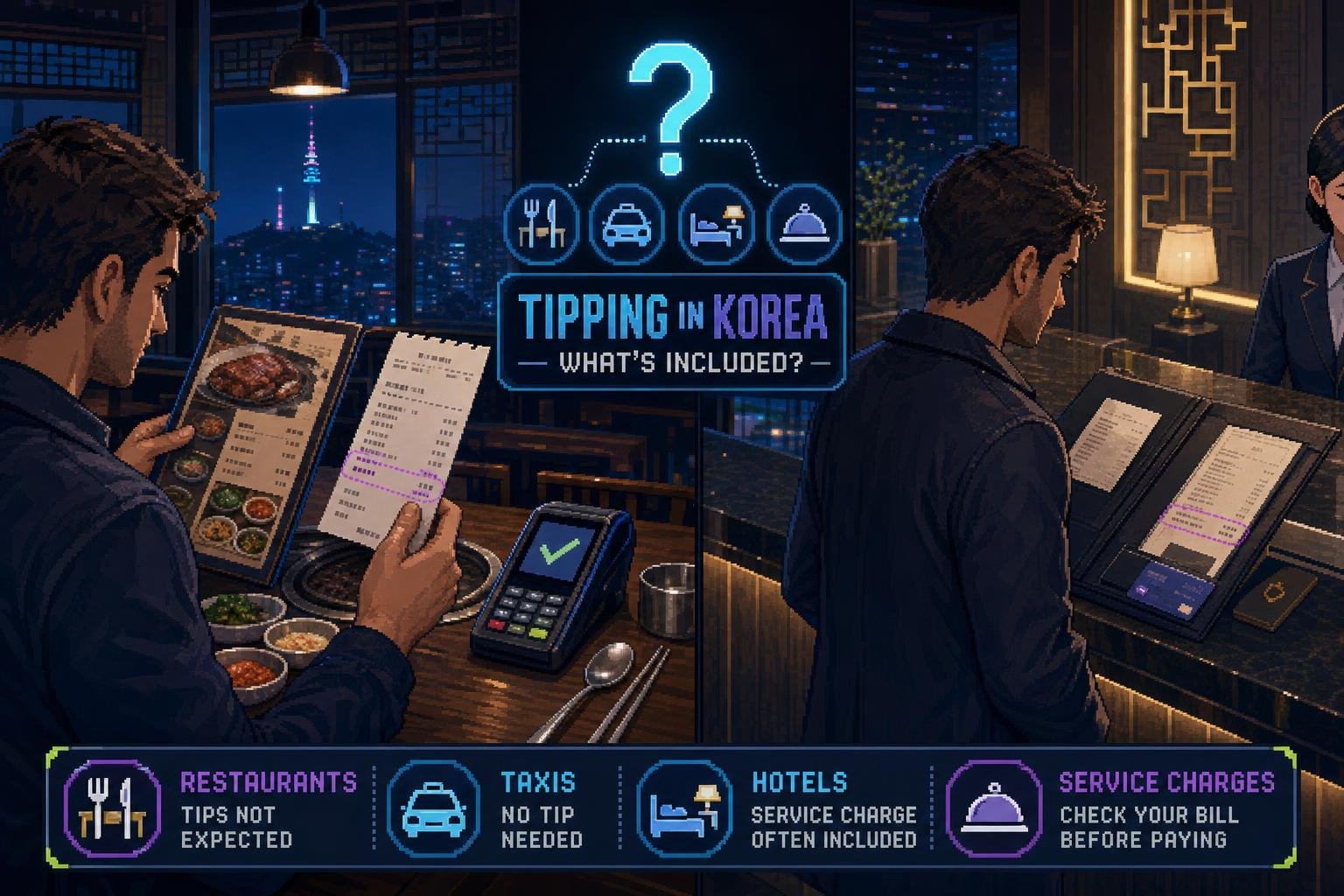
If you are visiting from a country where tipping is automatic, Korea can feel unfamiliar at the end of a meal or ride. The important distinction is between an optional tip and a charge that the business has already listed as part of the service.
In practical terms, you should not add 15% or 20% simply because you received table service. Instead, check whether the quoted price already covers the service and whether a separate service charge is clearly shown.
At a glance: what to pay
| Situation | What is normally expected | What to check |
|---|---|---|
| Ordinary restaurant | Pay the menu price; no additional tip | Look for a separately listed service charge or other required fee |
| Upscale restaurant or hotel restaurant | No extra discretionary tip is normally needed | Check whether a service charge is already added to the bill |
| Taxi | Pay the meter, quoted fare, or app fare | Separate tolls, call fees, late-night surcharges, or approved flat fares are not tips |
| Hotel | No routine tip for reception, housekeeping, or luggage help | Review the booking and final bill for listed hotel or restaurant service charges |
Restaurants: do not add a tip automatically
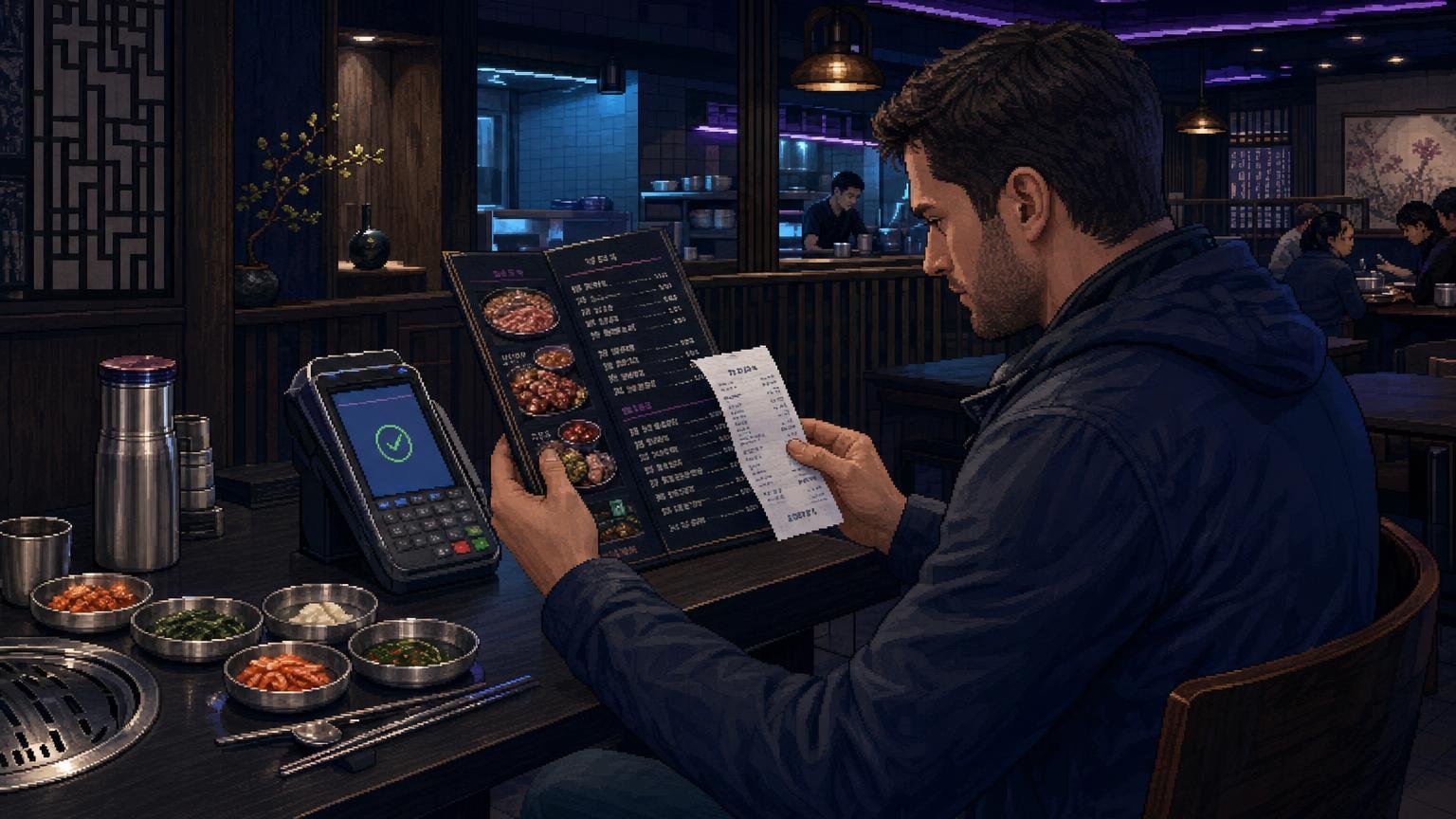
At a typical Korean restaurant, tipping is not required or expected. Pay the amount shown on the menu and the final bill. This applies to casual restaurants, Korean barbecue restaurants, cafés, food courts, and most everyday dining situations.
You may see a tip jar, a card-terminal prompt, or a request on a digital payment screen in some businesses that cater to international customers. That does not create a general Korean tipping rule. If the amount is optional, you can decline it without being rude.
How to check the bill
- Compare the dishes and quantities on the bill with your order.
- Look for words such as 봉사료 (service charge) or 부가세 (value-added tax).
- Check whether the service charge is already included or listed separately.
- Pay the final amount shown by the restaurant rather than adding a customary percentage from your home country.
Some major hotels and upscale restaurants may add a 10% service charge, in addition to VAT, according to the official Seoul travel guide. This is a business charge shown on the bill, not a second tip that you need to calculate yourself.
Service charges: what the extra amount means
A service charge is not the same as a voluntary gratuity. It is an amount the business may apply under its pricing or booking conditions. It can be associated with a hotel restaurant, banquet, private room, upscale dining venue, or a restaurant with a separate dining-service fee.
Before ordering
Check the menu, reservation page, or hotel information for wording such as service charge, 봉사료 별도 (service charge separate), or 부가세 별도 (VAT separate). If the wording is unclear, ask: “Is the service charge included?”
When the bill arrives
Confirm that any service charge matches what was displayed or explained before you ordered. If an amount appears that you do not understand, ask the staff to explain it before presenting your card or cash.
If the total seems different
Keep the receipt and compare it with the menu or booking confirmation. For a serious billing problem, ask the business to correct it first and consider contacting a tourist information service or consumer counseling channel.
Taxis: pay the fare, not a tip
Taxi drivers in Korea do not normally expect a tip. Pay the amount shown on the meter, the approved section fare, or the fare displayed by the taxi-hailing service.
Keeping the change is acceptable if you want to show appreciation, but it is optional. You do not need to round up, and you should not feel pressured to add a percentage after a normal ride.
A higher total may have a legitimate explanation, such as a late-night surcharge, a toll, an outside-city surcharge, a call fee, an international-taxi surcharge, or a pre-agreed fare for a brand taxi or airport transfer. These are transport charges, not tips.
For Seoul taxis, the Seoul Metropolitan Government states that taxis generally charge by the meter, while approved fare plans can apply to some services. If the fare looks wrong, ask for a receipt and record the vehicle details before leaving.
Hotels: routine tipping is not necessary
At most Korean hotels, you do not need to leave cash for housekeeping, reception, bell service, or a concierge after ordinary assistance. A polite thank-you is sufficient.
Luxury and international hotels can have their own service-charge or hospitality practices, especially for restaurants, room service, banquets, or special arrangements. Check the bill or hotel information rather than assuming that every hotel uses the same policy.
If you want to thank a staff member for exceptional help, you can offer a small amount, but it may be declined. Do not leave money in a room or on a counter without making clear that it is intentional; staff may think you forgot it.

What to do if a business asks for a tip
First, check whether the request is clearly optional. A voluntary prompt on a payment screen or a tip jar is different from an unexplained amount added to your bill.
- If it is optional, you can select no tip or simply pay the stated total.
- If it is listed as a service charge, ask whether it was included in the displayed price or booking terms.
- If it appears unexpectedly, ask for an itemized receipt and request an explanation before paying.
- If you believe you were overcharged, keep the receipt, photograph the menu if possible, and note the business name, time, and location.
Do not assume that a service charge is automatically dishonest. The key question is whether the charge was clearly disclosed and whether the final amount matches the information provided before purchase.
Which approach works best for different travelers?
- Eating at everyday local restaurants: pay the listed price and do not add a tip.
- Dining at a luxury hotel or upscale restaurant: check for a service charge before calculating the total.
- Using taxis in Seoul: follow the meter or approved app fare; keep change only if you wish.
- Staying at a standard hotel: do not prepare daily housekeeping tips as a routine requirement.
- Receiving unusually extensive private assistance: a thank-you is appropriate, and a small optional gesture may be accepted, but there is no universal percentage to follow.
Common mistakes to avoid
- Adding 20% automatically: this is not standard practice in Korea.
- Confusing a surcharge with a tip: late-night taxi charges, tolls, call fees, and hotel service charges are separate pricing items.
- Assuming every hotel is identical: ordinary hotels and luxury international hotels may handle service charges differently.
- Leaving cash without explaining it: staff may think you left money behind accidentally.
- Arguing before checking the receipt: first confirm whether the amount is a disclosed service charge or another legitimate fee.
FAQ
Do I need to tip at Korean restaurants?
No. Tipping is not normally required or expected at ordinary Korean restaurants. Pay the stated final amount and check whether a separately disclosed service charge applies.
Is a 10% service charge the same as a tip?
No. A service charge is a business fee shown on the bill or booking information. A tip is an optional payment from the customer. If a service charge has already been added, you do not need to add another percentage.
Should I tip a taxi driver in Korea?
No tip is expected. Pay the meter, app fare, or agreed fare. Letting the driver keep small change is acceptable but optional.
Should I leave money for hotel housekeeping?
Routine housekeeping tips are not a standard requirement in Korea. At a luxury or international hotel, check the hotel’s own policy or bill if you are unsure.
What if a payment screen asks me to choose a tip?
Check whether the option is voluntary. You can select no tip if you do not want to add one. A payment prompt does not change the usual Korean custom.
What should I do if an unexplained charge appears?
Ask for an itemized receipt and compare it with the menu, booking information, or quoted fare. If the issue cannot be resolved, keep your evidence and contact a relevant tourist information or consumer-support service.