

Korea’s post offices are useful when you want to send a postcard home, mail souvenirs, or return a small package before leaving the country. The confusing part is usually not finding a stamp—it is choosing the right service and completing the address and customs information correctly.
This guide focuses on the practical basics for foreign travelers: where to go, what to prepare, how to buy stamps, how to send a package, and what to check before handing over an international item.
At a glance
| What you are sending | What to ask for | What to prepare |
|---|---|---|
| Postcard | International postcard postage | Recipient’s overseas address and postal code |
| Letter or documents | International letter mail | Address, postal code, and sender details |
| Small package or souvenirs | International parcel, small packet, K-Packet, or EMS | Contents, quantity, value, weight, origin, and recipient contact details |
| Urgent or trackable package | EMS | Detailed address and customs information; check destination availability first |
Regular international mail is usually the simplest choice for postcards and light letters. EMS is the more time-sensitive express option, while parcel services are better for boxed items. The exact services available depend on the destination country, item type, weight, and current postal conditions.
1. Find the right post office
Use a full 우체국 (ucheguk) rather than assuming that every small postal counter offers every international service. Larger branches are more likely to handle EMS, international parcels, customs questions, and packaging supplies.
Korea Post provides a post-office search page where you can search by branch name or address. If you are sending something internationally, check the branch before making a special trip, particularly if you need EMS or help with a customs declaration.
Postal counter service is generally available on weekdays during daytime business hours, but individual branches may have different arrangements. Korea Post’s customer center lists weekday hours of 09:00–18:00 and is closed on Saturdays and public holidays. Do not arrive just before closing if you need to complete a package declaration.
2. Prepare the address before you go
Write the recipient’s address in the format used by the destination country. Use Roman letters and Arabic numerals unless the destination country’s postal system specifically requires another format.
- Recipient’s full name
- House number and street or local delivery details
- Apartment, unit, or building information when relevant
- City, state, province, or region
- Postal code
- Country name in English
- Recipient’s phone number for packages or express mail
For the sender’s details, prepare the address where you are staying in Korea, such as your hotel or accommodation address. If you are leaving Korea soon, make sure the sender information is still useful for possible return or delivery questions.
3. Sending a postcard and buying stamps
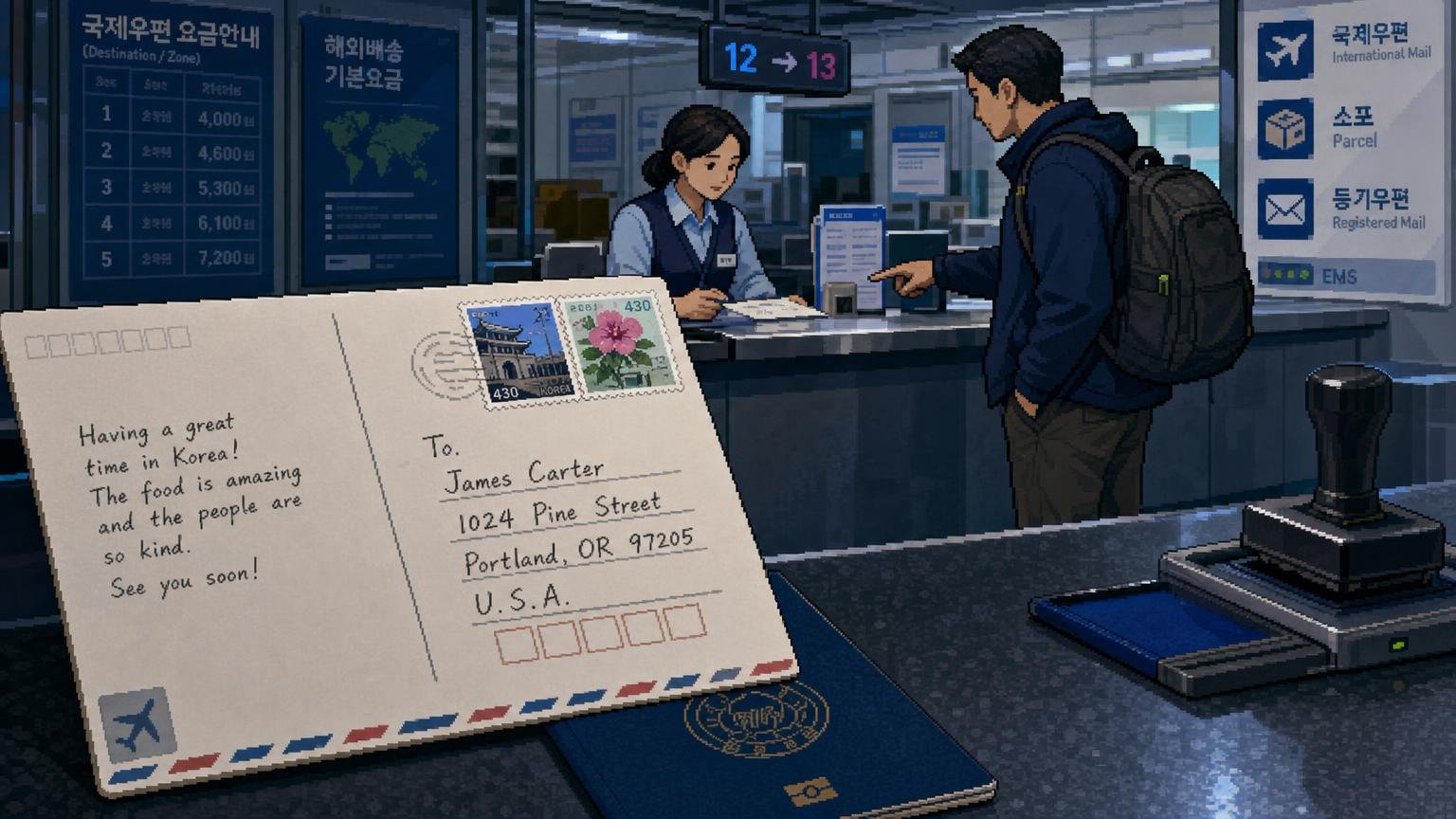
Take the unstamped postcard to the postal counter and say:
해외로 엽서 보내고 싶어요.
Haero yeopseo bonaego sipeoyo.
“I would like to send a postcard overseas.”
Korea Post’s international postage table currently lists a standard air postcard rate of 430 won and a surface postcard rate of 310 won. The delivery method and destination conditions should still be confirmed at the counter because postal services and supplementary charges can change.
You can ask the staff to calculate the postage and provide the stamp or postage label. If you specifically want a Korean-design stamp, ask whether decorative stamps are available, but do not assume that a decorative stamp by itself covers the required international postage.
Useful phrases include:
- 해외 우표 주세요. — “Please give me an international stamp.”
- 미국으로 보내고 싶어요. — “I want to send this to the United States.”
- 항공으로 보내고 싶어요. — “I want to send it by air.”
- 이 우표로 충분한가요? — “Is this stamp sufficient?”
After the stamp is attached, place the postcard in the international mail slot or follow the staff’s instructions. If you are unsure, hand it back to the counter rather than putting it into a domestic mailbox.
4. Sending a letter or documents
For a normal international letter, bring the envelope to the counter and ask for international letter mail. The postage depends on the destination zone, weight, and mailing method.
Write the destination country clearly in English on the last line of the address. Leave enough space for the stamp or postal label in the upper-right area of the envelope. Put your own name and Korean return address on the back or upper-left area if there is room.
Do not describe merchandise as “documents” simply to avoid a customs form. A letter containing only correspondence is different from an envelope containing goods, samples, money, medication, or other items.
5. Sending a package internationally
Step 1: Bring the item or pack it at the post office
You may bring a sealed box, but leave it easy to inspect if the counter needs to check the contents. Many branches sell boxes, envelopes, tape, and other packing materials, although the available sizes vary.
Step 2: Tell the counter where it is going
Give the destination country and explain whether the package is a gift, merchandise, sample, or document. The staff can tell you which international services are available for that destination.
Step 3: Complete the customs information
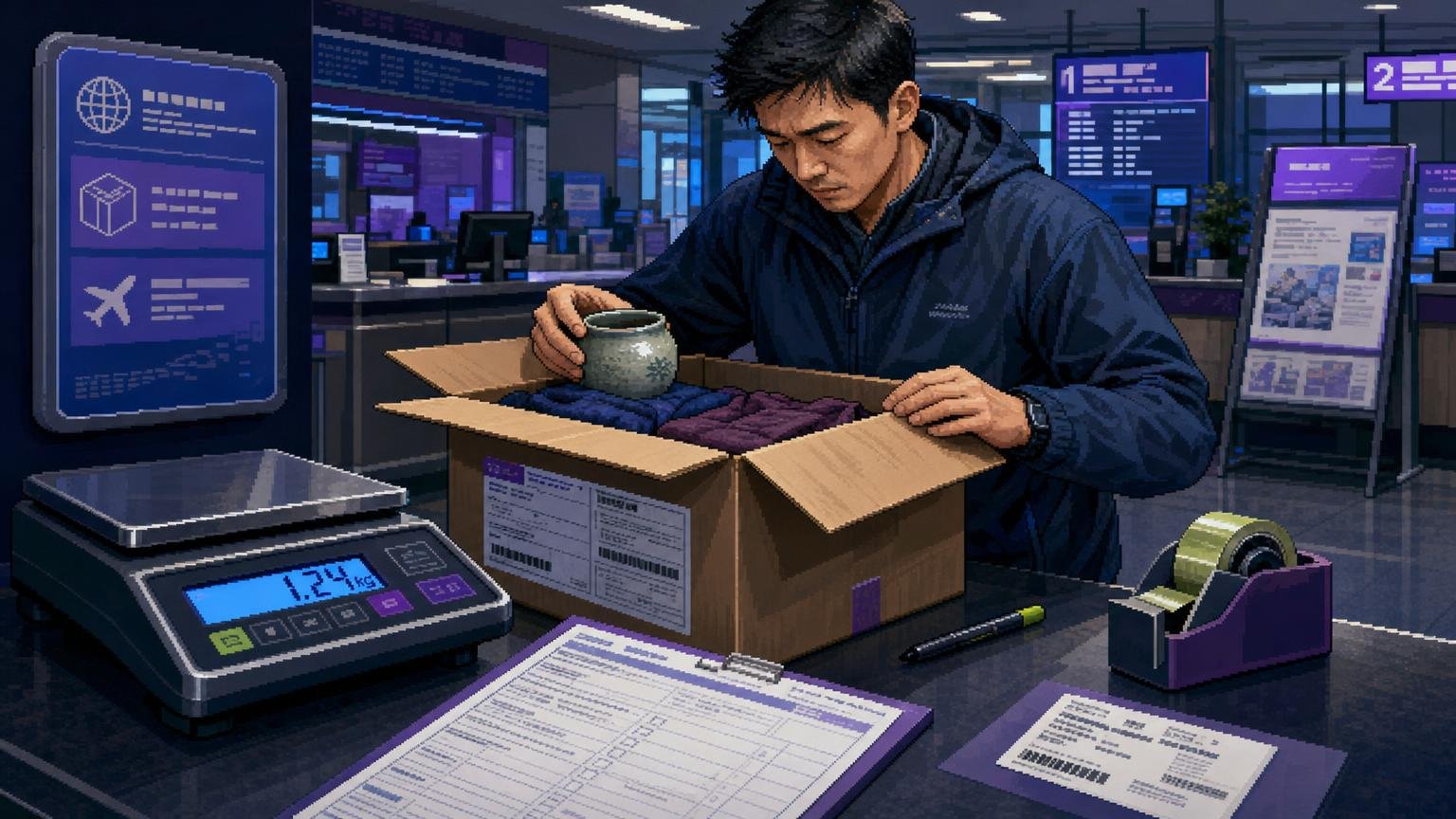
For goods, describe each item accurately in English. Korea Post’s international-mail form asks for the item description, quantity, total value, net weight, country of origin, and—in many cases—an HS tariff number. “Souvenirs” is too vague; use descriptions such as “cotton T-shirts,” “printed books,” or “ceramic mug.”
Step 4: Choose the service
The counter may offer regular international parcel service, surface mail, K-Packet, or EMS depending on the destination and the package. Air service is normally faster than surface service. EMS is an express service, but it is not automatically available to every destination at every time.
Step 5: Check the receipt and tracking number
Before leaving, confirm the destination address, service type, postage, and tracking number. Keep the receipt until the item is delivered or no longer needed.
6. How to choose between regular mail, parcel service, and EMS
| Choose this | Best for | Important point |
|---|---|---|
| International postcard or letter | Postcards, greetings, and light correspondence | Usually the simplest and least expensive option |
| Regular air parcel | Souvenirs or personal items when speed is not the priority | Price depends on destination and weight |
| Surface parcel | Heavier items when lower postage matters more than speed | Delivery can take substantially longer |
| K-Packet or small-packet service | Eligible small, light merchandise | Destination and weight limits apply |
| EMS | Urgent or higher-priority international shipments | Check current country availability, delivery conditions, and any surcharge |
Use Korea Post’s online postage calculator for an estimate, but treat the result as a reference only. The final amount is calculated when the package is submitted, and additional transportation fees or service charges may apply.
Korea Post also states that international EMS smart pre-registration can provide a 5% postage discount, except when postage is paid with stamps. This is optional; a traveler who only needs to send one postcard or small package may find counter service simpler.
7. Customs and prohibited items
Every destination country has its own import rules. The fact that an item can be purchased in Korea does not mean it can be mailed into another country.
Before packing a package, check Korea Post’s destination-specific mailing conditions and prohibited-items information. Common problem items include liquids, aerosols, flammable products, perfumes, batteries, e-cigarette products, seeds, food, medicines, and valuable items. Some products are completely prohibited, while others require documentation or destination-country approval.
Be especially careful with lithium batteries. Korea Post’s international-mail guidance lists many lithium-ion and lithium-metal batteries and devices containing them as prohibited or restricted for international air shipment. If you are mailing electronics, ask the counter before packing the device.
For goods, declare the real contents and a reasonable value. Customs information is used by the destination country to assess admissibility and possible taxes. A vague or inaccurate description can cause delays, return, seizure, or additional questions.
8. Payment and identification for foreign visitors
Postage is paid at the branch counter after the item is weighed and the service is selected. Payment options can differ by branch and terminal, so carrying Korean won is the safest backup. You can ask whether your foreign-issued card is accepted before the transaction is finalized.
For ordinary postcard or letter postage, a passport is not normally part of the basic mailing process. For a package, however, bring your passport or another form of identification if you have one, especially if the staff needs to confirm sender information or complete a customs-related procedure. Requirements can vary according to the service, item, and current rules.
A Korean phone number is not always needed for a simple postcard, but package and EMS forms commonly request sender and recipient contact details. If you do not have a Korean mobile number, ask whether your accommodation telephone number or another contact method can be used for that service.
Common mistakes and troubleshooting
- Going to a small branch for a complex shipment: use a larger post office when you need EMS, customs help, or unusual packaging.
- Writing only the hotel name: include the full sender address and contact information requested on the form.
- Using a vague contents description: list the actual items, quantity, value, and origin.
- Assuming all countries accept the same items: check destination-specific conditions before packing food, cosmetics, batteries, medicine, or seeds.
- Choosing EMS without checking availability: current service availability and delivery guarantees can differ by destination.
- Leaving without the tracking number: photograph or save the receipt before you leave the branch.
- Arriving at closing time: package declarations and international-mail processing take longer than buying a domestic stamp.
What may be different
Branch: Packaging supplies, English assistance, international services, and payment terminals vary by location.
Destination: Accepted services, weight limits, delivery estimates, customs requirements, and prohibited items depend on the destination country.
Service type: Postage differs between regular mail, air parcel, surface parcel, K-Packet, and EMS. Additional transportation fees may also apply.
Payment: Foreign-card acceptance is not guaranteed at every branch, so keep a payment backup.
Delivery: Estimated delivery times do not include holidays, customs retention, or destination-country delays.
FAQ
Can a foreign tourist use a Korean post office?
Yes. Foreign visitors can send postcards, letters, and packages through Korea Post. Prepare the address and customs information in advance, and ask the counter staff to calculate the postage.
Can I buy one stamp for a postcard?
Yes. Ask for international postcard postage. The required value depends on the mailing method and current rate table.
Do I need a Korean phone number?
Not usually for a simple postcard. Package and EMS forms commonly request sender and recipient contact details, so requirements may be stricter for parcels.
Can I mail Korean snacks or cosmetics?
Sometimes, but not automatically. Food, liquids, aerosols, alcohol, and cosmetics may be restricted by air-mail safety rules or the destination country’s import regulations. Check before packing.
Is EMS always the fastest option?
EMS is designed for express international delivery, but current availability, customs processing, transport disruptions, and destination-country conditions affect the actual delivery time.
Can I send a package without a box?
The branch may sell boxes or envelopes, but stock and sizes vary. Bringing a suitable box in advance is safer for an unusual or fragile item.
Where can I check the exact postage?
Use Korea Post’s international postage calculator for an estimate, then confirm the final price at the post-office counter before paying.
Official Information
- Korea Post: Expected delivery days and international postage calculator
- Korea Post: International postage tables, including postcard and K-Packet rates
- Korea Post: Items allowed and prohibited for international postal services
- Korea Post: Current EMS destination availability
- Korea Post: International-mail smart pre-registration and customs information
- Korea Post: Post-office search and contact information