

A Korean cooking class is easier to enjoy when you treat it as a scheduled lesson rather than an informal restaurant activity. Some programs accept individual foreign tourists through an online application. Others are private or group-based and require email contact before the date is confirmed. A few reservation systems may ask for a Korean phone number, while others can handle communication by email.
The important question is not simply “Can foreigners join?” It is “Can this particular class accept me, on my date, with my language and dietary needs?” Use the checklist below before making a reservation.
At a glance: what to check before booking
| Check | Why it matters | What to confirm |
|---|---|---|
| Class type | Some classes are public sessions; others are private or group-only. | Whether solo travelers and small groups may apply. |
| Language | “Foreigners welcome” does not always mean the whole lesson is in English. | Instruction language, interpretation, and language of recipes. |
| Menu | Korean dishes may contain meat, seafood, eggs, dairy, nuts, fish sauce, or fermented ingredients. | Exact dishes and major ingredients. |
| Reservation details | Application, confirmation, and payment may be separate steps. | How to apply, when confirmation arrives, and how to pay. |
| Contact details | Some programs need a local phone number or email confirmation. | Whether an overseas number is accepted and how urgent changes are handled. |
| Cancellation policy | Ingredients may be purchased after confirmation. | Deadline, no-show policy, and whether participant numbers can be changed. |
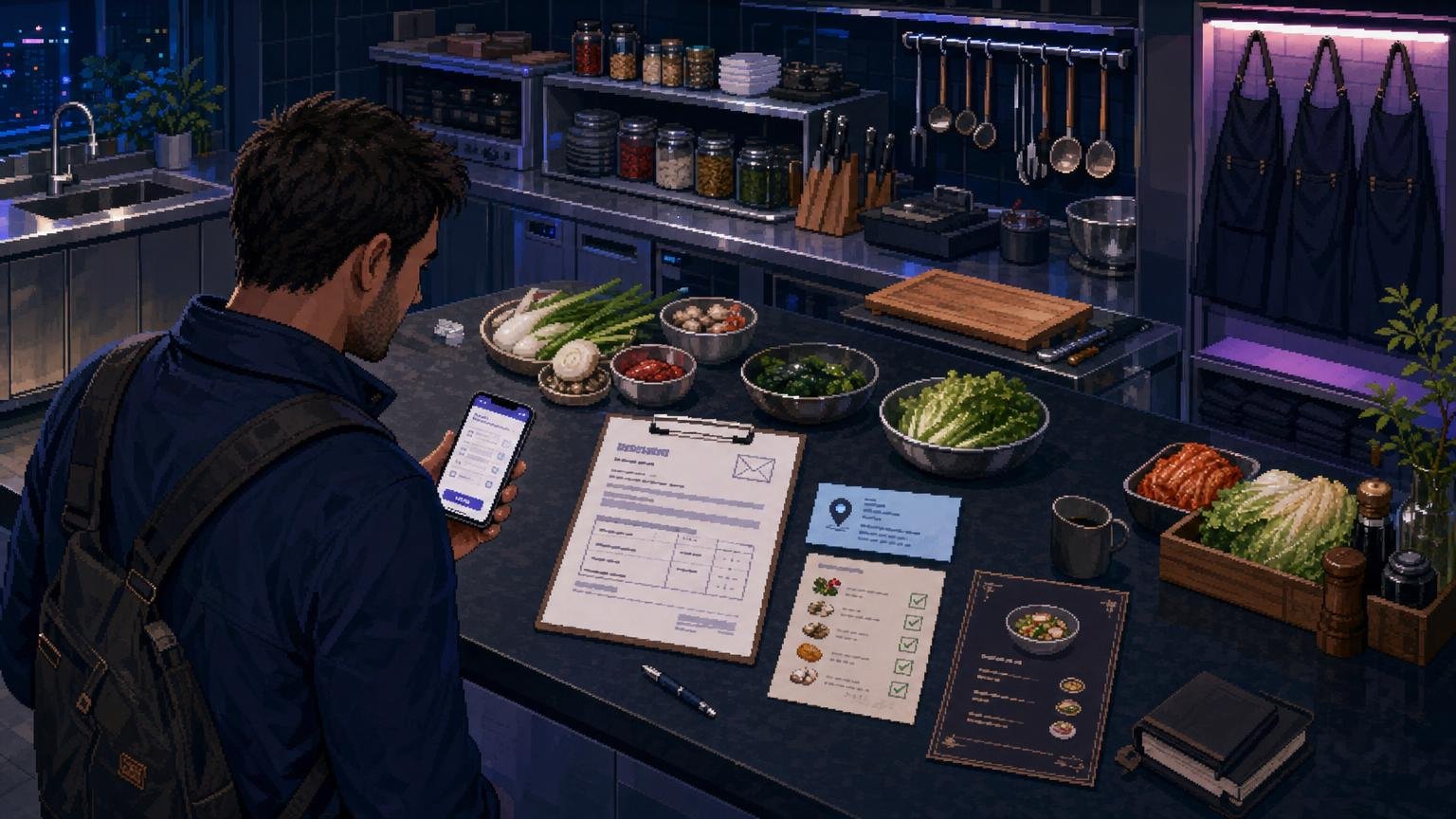
How to find a class that accepts foreign travelers
1. Start with official tourism and food-organization listings
Search for a current listing from a municipal tourism office, the Korea Tourism Organization, or a Korean food organization. These listings can help you identify the venue, language, approximate format, and official contact route. Do not assume that an old blog post or booking-platform description is still current.
For example, the Seoul Hallyu K-Food Cooking Class page currently describes a monthly program for foreign tourists visiting Seoul. It lists an English- and Korean-language hands-on class with a chef demonstration, cooking, tasting, and networking. The page also explains that applicants receive a confirmation request before the program and must reply to finalize participation. This is a useful model of how a public foreigner-oriented class may work, but its schedule and availability should be checked each time.
2. Decide whether you want a public or private class
- Public class: Usually cheaper or more structured, but dates may be limited and you may be placed with other participants.
- Private class: More flexible for families, couples, or dietary requests, but it may cost more and require direct email communication.
- Group class: Useful for schools, companies, or large travel parties, but the provider may have a minimum group size and a separate quotation process.
Some Korean food venues publish an online calendar with individual and group categories. Others only confirm a class after contacting the organizer. If the listing says “inquiry required,” do not treat the displayed date as a confirmed booking.
Step-by-step booking process
Step 1: Choose the food you actually want to make
Read the menu instead of choosing only by the class title. A “Korean food” class may focus on gimbap, bulgogi, japchae, kimchi, temple food, traditional sweets, fermented foods, or a regional dish. Consider whether you want a practical meal you can recreate at home or a more cultural demonstration with traditional ingredients.
Step 2: Check the language and teaching format
Look for a clear statement such as English instruction, bilingual instruction, or interpretation available. Confirm whether the instructor demonstrates first and participants cook afterward, or whether the class is mainly a demonstration and tasting. If a recipe sheet is important to you, ask whether it is provided in English.
Step 3: Submit the requested information accurately
A reservation form may ask for your name, email address, number of participants, preferred date, allergies, and phone number. Give the same name you will use when checking in. If you do not have a Korean phone number, enter your overseas number only if the form accepts it; otherwise email the organizer before submitting multiple applications.
Step 4: Wait for confirmation, not just an application receipt
An automated message may only mean that your form was received. A real confirmation may arrive later by email. Some programs ask selected applicants to reply by a deadline. If you do not reply, the place may be released or the reservation may be canceled.
Step 5: Confirm payment and cancellation terms
Check whether payment is online, by bank transfer, by card, or at the venue. Do not assume that a foreign card will work unless the booking page or organizer confirms it. Also check when cancellation becomes non-refundable. Classes may prepare ingredients in advance, so late changes can be restricted.
Step 6: Save the practical details
Keep the confirmation email, venue address in Korean and English, start time, contact email, and cancellation instructions. Cooking studios can be inside commercial buildings or on upper floors, so allow extra time to find the entrance. If you are staying in a hotel, ask the front desk to write the venue name in Korean for a taxi or map search.
Dietary restrictions and allergies
Tell the organizer before booking, not when you arrive. Korean cooking classes may use beef, pork, chicken, seafood, eggs, dairy, nuts, mushrooms, wheat, sesame, soy, fish sauce, shrimp paste, or other fermented seafood. Vegetarian, vegan, halal, gluten-free, and severe-allergy requests may be possible in some classes but impossible in others.
Ask three separate questions:
- Can the recipe be changed?
- Can the class prevent cross-contact with the ingredient you avoid?
- Will the tasting portion contain the same ingredient even if your cooking station does not?
If the organizer cannot give a clear answer, choose a different class. Do not rely on the English translation of a dish name alone. For a serious allergy, carry a written explanation in Korean and tell the instructor again at check-in.
What usually happens during the class
Formats differ, but a hands-on Korean cooking class commonly follows this sequence:
- Check-in and seating
- Introduction to the menu and ingredients
- Chef demonstration or explanation
- Participant preparation and cooking
- Plating and tasting
- Questions, recipe notes, or group conversation
You may not cook every part of the dish from the beginning. Some ingredients may already be washed, measured, or prepared so the class can finish on time. This is normal and does not necessarily mean the class is only a demonstration. Ask which steps are prepared in advance if learning the full process is important to you.
Expect practical kitchen tasks such as chopping, mixing, seasoning, rolling, shaping, pan-frying, or assembling. The instructor may use Korean cooking terms for tools and ingredients, so watching the demonstration carefully is often as important as reading the recipe.
Cooking-class etiquette in Korea
Arrive early and be ready to start
Aim to arrive about 10 to 15 minutes before the advertised start time unless the organizer gives different instructions. Late arrivals can miss safety guidance, ingredient explanations, or the first demonstration. Some studios may not be able to repeat the whole lesson for one late participant.
Listen before changing the recipe
Korean cooking often involves balancing salty, sweet, spicy, sour, fermented, and savory flavors. If you want to adjust spice or avoid an ingredient, ask before adding a substitute. Do not independently change shared ingredients without telling the instructor.
Keep your station tidy
Follow the studio’s instructions for knives, burners, waste, used utensils, and washing dishes. If an ingredient falls on the floor or you are unsure whether a utensil is clean, tell the instructor rather than quietly returning it to the table.
Share the cooking space considerately
Many classes use shared counters or ingredients. Give other participants room, avoid taking over a communal bowl, and wait for the instructor’s directions before serving yourself. If photography is allowed, take photos without blocking another person’s station.
Ask before photographing people
Food photos are usually less sensitive than photos of other participants or staff. Ask permission before including someone in a close-up image, especially during a small class.
Respect the tasting portion
The food you prepare is normally part of the class experience. Take a small portion first if you are unsure about a strong flavor, but do not waste food deliberately. If you cannot eat something because of an allergy or religious restriction, explain this in advance.

Which type of class suits you?
| Your situation | Best fit | What to prioritize |
|---|---|---|
| Solo traveler with limited time | A scheduled public class for individual applicants | Central location, clear start time, English instruction, and a short format. |
| Couple or small group | Public class or small private session | Whether you can book together and whether the menu suits everyone. |
| Family with children | A class that states its age policy clearly | Guardian requirements, knife and heat safety, and class length. |
| Vegetarian or vegan traveler | A class advertising a suitable menu | Ingredient substitutions and cross-contact policy confirmed in writing. |
| Traveler interested in traditional culture | Temple food, fermented food, royal cuisine, or traditional sweets | Whether the lesson emphasizes cultural explanation as well as cooking. |
| Traveler without a Korean phone number | Email-based or internationally accessible booking | Overseas-number acceptance, email confirmation, and emergency contact method. |
Common booking problems and what to do
The class looks available, but the form will not submit
The date may be reserved for a partner group, the class may require a Korean account, or the displayed schedule may not be open to public applicants. Look for an English contact email and ask whether individual foreign travelers can apply. Do not submit repeated forms for the same person unless the organizer tells you to.
You received an application email but no final confirmation
Check your spam folder and the confirmation deadline. If the class is soon, send one concise follow-up email with your name, date, number of participants, and application time. Avoid sending several different versions of the request, which can create duplicate bookings.
The class requires a Korean phone number
Ask whether an overseas number can be entered with your country code or whether email confirmation is acceptable. Some experiences specifically request a phone number in Korea, while other programs communicate by email. This is a rule of the individual program, not a universal requirement for every Korean cooking class.
Your dietary request was not answered clearly
Do not wait until the day of the class. Ask for the ingredient list and whether substitutions are possible. If the provider cannot confirm safe preparation, choose a menu designed for your needs instead of hoping the instructor can change it at the last minute.
You need to cancel after confirmation
Contact the organizer immediately using the official email or booking channel. Some programs prepare ingredients after confirmation and may limit participant changes or treat a no-show differently from an early cancellation. Keep a record of your cancellation request.
FAQ
Can a foreigner join a Korean cooking class without speaking Korean?
Yes, some classes specifically offer English instruction or interpretation. Confirm the teaching language before booking because “foreigner-friendly” does not always mean that every explanation, recipe, or booking step is in English.
Do I need a Korean phone number?
Not always. Some programs request a Korean phone number, while others use email or accept an overseas number. Check the individual reservation form and contact the organizer if the form blocks your country code.
Can I walk in on the day?
Usually you should not depend on a walk-in place. Many classes prepare ingredients in advance, use small capacities, or require confirmation. Reserve ahead unless the official page clearly states that walk-ins are accepted.
Can I join if I have a food allergy?
Possibly, but ask before booking. Confirm the ingredients, substitutions, and cross-contact policy in writing. A class may be unable to accommodate a severe allergy even if the dish itself appears suitable.
Are Korean cooking classes suitable for children?
It depends on the program. Some classes require children to attend with a guardian, and some may have age restrictions because of knives, hot pans, or limited workspace. Check the specific policy before reserving.
Will I eat the food I cook?
Many hands-on classes include tasting or a meal after cooking, but the format varies. Confirm whether tasting is included and whether the prepared food is shared by the group.
Should I bring anything?
Usually bring your booking confirmation, dietary information, and a way to contact the organizer. Wear comfortable clothes and closed-toe shoes if possible. Ask whether the venue provides aprons, gloves, or containers before bringing your own.
Official Information
- Seoul Metropolitan Government: K-Food Cooking Class — current program format, eligibility, application guidance, menu information, and participant instructions.
- Hansik Space E:eum: Reservation Calendar — current schedule and availability categories for cooking classes and food-related programs.
- Hansik Promotion Institute: Hansik Learning Center — information about cooking, tasting, group capacity, and language options.
- VISITKOREA: O’ngo Food Communications — an example of a foreign-tourist cooking provider that requires advance reservation and direct inquiry.
- VISITKOREA: Experience Making Korean Foods First-Hand — examples of reservation information, dietary questions, and foreign-participant requirements for food experiences.