
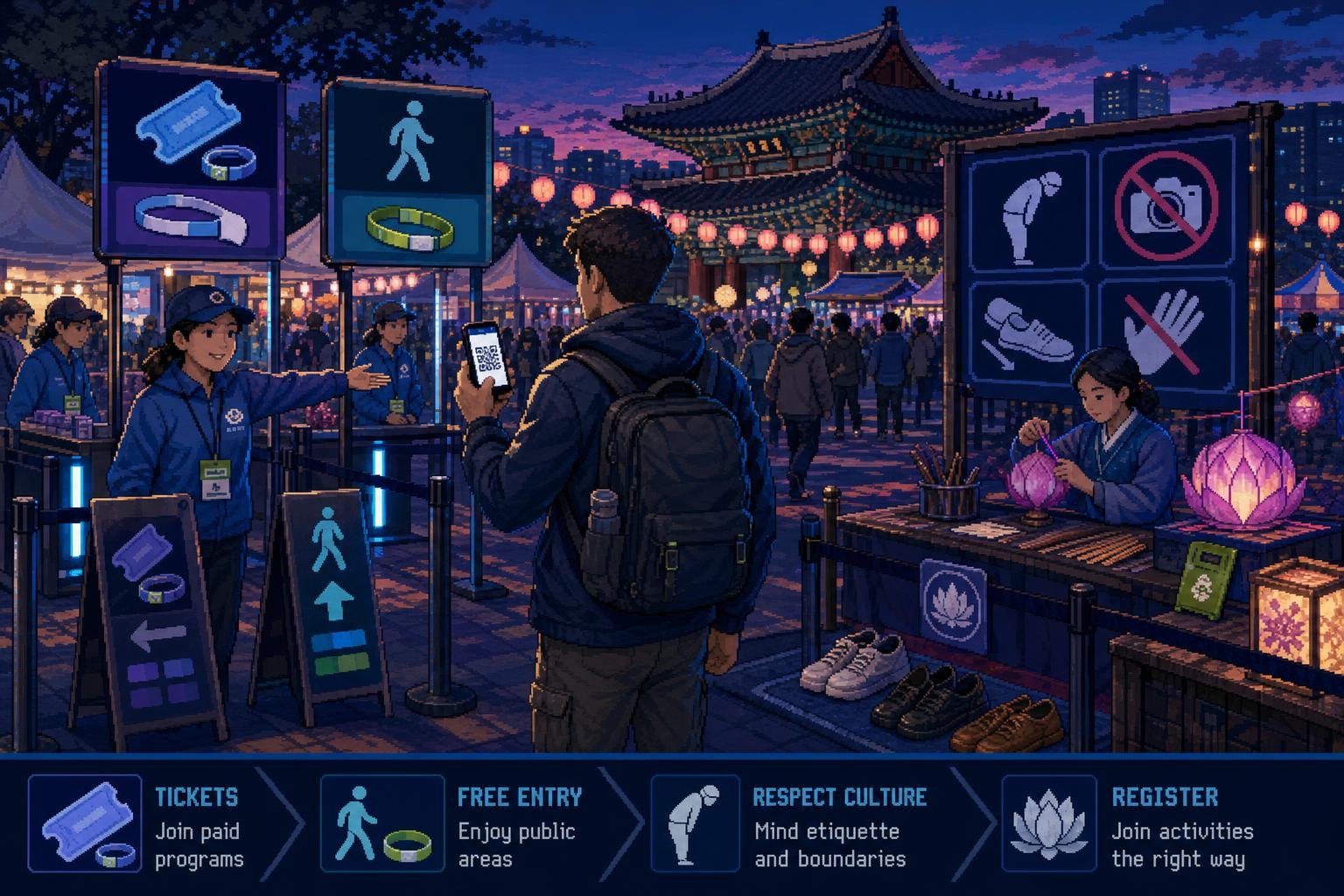
“Korean festival” can mean very different things. A city food festival may have open streets and free booths, while a rock festival, film screening, lantern parade participation program, or hands-on workshop may require a ticket or advance registration.
The safest approach is to decide which part you want to attend first: the general festival area, a scheduled performance, a paid activity, or a restricted participation program. That choice determines whether you need a ticket, how early to arrive, and what identification to carry.
At a glance
| Festival situation | Typical entry method | What to check |
|---|---|---|
| Open city, food, lantern, or cultural festival | Often free entry; walk in during event hours | Venue, daily program, crowd controls, and whether individual activities cost extra |
| Concert or music festival | Advance ticket, QR code, wristband, or ticket pickup | Ticket release time, identity checks, payment method, age rules, and entry gate |
| Film or performing-arts festival | Individual screening or performance ticket | Language information, seat assignment, late-entry rule, and pickup procedure |
| Workshop or limited participation program | Advance registration or limited on-site registration | Capacity, registration deadline, materials fee, and language support |
| Parade participation or special viewing area | May require registration, invitation, or a separate pass | Meeting point, collection time, eligibility, and whether public participation is limited |
The Korea Tourism Organization’s current festival directory is a useful starting point, but it is not a substitute for the individual festival’s own notice. The directory itself advises visitors to check the official festival website for current details, and its 2026 guidance says international tourists are generally welcome while most festivals do not require advance reservations.
How to check whether you need a ticket
1. Find the official event page
Start with the festival’s official website or its listing on VisitKorea. Look for the Korean terms 입장료 (admission fee), 예매 (advance ticketing), 사전예약 (advance reservation), 현장접수 (on-site registration), and 무료 (free).
Do not assume that a free festival means every program is free. A public festival may charge separately for food experiences, craft workshops, reserved seating, exhibitions, or special performances.
2. Separate general entry from special programs
Check whether the notice refers to the whole festival or only one activity. For example, a lantern festival may be open to everyone while joining a parade requires advance registration. A food festival may have free entrance but paid cooking sessions. A film festival may have a free outdoor event alongside ticketed screenings.
3. Use only the ticket route named by the organizer
Some events sell tickets through a Korean ticket platform, while others use the festival’s own website, an overseas-facing page, a tourism promotion page, or an on-site booth. Follow the link published by the organizer rather than searching for a similarly named event on a resale site.
Before paying, check the event date, venue, ticket type, entry time, refund policy, and whether the ticket is transferable. A ticket that appears valid may still be restricted to the original purchaser.
4. Check foreigner requirements before payment
Look for information about passport name matching, foreign-card acceptance, Korean phone verification, account registration, and ticket pickup. These conditions differ by event and ticket seller. If the checkout page requires a Korean mobile number or a local identity-verification step that you cannot complete, look for an official overseas sales channel or ask the organizer about on-site purchase options before buying.
5. Save proof of purchase offline
Keep the confirmation email, QR code, reservation number, and passport name in screenshots as well as in the original app or email. Carry the passport used for the booking if the event says identity verification is required. Do not rely on a screenshot alone when the organizer specifically requires the original app or an identification document.
What to do on the day
- Check the venue notice again. Outdoor festivals may change entrances, programs, or viewing areas because of weather, safety controls, or local conditions.
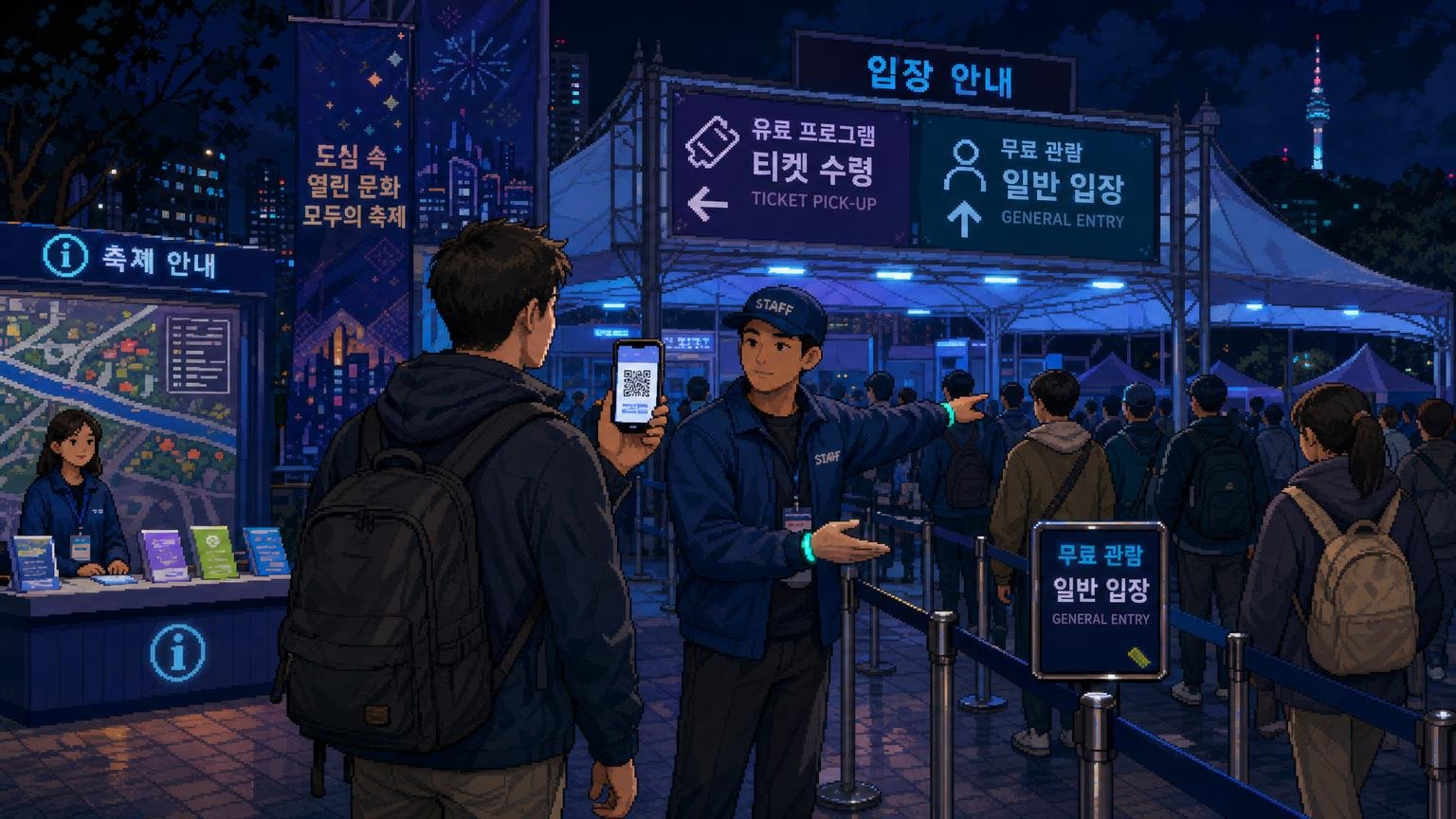
- Arrive earlier than the headline start time. Allow time for ticket pickup, wristband collection, bag checks, registration, and walking between stages or program areas.
- Use the correct queue. Ticket pickup, general admission, reserved seating, workshop registration, and accessibility assistance may have separate lines.
- Keep your confirmation and passport accessible. Put them somewhere easy to reach rather than at the bottom of a large bag.
- Ask staff when you are unsure. Show the Korean event name, venue, or confirmation screen. A short written question on your phone can be easier than trying to explain the whole situation verbally.
Festival etiquette that helps you fit in
Respect the space, not just the program
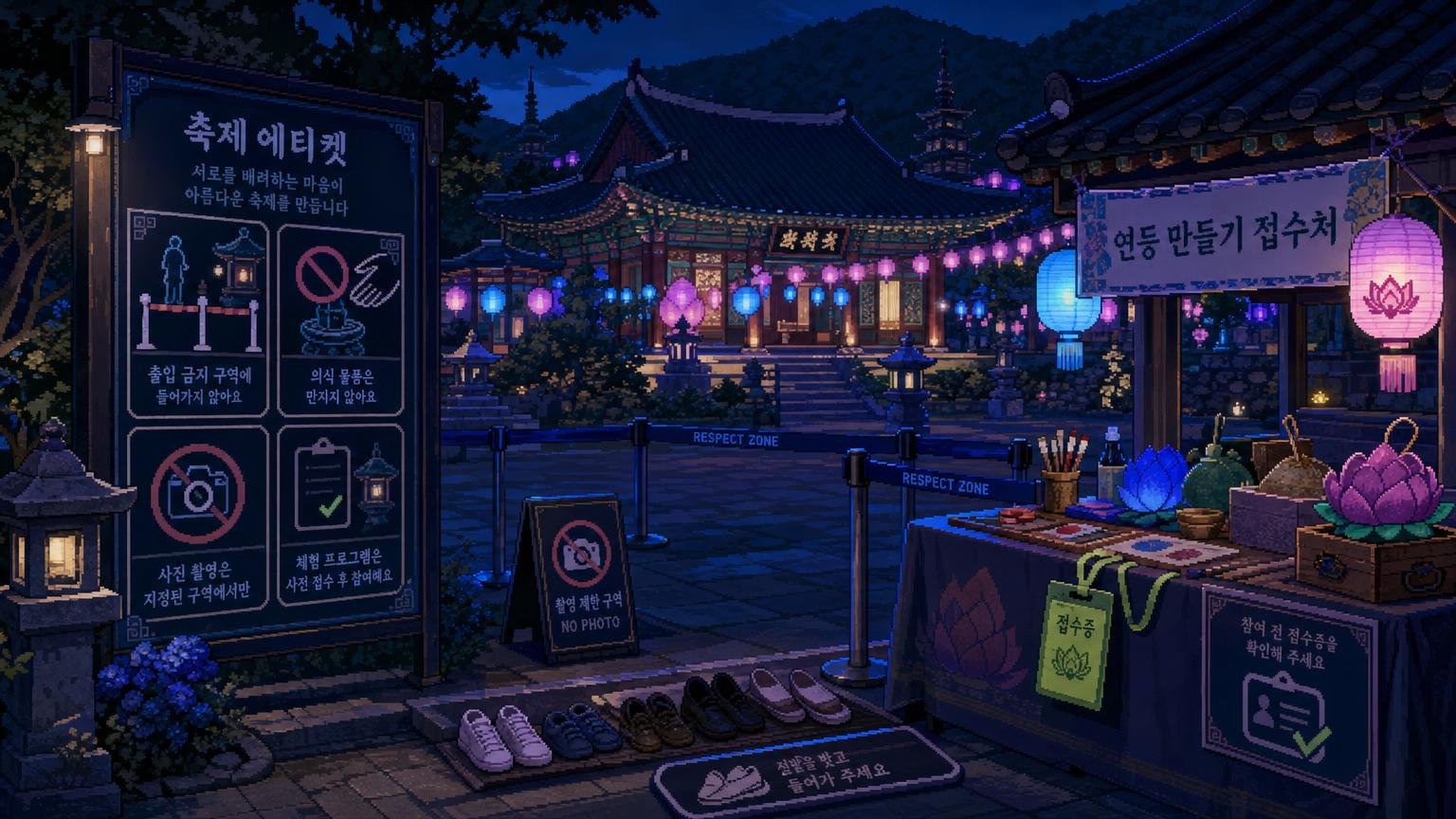
Keep walkways, entrances, emergency routes, and viewing areas clear. Do not sit in a reserved or staff-controlled area unless you have the correct pass. At crowded outdoor events, avoid stopping in the middle of a moving walkway to take photos.
Ask before photographing people
Large public performances can normally be photographed from permitted areas, but do not assume that individual performers, children, workshop participants, vendors, or worshippers want close-up photos. Ask with a simple 사진 찍어도 돼요? (“May I take a photo?”) and accept no without argument.
Be especially careful at temples and religious festivals
Some festivals take place around Buddhist temples, shrines, memorial spaces, or religious ceremonies. Keep your voice low during formal moments, follow signs about where to stand, and do not touch ritual objects or enter restricted areas. Dress practically and avoid treating a ceremony as a photo prop.
Join activities only when participation is invited
Some festivals encourage visitors to make crafts, carry lanterns, dance, share food, or join a parade. Wait for the organizer’s instructions, register when required, and do not take materials intended for registered participants. If a program is first-come, first-served, expect supplies or spaces to run out.
Handle food, alcohol, and waste responsibly
Follow booth instructions about payment, waiting, allergens, and where to collect food. At beer or food festivals, keep drinks away from equipment, children, and crowded movement areas. Use the provided recycling and waste bins; outdoor festival sites may separate containers more carefully than you expect.
Ticket problems and practical alternatives
The website is only in Korean
Look for an English, Japanese, or Chinese version, an official social-media notice, or a tourism listing that links back to the organizer. Browser translation can help you understand a page, but check names, dates, and cancellation conditions carefully before payment.
Your foreign card is declined
Do not repeatedly submit the same payment if the result is unclear. Check whether the seller accepts overseas cards, whether 3-D Secure approval is required, and whether another official sales channel exists. A Korean card or Korean account may be required for some sales systems, but this is not universal.
The booking form asks for a Korean phone number
This is a ticket-system issue, not a general rule for all Korean festivals. Do not enter a random number. Ask the organizer whether foreigners can use a passport, an overseas number, an official global page, or on-site registration.
You only have a screenshot
Bring the original confirmation when possible. Some venues scan a QR code from an app or email, while others accept a printed ticket or screenshot. If the event requires passport matching, the name on the booking must match your passport details.
The event is sold out
Check the organizer’s official notice for additional releases, cancellations, day-of tickets, or free public areas. Do not buy from an unofficial reseller unless the event explicitly permits ticket transfers and you understand the identity-check rules.
You arrive late
Late entry may be allowed for an outdoor festival but restricted for a seated performance, screening, ceremony, or guided activity. Read the late-entry rule before leaving for the venue and ask staff rather than entering through a closed gate.
Which festival approach suits you?
- You want a relaxed first festival: Choose a free public festival area with no complicated reservation. Arrive during daylight, walk the site once, then select one or two activities instead of trying to do everything.
- You are traveling for a specific artist or performance: Treat it like a ticketed event. Confirm the ticket release date, identity rules, entry gate, and last entry time before building your day around it.
- You want hands-on cultural participation: Check capacity and language support first. Advance registration is safer for popular workshops, while on-site programs may be available only until supplies run out.
- You are attending a religious or traditional festival: Read the organizer’s participation instructions and observe before joining. The most respectful choice is to follow the local format rather than assuming every activity is designed for casual tourist participation.
- You have limited Korean: Save the event name in Korean, screenshot the venue and program details, and keep the 1330 Korea Travel Helpline information available for travel-related questions.
FAQ
Can foreigners attend Korean festivals?
Yes. VisitKorea states that international tourists and non-Korean residents are generally welcome at Korean festivals. The exception is a limited program or event that has its own eligibility, capacity, or registration rules.
Do I usually need a ticket?
Not always. Many public city, food, lantern, and cultural festivals are free to enter, but special performances, workshops, screenings, reserved areas, and parade participation may require separate tickets or registration.
Can I buy a festival ticket at the venue?
Sometimes, but never assume it. Some events offer on-site registration or day-of sales, while others sell out in advance or require an online reservation. Check the official event notice before traveling to the venue.
Will my foreign credit card work?
It depends on the ticket seller and payment page. Check the accepted payment methods before checkout. If overseas cards are not supported, look for an official international sales route or ask the organizer about another legitimate purchase method.
Do I need a Korean phone number?
Some online booking systems may request Korean phone verification, but this is not a universal festival requirement. Check the exact ticketing system and do not use a random phone number. Contact the organizer if the official booking route is inaccessible to foreign visitors.
Should I bring my passport?
Bring it when the ticket notice says the booking name must match a passport or when ticket pickup requires identity verification. Even when it is not required, carrying appropriate identification is sensible for a ticketed event.
Is it rude to take photos at a Korean festival?
Photography is often part of the experience, but respect no-photo signs, restricted zones, performers’ instructions, and other visitors’ privacy. Ask before taking close-up photos of individuals or private activities.
What if I do not understand the announcements?
Keep the event name and your ticket information visible on your phone, watch staff behavior, and ask for help at an information booth. For general travel assistance, VisitKorea provides the 1330 Korea Travel Helpline with multilingual support.
Official Information
- VISITKOREA: Festival directory — browse current festivals by region and date.
- VISITKOREA: Festival ticket and planning guidance — general advice on ticketed festivals and checking event details.
- VISITKOREA: 2026 autumn festival guide — a current example of festival listings, participation guidance, and the 1330 travel helpline.
- VISITKOREA: 2026 Yeon Deung Hoe guide — an example showing how free entry, paid activities, and parade registration can differ within one festival.
- VISITKOREA official English website — confirm current destination and travel information before departure.