

A language exchange is different from a Korean class. You normally meet Korean speakers and international participants, divide your time between Korean and another language, and continue the conversation around everyday topics. Some groups are carefully structured; others are informal social gatherings in a café or bar.
For a foreign visitor, the difficult part is usually not finding the word “language exchange.” It is choosing a genuine exchange, understanding whether foreigners can attend, checking the payment and registration rules, and avoiding an event where you feel unprepared or pressured to speak only English.
At a glance: which type should you choose?
| Type | Best for | What to check before joining |
|---|---|---|
| Meetup group | Travelers and residents who want an in-person group | Event date, location, language mix, reservation, cost, and whether walk-ins are allowed |
| University buddy program | International students enrolled in Korea | Eligibility, application period, residence or enrollment requirements, and selection process |
| Foreign-resident center program | Foreign residents who want structured Korean practice | Current term, class level, registration method, and whether the program is a class rather than a free conversation meetup |
| Language-exchange app | Visitors who are not in Seoul long or prefer one-to-one practice | Account verification, privacy settings, preferred language, and whether a person wants language practice rather than dating or social contact |
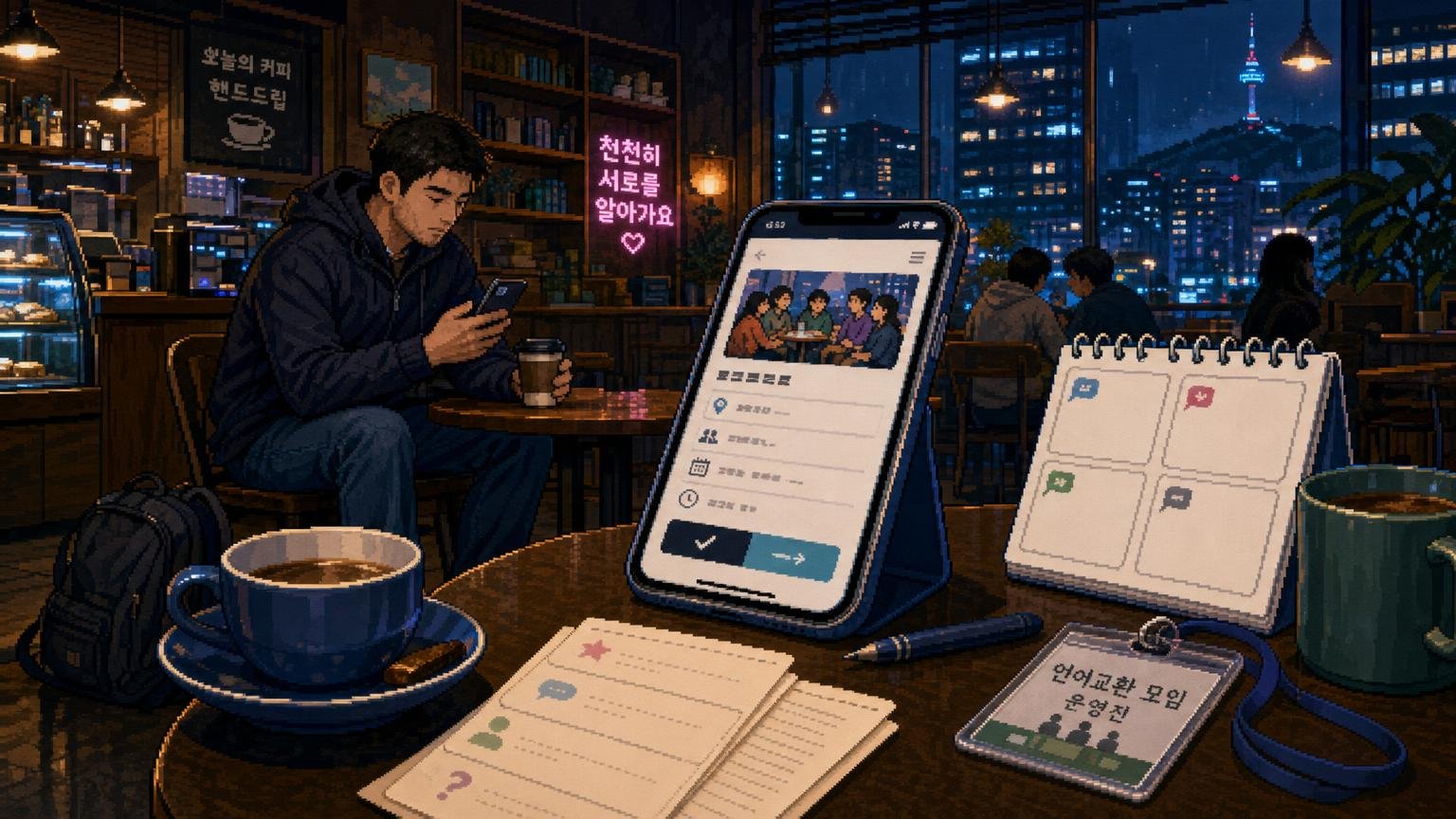
Option 1: Find an in-person exchange on Meetup
Meetup is one of the most direct ways to find a current event in Seoul and other Korean cities. Its Korea language-exchange topic page lists groups in areas including Jongno, Gangnam, Hongdae, Itaewon, Bundang, Suwon, and Busan. Listings and member numbers change, so use the current page as a search starting point rather than assuming that an old event is still active.
Step 1: Search with a specific location
Use terms such as “Korean English language exchange,” “Korean conversation,” “language exchange Hongdae,” or “language exchange Busan.” A location-based search is more useful than searching for a general Korea group because travel time can be significant.
Step 2: Read the complete event description
Check whether the gathering welcomes travelers, international residents, exchange students, or only members of a particular group. Also look for the format: rotating tables, free conversation, small-group discussion, a café meeting, or a social event with optional food and drinks.
Step 3: Check the real cost
Some groups are free apart from buying a drink. Others charge an event fee, require advance payment, or operate as a paid membership community. Do not assume that “language exchange” means free entry. One current Seoul listing, for example, states that registered membership and a minimum number of sessions are required, while other groups use a simpler café-order system.
Step 4: Reserve or join the group
Press the RSVP or “Join” button if the organizer requires it. If the listing says that places are limited, do not rely on arriving without registration. Save the organizer’s message, venue address, and meeting instructions on your phone.
Step 5: Arrive and introduce yourself
Arrive about 10 minutes early if the venue is unfamiliar. Tell the organizer, “I’m here for the language exchange.” A useful introduction is: “Hi, I’m from [country]. I’m learning Korean at beginner level, and I can help with English.”
Option 2: Join through a university or buddy program
If you are studying at a Korean university, ask your international office, student union, dormitory office, or Korean-language program about buddy and conversation schemes. These may be more suitable than a large public meetup if you want repeated contact with the same Korean students.
Seoul Metropolitan Government’s “30 Days in Seoul” newcomer course is an example of a more selective cultural-exchange route. The 2026 notice was limited to international students enrolled at universities in Seoul who had been in Korea for less than one year, with Korean university students serving as local buddies. The program used small teams and interest-based matching, but its application period and eligibility were specific to that recruitment round. Treat it as a type of opportunity to monitor, not as a drop-in meetup.
For this route, prepare your university name, department, length of stay, Korean level, interests, and a short reason for wanting to meet local students. Apply during the stated recruitment period and do not assume that late applications or tourists will be accepted.
Option 3: Check Seoul foreign-resident centers
Seoul operates Korean-language education through foreign-resident centers and related facilities. These programs are usually classes rather than casual language exchanges, but they can be a reliable way to meet other foreign residents and build enough Korean confidence to join a conversation group later.
The Seoul Foreigners Portal publishes center notices and registration information. Course availability, class level, online or in-person format, and eligibility can differ by center and term. Some notices are intended for foreign residents with a valid visa rather than short-term visitors, so check the individual announcement before applying.
If your main goal is speaking practice, look for words such as 회화 (conversation), 말하기 (speaking), or 언어교환 (language exchange). A course labelled only 한국어 강좌 may be a standard Korean class, not a partner-exchange session.
Option 4: Start online before meeting people in person
A language-exchange app can be useful if you are staying in Korea for only a few days, visiting a city without a regular meetup, or feeling nervous about joining a large group. HelloTalk describes its service as a way to connect with native speakers for language practice and friendship.
Set your profile clearly: “Visiting Seoul until Friday. Beginner Korean. Looking for 30 minutes of Korean and 30 minutes of English practice.” This attracts more suitable partners than writing only “I want to make Korean friends.” Use the app’s privacy and blocking tools, and move to an in-person meeting only when you are comfortable.
For a first meeting, choose a public café in a busy area, tell someone where you are going, and keep the meeting short. A person who ignores your language-exchange request, asks for money, or immediately pressures you to meet privately is not a good exchange partner.

How to prepare before your first exchange
- Know your actual level. Say “I know Hangul but speak slowly” or “I am a complete beginner.” This helps the organizer place you with a suitable group.
- Prepare five easy topics. Use your hometown, food, work or study, travel plans, hobbies, and Korean places you have visited.
- Bring conversation questions. Try “What do you usually do on weekends?” or “What Korean food do you recommend for a beginner?”
- Prepare a language rule. Suggest 15 minutes in Korean and 15 minutes in English, or agree to switch whenever one person needs help.
- Save the venue in Korean. Café names and addresses are easier to show to a taxi driver or read in a map app when copied in the original Korean listing.
- Bring a small notebook or use a notes app. Write down useful corrections, but do not interrupt every sentence to ask for perfect grammar.
What to say when you arrive
You do not need advanced Korean to join. These sentences are enough to start:
- 안녕하세요. 언어교환 모임에 왔어요. Hello. I came for the language exchange.
- 한국어를 조금 공부하고 있어요. I am studying a little Korean.
- 천천히 말해 주세요. Please speak slowly.
- 영어로 말한 다음 한국어로 말해 볼까요? Shall we speak in English and then try in Korean?
- 잘 모르겠어요. 다시 말해 주세요. I am not sure I understand. Please say it again.
If you cannot read Hangul yet, save these lines as a screenshot. You can also show the English meaning without making the conversation stop.
How to choose a good exchange
Choose a group based on the kind of practice you want, not simply on the number of members.
- For maximum speaking time: choose a small group or a table-rotation format.
- For meeting many people: choose a larger social meetup, but expect shorter conversations.
- For beginner Korean: look for listings that explicitly welcome beginners or provide conversation prompts.
- For serious study: choose a recurring group with a stated language ratio or structured discussion.
- For a short holiday: choose a one-off RSVP event or an app rather than a program requiring several sessions.
- For university students: check campus buddy programs before paying for a public event.
Common mistakes and troubleshooting
The event page is active, but the event is cancelled
Check the latest organizer message on the event page on the day of the meeting. If the venue or time is unclear, message the organizer before travelling across the city.
The group is mostly foreigners
This can happen even when the event title includes Korean exchange. Ask the organizer how many Korean participants are expected and whether tables are mixed. If Korean practice is your priority, a small recurring group or university buddy program may work better than a large social event.
The event requires a Korean phone number
This depends on the platform and organizer. Do not invent a Korean number or use another person’s account. Try an event platform that accepts your email, ask the organizer whether foreign registration is possible, or use an in-person venue that accepts walk-ins.
You are asked to pay more than expected
Read whether the listed amount covers entry, a café drink, a membership, or only advance registration. Keep a screenshot of the original event description and ask for clarification before paying.
The conversation becomes a date or sales pitch
Language exchange is not a guarantee of friendship or dating. Say clearly that you came to practise languages. If someone pressures you to share private information, buy a product, or move to a private location, end the conversation and contact the organizer if appropriate.
What may be different
- Meetup groups, venues, organizers, participant numbers, and fees can change without notice.
- Some events accept travelers, while others are limited to registered members, residents, students, or people who commit to several sessions.
- Seoul foreign-resident center courses follow term-based recruitment and may have separate rules for residents and short-term visitors.
- University buddy programs normally have fixed application windows and selection procedures.
- App registration, phone verification, privacy controls, and matching functions can change after an app update.
FAQ
Can I join a Korean language exchange if I speak almost no Korean?
Yes, if the organizer welcomes beginners. Choose a listing that mentions beginner participation, and state your level honestly when you RSVP.
Do I need to bring a Korean friend?
No. Many public groups are designed for people who arrive alone, but this varies by organizer. Confirm the rule on the current event page.
Is a language exchange the same as a Korean class?
No. A class normally follows a teacher and lesson plan. An exchange depends on conversation between participants, so the structure and correction quality vary.
Can a tourist join a Seoul foreign-resident center class?
Not automatically. Some programs are designed for foreign residents and may require a valid visa or other eligibility. Check the current notice before applying.
How long should my first exchange be?
One scheduled session is enough to evaluate the format. If you arrange a private one-to-one meeting, 30 to 60 minutes in a public place is a sensible first appointment.
What if I only want Korean practice and not a social party?
Search for “Korean conversation,” “speaking practice,” or “Korean study” rather than only “language exchange.” Read the description for words such as social, party, drinks, or networking if you want a quieter study-focused setting.
Official Information
- Seoul Foreigners Portal — current notices, foreign-resident services, and program information.
- Seoul Metropolitan Government: Korean Language Classes for Foreign Residents — background on Korean-language education through Seoul foreign-resident centers.
- Seoul Metropolitan Government: 30 Days in Seoul Newcomer Course — an example of eligibility and application rules for a Seoul student buddy program.
- Meetup: Language Exchange Groups in Korea — current public listings and group searches; individual organizer rules apply.
- HelloTalk — online language-exchange platform for finding conversation partners.