
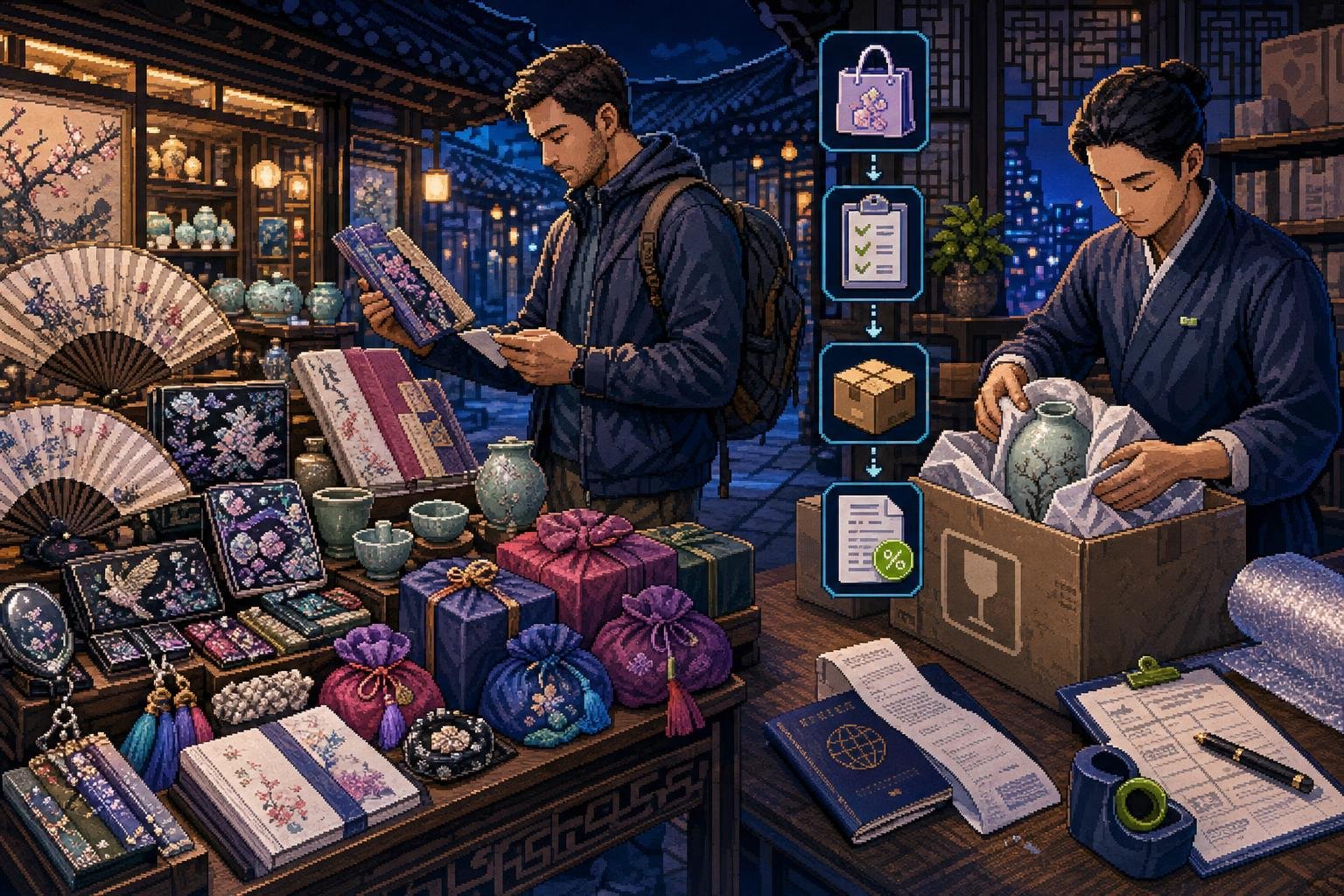
Traditional Korean souvenirs range from small hanji paper goods and folding fans to mother-of-pearl accessories, ceramics, textiles, tea items, and contemporary objects inspired by Korean heritage. The main challenge is not finding something attractive. It is choosing an item that is genuinely suitable for your budget, luggage, destination-country rules, and intended use.
This guide focuses on the buying decision: where to shop, how to judge quality and authenticity, and how to handle tax refunds or overseas shipping without creating problems at the airport or customs.
At a glance: which shopping option suits you?
| Where to shop | Best for | What to expect | Check before paying |
|---|---|---|---|
| Insa-dong street and alleys | Comparing many styles and price levels | Craft shops, galleries, tea-related goods, hanji, accessories, ceramics, and small gifts | Material, maker information, packaging, and return policy |
| Ssamzigil | Modern craft and compact gifts | A multi-floor craft complex with traditional and contemporary products | Individual shop payment, tax-refund availability, and shipping options |
| Tong-In Store | Traditional crafts and gallery-style shopping | Many specialist sellers in one traditional-craft shopping center | Whether the piece is contemporary, antique, or reproduction |
| National Souvenir Center | Screened or award-winning tourist souvenirs | Traditional craft items and products selected through quality screening | Size, care instructions, and whether the shop offers shipping |
| Museum or palace cultural-goods shop | Easy-to-carry designs with a clear heritage connection | Contemporary products inspired by collections, architecture, or traditional motifs | Stock, opening hours, and whether overseas delivery is available |
Insa-dong is the easiest starting point if you want to compare products in person. Ssamzigil is a craft-focused complex, while Tong-In Store brings many traditional-craft sellers together. The National Souvenir Center is useful when you prefer products selected through an official souvenir-screening process rather than an unfiltered street-market selection.
Where to buy traditional Korean souvenirs
1. Insa-dong: the practical first stop
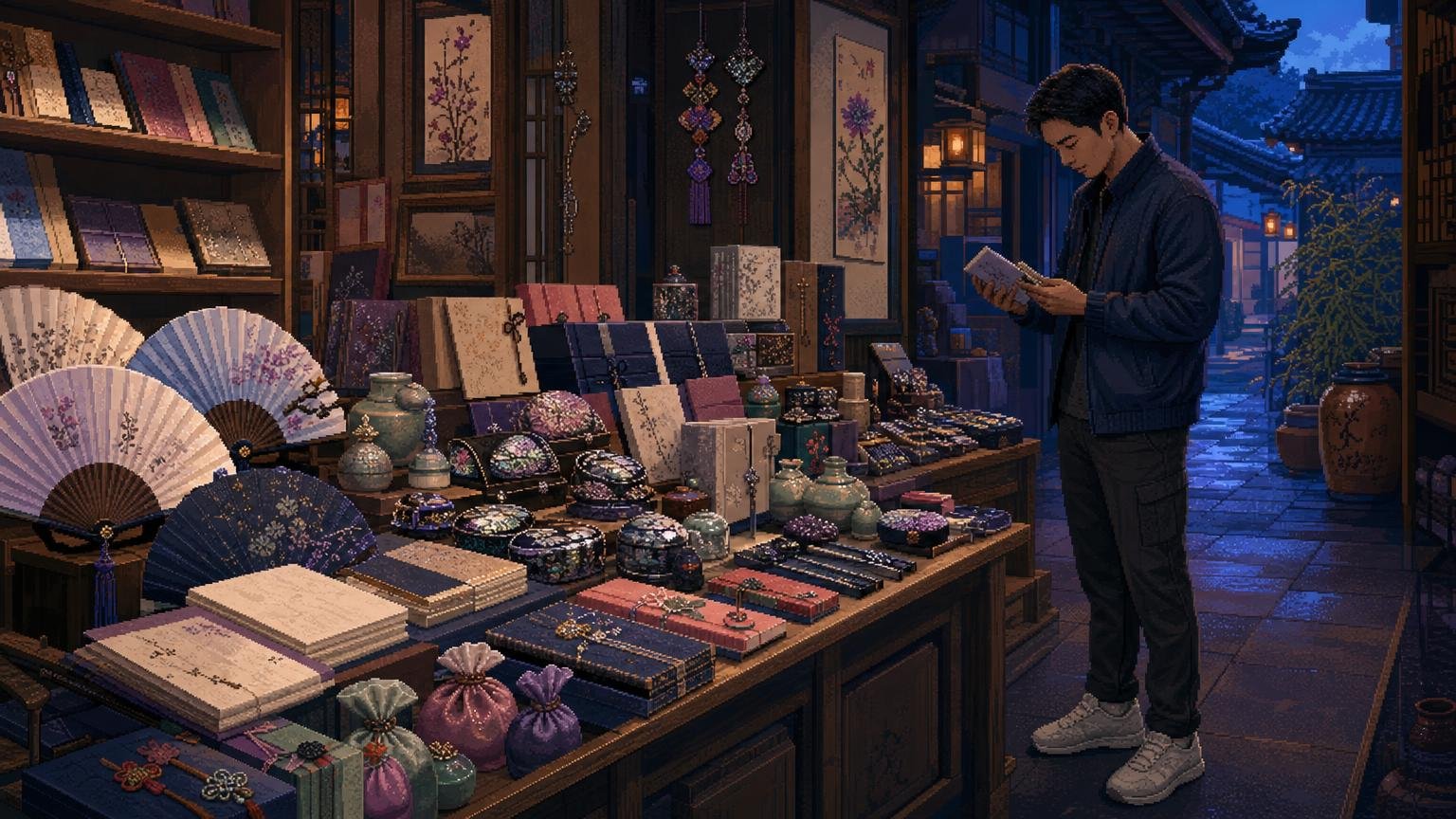
Insa-dong’s main street and side alleys contain craft shops, galleries, traditional-style stores, and cultural complexes. It is suitable for travelers who want to compare several categories in one visit, including hanji goods, fans, pouches, calligraphy-related items, small ceramics, accessories, and decorative objects.
Do not assume that every shop sells handmade products or that every item is made in Korea. Ask directly if origin matters to you. Useful questions include:
- “Is this made in Korea?”
- “What material is this?”
- “Is this handmade or factory-produced?”
- “Can you pack this for checked luggage?”
- “Do you offer overseas shipping?”
- “Is tax refund available?”
2. Ssamzigil: contemporary craft in a concentrated space
Ssamzigil is an Insa-dong craft complex with small shops, galleries, and workshops. It is a good choice when you want traditional inspiration in a modern format, such as stationery, accessories, textiles, lifestyle objects, or compact decorative pieces.
Because individual businesses operate within the complex, payment methods, tax-refund service, packaging, and overseas shipping may differ from one shop to another. Treat each shop as a separate purchase point rather than assuming that the whole building follows one policy.
3. Tong-In Store: specialist craft sellers
Tong-In Store is aimed at shoppers who want a more craft-focused experience, with numerous sellers offering traditional and contemporary Korean crafts. It can be a better fit than a general souvenir shop if you are looking for ceramics, woodwork, metalwork, textiles, or artwork with more specialized presentation.
For expensive or older-looking objects, ask whether the item is a modern reproduction, a contemporary artwork, or an antique. If the seller describes an item as old, valuable, or culturally significant, request written information and ask whether any export permission or documentation is required.
4. National Souvenir Center: screened tourist products
The Insa-dong National Souvenir Center is operated by the Ministry of Culture, Sports and Tourism and the Korea Tourism Association. Its products include traditional craft items and award-winning tourism souvenirs, and the center states that the brands it sells are screened before acceptance.
This does not mean every product will suit every budget or suitcase. It does mean the center is a useful place to begin if you want a more curated selection and clear tourist-souvenir positioning.
5. Museum and palace shops: heritage-inspired gifts
Museum and palace shops often sell contemporary products based on Korean art, architecture, historical objects, or traditional patterns. These shops are especially useful for gifts that are easy to explain to someone who has never visited Korea, such as a design inspired by a museum collection or a palace motif.
For travelers who are already visiting the National Museum of Korea, its MU:DS shop is a practical option. The official tourism information also notes that MU:DS products are available through an online store with overseas shipping, which can be useful if you see an item later and do not want to carry it home.
What to look for before buying
Check the material, not only the appearance
Two items may look similar but have very different materials and care requirements. For example, a mother-of-pearl-style finish may be genuine shell inlay, a printed pattern, or a synthetic imitation. A ceramic object may be handmade, partly handmade, or mass-produced. Read the label or ask the seller instead of relying on the display.
For textiles and paper goods, check whether the item is delicate, washable, moisture-sensitive, or likely to crease. For ceramics, inspect the rim, corners, glaze, and any repaired area under good light. For lacquered or inlaid products, ask how the surface should be cleaned and whether heat or water can damage it.
Look for useful information on the package
A good tourist gift should be easy to identify after you return home. Useful packaging may include the product name, materials, place of manufacture, maker or brand, care instructions, and a short explanation of the Korean motif. Keep this information if you may need to explain the item to customs, a recipient, or an insurance provider.
Choose size and durability for your actual trip
- Best for carry-on: paper goods, fabric accessories, small wood items, flat ornaments, and lightweight stationery.
- Needs careful packing: ceramics, glass, lacquerware, carved items, and anything with a delicate protruding part.
- Better to ship: large framed art, bulky ceramics, multiple gift sets, or items that would use most of your suitcase.
- Check before buying: food, plant materials, seeds, animal products, liquids, sprays, and items containing batteries.
Distinguish a souvenir from a potentially restricted object
Do not buy old-looking objects, weapons, antique furniture, animal materials, or items described as cultural property without asking about export requirements. Korea Customs Service states that cultural assets covered by other laws are restricted, and Korean cultural-property rules may require confirmation or approval before export.
Decorative swords and weapon replicas can also create problems. Korea’s official travel guidance lists weapons, including replicas and decorative weapons, among restricted items. If you are unsure, choose a clearly modern, non-weapon decorative product or ask the seller and customs before purchase.
How to ask about price, quality, and shipping
Step 1: Compare two or three similar items
Look at the same category in more than one shop. Compare material, size, finish, packaging, and maker information, not only the headline price.
Step 2: Confirm exactly what is included
Ask whether the price includes a box, protective wrapping, a stand, batteries, accessories, or gift packaging. A displayed item may not include everything shown beside it.
Step 3: Ask for a written receipt
Keep the receipt until you arrive home. It helps with tax refunds, shipping claims, exchanges, and identifying the store later.
Step 4: Decide between carrying and shipping
Ask for the total shipping cost, estimated delivery method, tracking availability, insurance, packing method, and what happens if the item is damaged or returned by customs. Get the destination address and postal code exactly right.
Step 5: Photograph the item and package before dispatch
This is useful for your own records, especially for fragile or higher-priced purchases. It is not a substitute for insurance, but it can help explain the condition and packaging if a dispute occurs.
Shipping traditional souvenirs from Korea
Many stores can arrange overseas delivery, but the service is not universal. Some shops use Korea Post, while others use a private courier or a store-specific shipping partner. The cheapest option may not provide the same tracking, delivery speed, insurance, or compensation conditions as a premium service.
Before agreeing to shipping, confirm:
- the final price, including packing and shipping fees;
- whether the shipment is tracked;
- whether insurance or compensation is included;
- the expected dispatch and delivery window;
- whether the seller will contact you if customs requests information;
- whether your destination country may charge import tax, VAT, brokerage, or handling fees;
- what happens if the parcel is refused, delayed, returned, or damaged.
If you use Korea Post, check the current international-mail restrictions before buying. Korea Post states that international mail is security-screened and that prohibited items may be returned to the originating post office. Its guidance also flags items such as swords, seeds, unmarked food, batteries, aerosols, perfumes, and certain liquids for prohibition or additional checking.
Food and plant-based souvenirs require extra care. A sealed, commercially manufactured food product may be accepted for international post in some circumstances, but your destination country can apply separate food, agricultural, or quarantine rules. Do not assume that because an item can leave Korea, it can automatically enter your country.
Tax refund tips for souvenir shopping
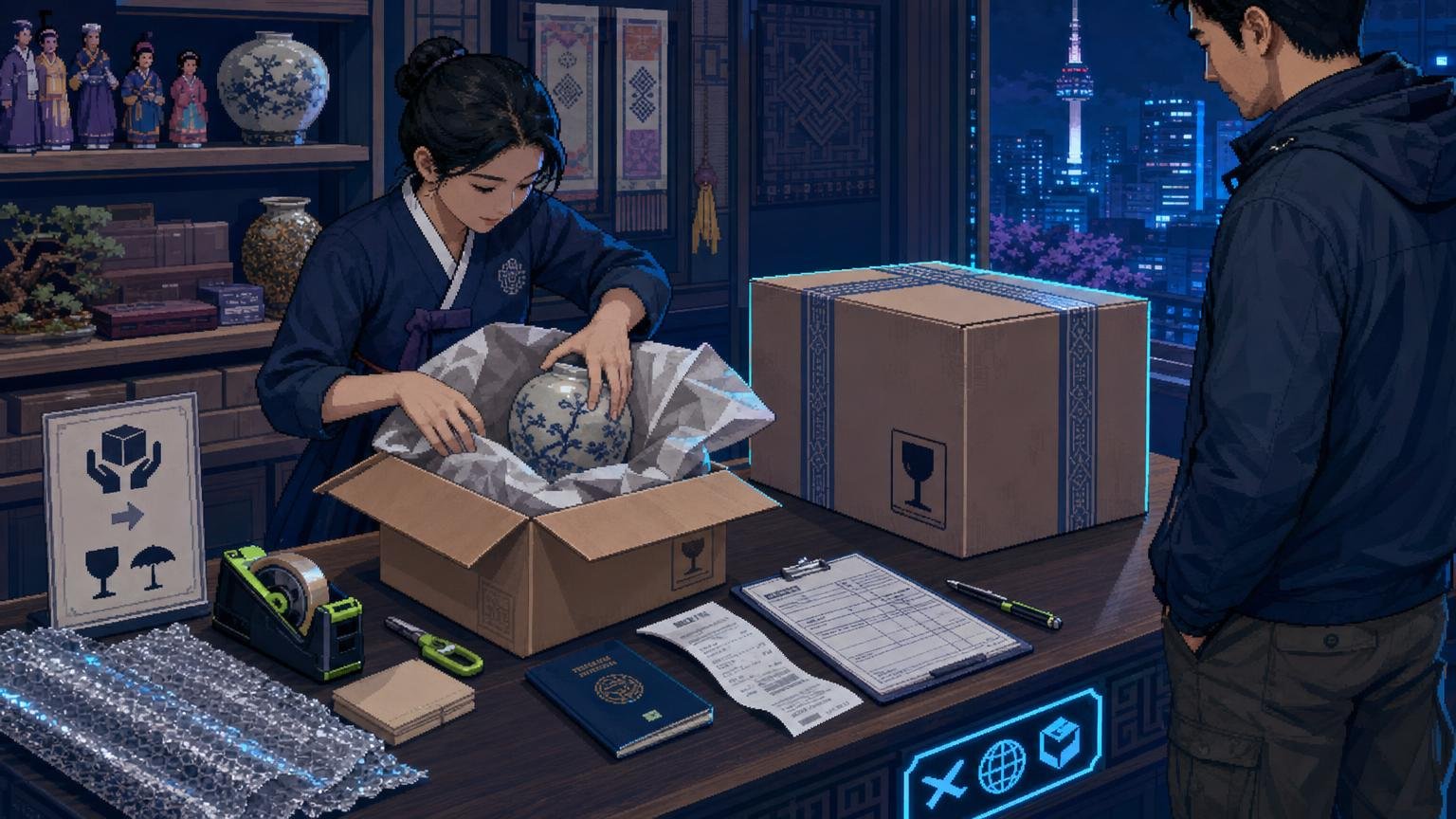
Tax refund and duty-free shopping are different. At a duty-free shop, eligible taxes are normally removed before or at the time of sale. With ordinary tax-refund shopping, you usually buy from a participating tax-refund store and complete an additional refund procedure.
Before paying
- Look for a visible “Tax Refund” or “Tax Free” sign.
- Ask whether the specific item and transaction qualify.
- Present your passport when requested by the cashier.
- Check that your name or passport information is recorded correctly on the receipt or refund voucher.
Current general requirements
VISITKOREA’s current tax-refund guide states that eligible foreign visitors generally need to have stayed in Korea for less than six months, purchase at least KRW 15,000 worth of goods in a qualifying transaction, and take the purchased goods overseas within three months. The goods must be new, unopened, and unused when presented for export confirmation.
For immediate tax refund, the same guide lists a single transaction limit of less than KRW 1 million and a total trip limit of KRW 5 million. For downtown tax refund, it lists a single-transaction limit of KRW 6 million or less. These limits and procedures can change, so check the official guide and the store’s current system on the day of purchase.
At the airport
Keep the refund voucher, passport, and the purchased goods available. If customs needs to confirm the export, you may need to show the goods before checking luggage or before placing them in checked baggage. Follow airport staff instructions because the exact process depends on the airport, terminal, refund provider, and whether the goods are in checked or carry-on luggage.
Do not open or use an item that you plan to claim for a tax refund. This is particularly important for gifts, clothing, cosmetics, and packaged products. If you have already used the item, the refund may be refused.
Which souvenirs are easiest for a first-time buyer?
- For several small gifts: choose hanji stationery, fabric pouches, folding fans, key cases, small accessories, or modern motif goods.
- For a design-conscious recipient: compare museum-shop or award-winning tourism-souvenir products.
- For someone who likes traditional craft: consider a small ceramic, wood, metal, or mother-of-pearl item, but confirm material and packing requirements.
- For a limited suitcase: select flat, lightweight products or use overseas shipping for fragile and bulky pieces.
- For a valuable purchase: request documentation, ask about export restrictions, and do not rely on a casual verbal description of age or authenticity.
- For a food gift: choose sealed commercial packaging and check both Korea Post restrictions and your destination country’s import rules.
Common mistakes and troubleshooting
“The shop said it was traditional, so it must be handmade.”
“Traditional” may describe a motif, shape, technique, or design inspiration. Ask whether the product is handmade, partly handmade, or mass-produced, and ask where it was made.
“The store accepts foreign cards, so tax refund must be available.”
Card acceptance and tax-refund eligibility are separate. Confirm the tax-refund sign and request the correct receipt before completing payment.
“I can open the gift now and still claim the refund later.”
Do not assume this. Current guidance says opened or used goods may not qualify. Keep eligible goods unused until departure.
“The seller will ship anything.”
Shipping acceptance depends on the postal operator, destination country, product material, packaging, and transport regulations. Ask before purchase, especially for liquids, food, seeds, animal materials, batteries, sprays, swords, or antique-looking objects.
“A low shipping price means the purchase is cheaper.”
Compare the complete cost, including packing, insurance, possible customs charges, and handling fees in your home country. A cheaper shipping method may also have slower or weaker tracking.
FAQ
Where is the easiest place to buy traditional Korean souvenirs in Seoul?
Insa-dong is the most practical starting point because it combines street shops, craft complexes, galleries, and specialist stores. Ssamzigil and Tong-In Store are convenient for comparing several craft sellers in one area.
Are traditional souvenirs in Korea handmade?
Some are, but not all. Ask about the material, manufacturing location, and whether the item is handmade, partly handmade, or factory-produced.
Can I get a tax refund for a souvenir?
Possibly, if the shop participates in Korea’s tax-refund system and the purchase meets the current eligibility rules. Ask before paying, present your passport if required, keep the refund documents, and keep the goods unopened and unused until departure.
Can I ship ceramics or fragile Korean crafts home?
Often, yes, but the store’s packing and compensation policy matter. Ask whether the shipment is tracked and insured, and compare the total cost with carrying the item in protective luggage.
Can I ship Korean food as a souvenir?
Some sealed, commercially manufactured foods may be accepted, but postal and destination-country rules differ. Check the product with the shipping operator and your country’s customs or quarantine authority before sending it.
Can I buy an antique Korean object as a tourist?
You should first confirm whether it is genuinely old, whether it is legally saleable, and whether export documentation is needed. Cultural assets and certain older objects may be restricted. If the seller cannot explain the item’s status, choose a clearly modern reproduction or contemporary craft piece instead.
Is a museum-shop souvenir always tax refundable?
No. Museum-shop products may be eligible only if the specific store participates in the tax-refund system and the purchase meets the requirements. Ask at checkout rather than assuming.
Official Information
- VISITKOREA: Insa-dong National Souvenir Center
- VISITKOREA: Ssamzigil Craft Complex
- VISITKOREA: Tong-In Store
- VISITKOREA: Comprehensive Tax Refund Guide
- Korea Post EMS: Items Accepted and Prohibited for International Mailing
- Korea Customs Service: Customs Procedures for Departure
- VISITKOREA: Gift Guide Rooted in Korean Tradition