

Shipping souvenirs home can be easier than carrying an overloaded suitcase, but international parcels are not just domestic packages with a foreign address. The parcel must pass export security checks, airline restrictions, and customs procedures in the destination country.
The main decision is not simply “Which service is cheapest?” It is whether you need a convenient post-office counter, faster courier handling, stronger tracking and customs support, or a service that accepts the specific items you bought.
At a glance: Korea Post or private courier?
| Option | Usually suits | Main advantages | Important cautions |
|---|---|---|---|
| Korea Post EMS | Normal souvenirs, clothing, books, packaged non-perishable goods | Accessible post-office process, international tracking, online price and delivery estimates | Destination restrictions still apply; customs delays are not included in estimated delivery times |
| Korea Post parcel or other international mail | Travelers comparing different speed and cost levels | More service types may be available depending on the destination and parcel size | Availability, weight limits, surcharges, and delivery times vary by country |
| Private courier | Urgent, valuable, bulky, or complicated shipments | Door-to-door collection or delivery options, detailed online shipment preparation, and customs-clearance support | Rates can be higher; duties, taxes, brokerage, or other charges may be billed separately |
Korea Post calculates international postage using the higher of actual weight and volumetric weight. Its online calculator is useful for checking a rough price, but the final amount is confirmed when the parcel is accepted. Courier companies also commonly use package dimensions as well as scale weight, so do not choose a large box just because the contents are light.
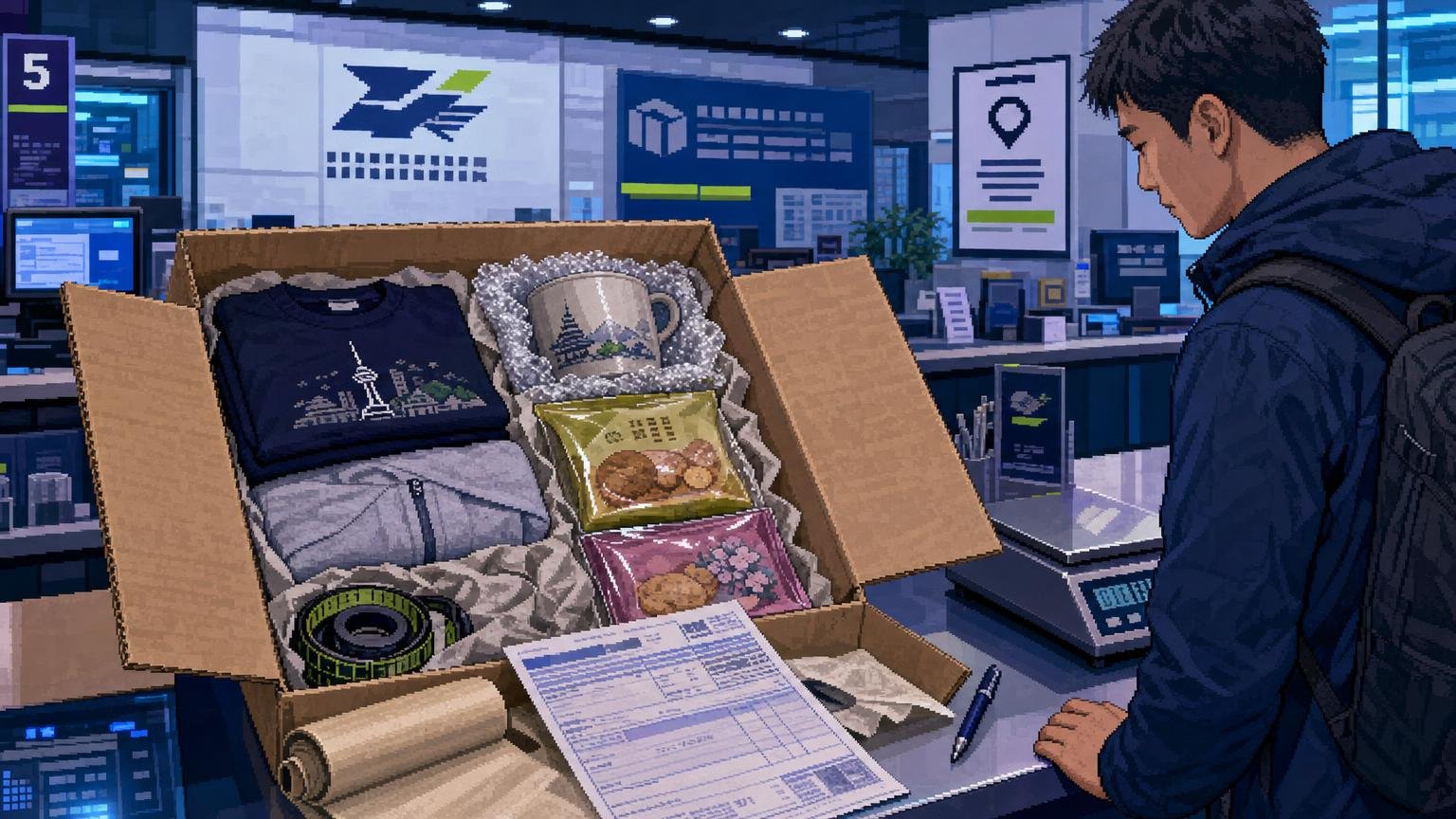
What to prepare before you go to a post office or courier counter
- Recipient’s full address: Write it in the format used by the destination country, including apartment or unit number, postal code, city, state or province where applicable, and country.
- Recipient’s phone number: A local number in the destination country is particularly useful if customs or delivery staff need to contact the recipient.
- Your own contact details: Korea Post’s international forms require sender information, including a name, address, and phone number.
- An item list: Prepare a simple list such as “cotton T-shirts,” “ceramic mug,” or “sealed seaweed snacks.” Avoid vague descriptions such as “gifts,” “Korean items,” or “miscellaneous.”
- Approximate individual values: Customs declarations generally require the value of each type of item and a total value. Do not deliberately write a lower value to reduce possible taxes.
- Destination-country customs information: The rules that matter most are usually the import rules of the country receiving the parcel, not only the export rules in Korea.
If you use Korea Post’s smart international-mail acceptance system, the contents description must be entered in English. Non-document shipments require detailed customs information such as the item description, quantity, total value, weight, country of origin, and, where applicable, HS code information. You can prepare the information online and then take the parcel to the selected post office counter.
How to ship with Korea Post
1. Check the destination and item restrictions
Use Korea Post’s destination-specific service information before packing. A country may accept ordinary clothing but restrict food, medicines, cosmetics, plant products, animal products, alcohol, or other items. A parcel can be accepted in Korea and still be refused, destroyed, or returned by the destination country.
2. Choose the service and check the estimate
Compare EMS, EMS Premium, international parcel, or another available postal service. Enter the destination, weight, and dimensions into Korea Post’s calculator. Treat the result as an estimate: surcharges, service availability, holidays, customs retention, and the final counter measurement can affect the actual charge.
3. Pack the contents before arriving
Some post offices may sell boxes or packing materials, but availability and assistance can vary by branch. It is safer to separate fragile items, cushion them properly, and have the parcel ready to close. Use a strong outer box rather than a thin shopping bag.
4. Complete the customs declaration accurately
List each item in plain English, with a quantity and value. “Ceramic cup, 1, USD 15” is more useful to customs than “souvenir.” Select the appropriate category, such as gift or merchandise, according to the real purpose of the shipment.
5. Keep the receipt and tracking number
Photograph the completed declaration and keep the receipt until the recipient confirms delivery. The tracking number is also needed when contacting the postal service about a delay or customs hold.
When a private courier may be better
A courier may be worth comparing when you need collection from your accommodation, door-to-door handling, more frequent tracking updates, or assistance with customs paperwork. Courier services generally create a shipment online or through a customer-service channel, then produce an air waybill and any required commercial or customs documents.
For example, FedEx’s Korea guidance asks shippers to enter shipment details, upload required documents, print the air waybill, and choose either pickup or drop-off. FedEx also advises using clear and consistent descriptions across documents because incomplete or conflicting information can cause customs delays.
This does not mean every courier has identical procedures. Account requirements, pickup coverage, payment arrangements, packaging services, declared-value limits, and destination restrictions vary by operator and shipment type. Check the quote carefully to see whether transportation, fuel surcharges, duties, taxes, brokerage, and optional insurance are included.
How to pack Korean souvenirs safely
- Remove unnecessary retail packaging: Bulky boxes and display packaging increase both size and volumetric weight.
- Protect breakables individually: Wrap ceramics, glass, bottles, and framed items separately. Fill empty spaces so objects cannot move when the box is shaken.
- Keep liquids upright and sealed: Use leak-resistant inner bags and absorbent material. Check both Korea’s transport restrictions and the destination country’s import rules.
- Do not mix vulnerable items with food: If food leaks or is rejected, it may contaminate books, clothing, paper goods, or electronics.
- Use a new, strong outer box: Reinforce seams with packing tape. Avoid boxes with old labels, barcodes, or agricultural images that could confuse inspection.
- Do not hide restricted contents: A parcel can be opened during screening or customs inspection, and inaccurate declarations can lead to delays, return, seizure, or penalties.
Items that commonly cause problems
Korea Post’s international-mail guidance lists dangerous goods and many restricted products, including explosives, flammable materials, illegal drugs, live animals, currency, precious metals, and other valuables. It also flags practical problem areas such as aerosols, compressed containers, unidentified liquids or powders, seeds, swords, and lithium batteries.
Do not assume that a small souvenir is automatically acceptable. Examples that deserve extra checking include:
- Perfume, sprays, aerosol cosmetics, and products in pressurized containers
- Portable chargers, rechargeable batteries, and electronics with built-in lithium batteries
- Food containing meat, dairy, fresh ingredients, or animal products
- Seeds, plants, dried plants, herbal products, and traditional medicines
- Alcohol, tobacco, medicines, and supplements
- Knives, swords, replicas, or objects that may be considered weapons
- Cash, jewelry, precious metals, passports, and other highly valuable items
Battery rules are especially easy to misunderstand. Korea Post’s current prohibited-item guidance states that rechargeable lithium-ion and lithium-metal batteries, including many devices containing them, are prohibited for standard international postal shipment. The exact rule can depend on the service and destination, so ask before placing a power bank, tablet, camera, electric beauty device, or similar product in the parcel.

Customs: what the recipient may have to pay
Shipping postage is not the same as import clearance. The destination country may assess customs duty, VAT, GST, sales tax, brokerage, or a postal handling charge based on the contents, declared value, product category, and local thresholds.
Do not label a valuable purchase as a “free gift” or declare an unrealistic value. The declaration should describe what is actually inside and what it is worth. Korea Post explains that high-value items may incur taxes or fees under the destination country’s customs rules. Private couriers may also bill duties and taxes to the recipient or another designated payer, depending on the shipment terms.
Tell the recipient in advance that a customs message, payment request, or delivery appointment may be necessary. A parcel can remain undelivered even when the international shipping fee has already been paid.
Which option should you choose?
- Choose Korea Post EMS if you have ordinary souvenirs, can visit a post office, want a familiar postal process, and do not need a guaranteed arrival date.
- Compare a private courier if you need pickup, door-to-door delivery, more structured digital paperwork, or specialist support for a valuable or complicated shipment.
- Split the shipment if one item is likely to create a customs or transport problem. Do not put important documents, fragile goods, and questionable food in the same box.
- Leave restricted items out if the rule is unclear. Sending an item first and hoping customs accepts it is more expensive than carrying it home or not buying it.
Common mistakes and troubleshooting
The parcel is heavier or more expensive than expected
Recheck the dimensions. Both postal and courier systems may charge by volumetric weight, so a large lightweight box can cost more than a compact heavier one.
The clerk says an item cannot be sent
Ask whether the item is prohibited by Korea’s transport rules, restricted by the selected service, or restricted by the destination country. A different courier is not automatically a solution; dangerous goods and import restrictions may apply across multiple services.
Tracking stops after export
This can happen while the parcel is waiting for destination customs processing or transfer to the local delivery operator. Check the destination country’s postal or courier tracking system as well as the original tracking page. If customs contacts the recipient, the recipient usually needs to respond directly.
The recipient receives a tax or payment request
Verify the message through the official postal or courier website before paying. Customs charges and delivery fees are determined by the destination country and shipment terms, not by the Korean post office counter alone.
FAQ
Can I ship souvenirs from any Korean post office?
International-mail services and acceptance hours can vary by branch. Use a branch that handles international mail, and check its current service availability before making a special trip.
Do I need a Korean phone number?
Korea Post’s international forms require sender contact information, including a phone or mobile number. If you are using a hotel, guesthouse, or temporary accommodation address, confirm that the property can receive contact or return notices.
Can I send snacks such as seaweed or packaged tea?
Some commercially packaged foods may be accepted, but acceptance from Korea does not guarantee import clearance. Ingredients, packaging, quantity, and destination-country rules all matter. Check the specific destination conditions before shipping food.
Is EMS always cheaper than a courier?
No. The answer depends on destination, weight, dimensions, speed, surcharges, pickup, insurance, and customs-related fees. Compare a real quote for the packed parcel rather than comparing brand names.
Should I write “gift” on the customs form?
Use “gift” only when the parcel is genuinely a non-commercial gift. You still need accurate descriptions, quantities, and values for the contents.
Can I ship a power bank or rechargeable device?
Do not assume that you can. Korea Post’s current international-mail guidance prohibits many rechargeable lithium batteries and devices containing them for standard postal shipment. Ask the selected operator about the exact item before packing it.
Official Information
- Korea Post: International-mail prohibited and restricted items
- Korea Post: Expected delivery days and price calculation
- Korea Post: International-mail smart acceptance
- Korea Post: International EMS sender, recipient, and contents information
- FedEx South Korea: How to prepare customs documents
- FedEx South Korea: Online international shipping steps