
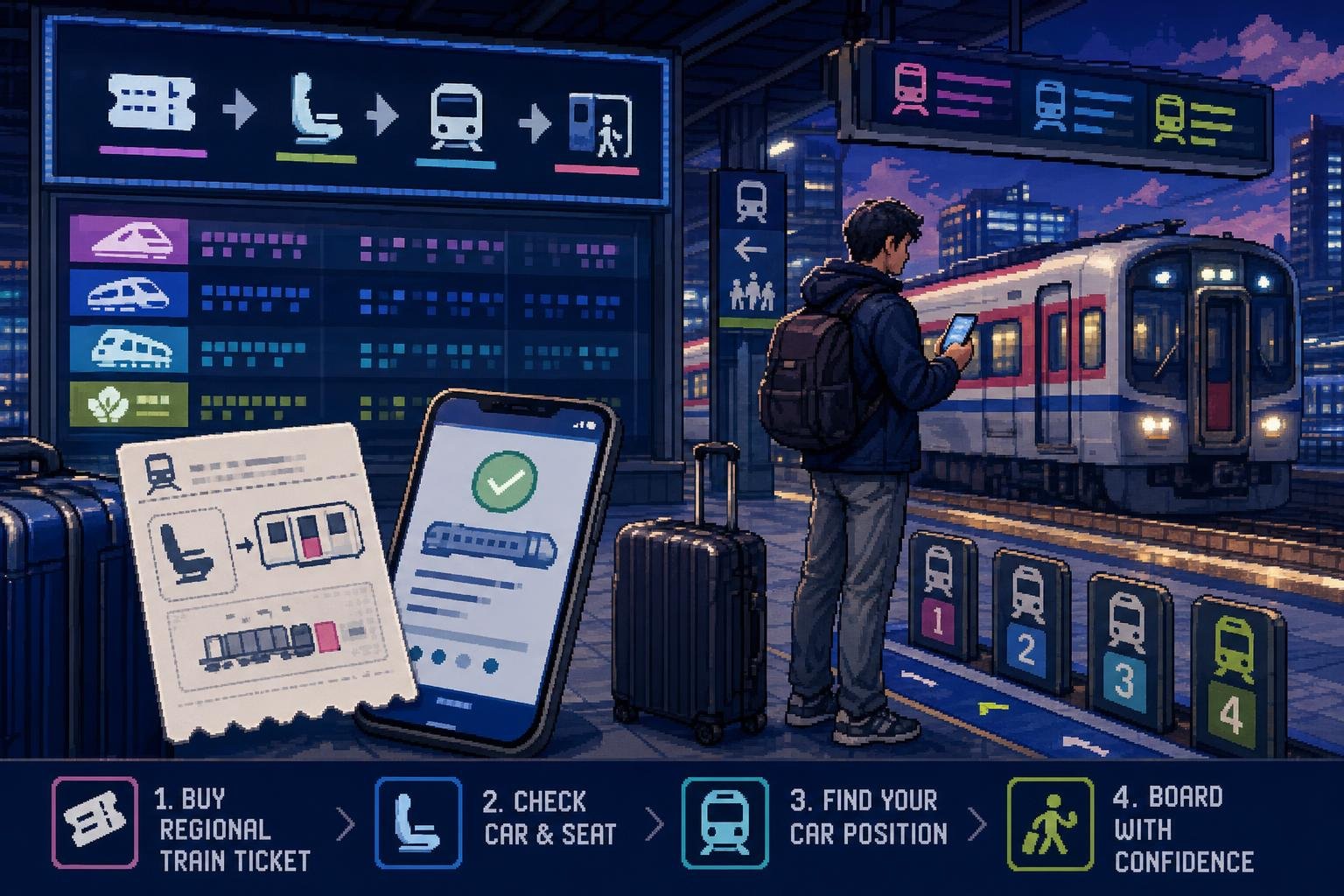
Regional trains are useful when your destination is not served conveniently by KTX, or when you want to stop at smaller cities and stations. The difficult part for many foreign visitors is not boarding the train. It is understanding the difference between Mugunghwa, ITX, and local services, knowing which station to select, and avoiding the mistake of treating a regional train like a city subway.
At a glance: which regional train should you choose?
| Train or service | What it is | Best for | How you normally pay |
|---|---|---|---|
| Mugunghwa | A conventional KORAIL train that usually makes more stops than faster services. | Smaller cities, rural stations, and lower-cost journeys when time is flexible. | Separate KORAIL train ticket. |
| ITX | A group of faster conventional services, including ITX-Cheongchun, ITX-Saemaeul, and ITX-Maum. | Regional journeys where you want a shorter trip than Mugunghwa but do not need KTX. | Separate KORAIL train ticket. |
| Other regular services | Services such as Nuriro or Saemaeul may appear in KORAIL search results depending on the route. | Routes with limited train choices or specific regional connections. | Separate KORAIL train ticket. |
| Metropolitan or local commuter trains | Urban and suburban rail services that operate as part of a metropolitan transport network. | Shorter journeys around Seoul and other large urban areas. | Usually a transit fare or transportation card system, not a long-distance KORAIL reservation. |
“Local train” is not always a precise official train name in English. In travel conversations, it can mean a slower regional train, a small-station service, or a metropolitan commuter train. Always check the actual service name in the KORAIL search result rather than relying on the word “local.” KORAIL and the Korea Tourism Organization list Mugunghwa and several ITX services among Korea’s conventional or regular trains.
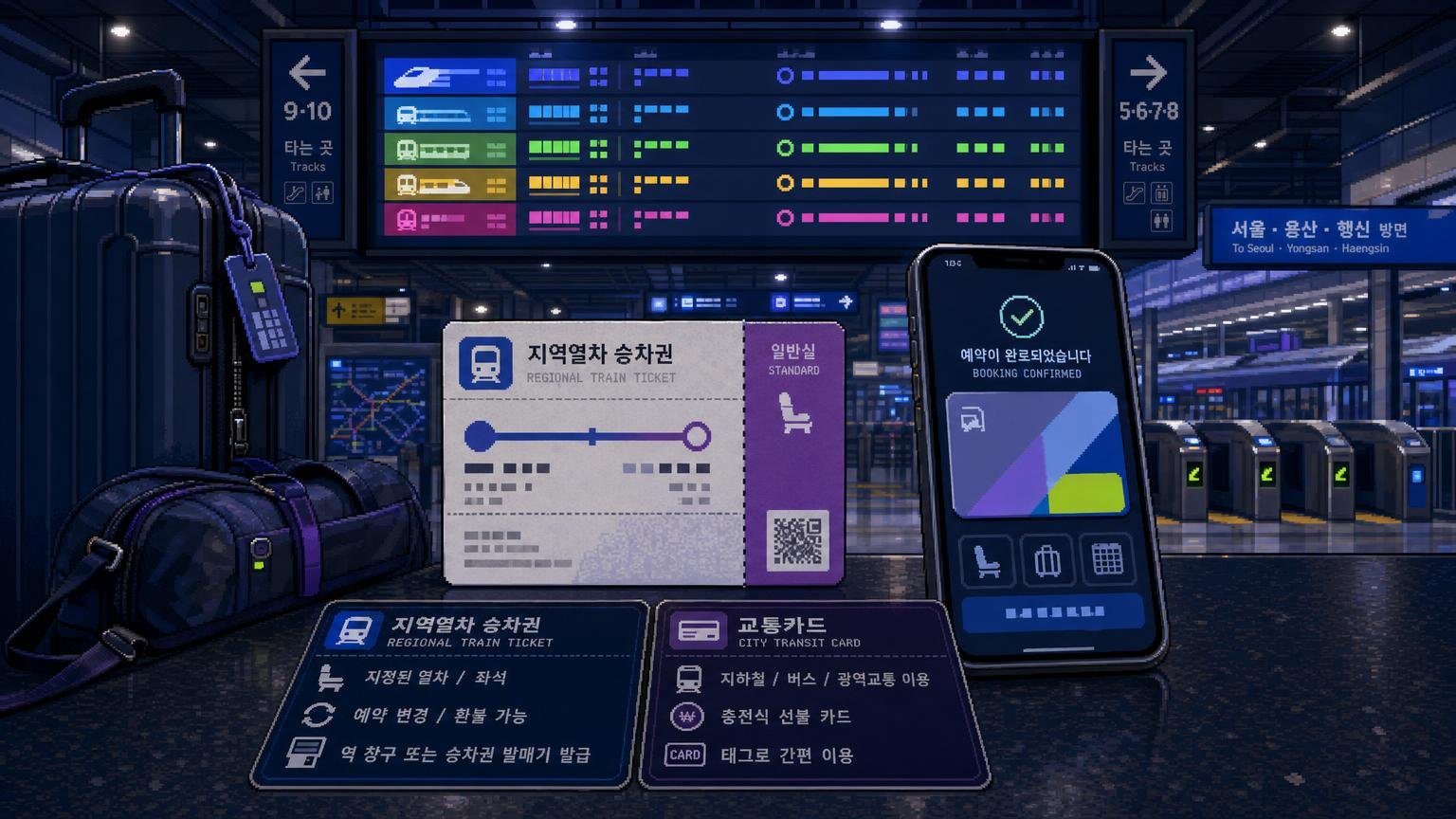
How to book a regional train online
1. Find the correct station names
Enter the station serving the place you actually want to visit. Korean cities may have more than one railway station, and the main station is not always the same as the KTX station. For example, a city may have a central station and a separate station on another railway line.
Use the English spelling shown by KORAIL. If you are unsure, compare the station name with your accommodation or destination map before paying.
2. Search the date and passenger count
On the English KORAIL booking page, select the departure station, arrival station, date, time, and number of passengers. Search results may show several train types on the same route.
KORAIL states that ordinary tickets can generally be purchased from one month before departure. The English KORAIL information page currently states that online purchases are available until 20 minutes before departure, while station sales have different cut-off times. Do not wait until the last minute if you need a particular departure or seat.
3. Compare the train type and arrival time
Do not choose only by the earliest departure. Check the train name, departure time, arrival time, number of stops, and whether the destination station is convenient for your plans.
- Choose Mugunghwa when the route includes a smaller station or when saving money matters more than speed.
- Choose ITX when it is available and gives you a useful balance between travel time and price.
- Choose another regular service when it is the only practical train or has a better timetable for your itinerary.
4. Select a seat when the system offers seat selection
Many intercity and regional KORAIL tickets are issued with a designated seat. Check the carriage and seat number carefully. Some trains may have seats facing different directions, so review the seat map if the website provides one.
Save the completed ticket on your phone and keep access to the booking email or confirmation details. A screenshot can be useful as a backup, but keep the original ticket information available if the booking page requires it.
5. Pay with a suitable method
KORAIL provides an English-language booking service for foreign visitors, and KORAIL has stated that its foreign-language reservation site supports overseas-issued credit cards. If payment fails, try a different card, confirm that overseas online payments are enabled, or buy the ticket at a station counter.
A Korean phone number is not something you should assume is required for every foreigner booking route. The available verification and payment steps can differ between the English website, the Korean app, station machines, and ticket counters. The English website is usually the simplest starting point for a short-term visitor.
What to do at the station
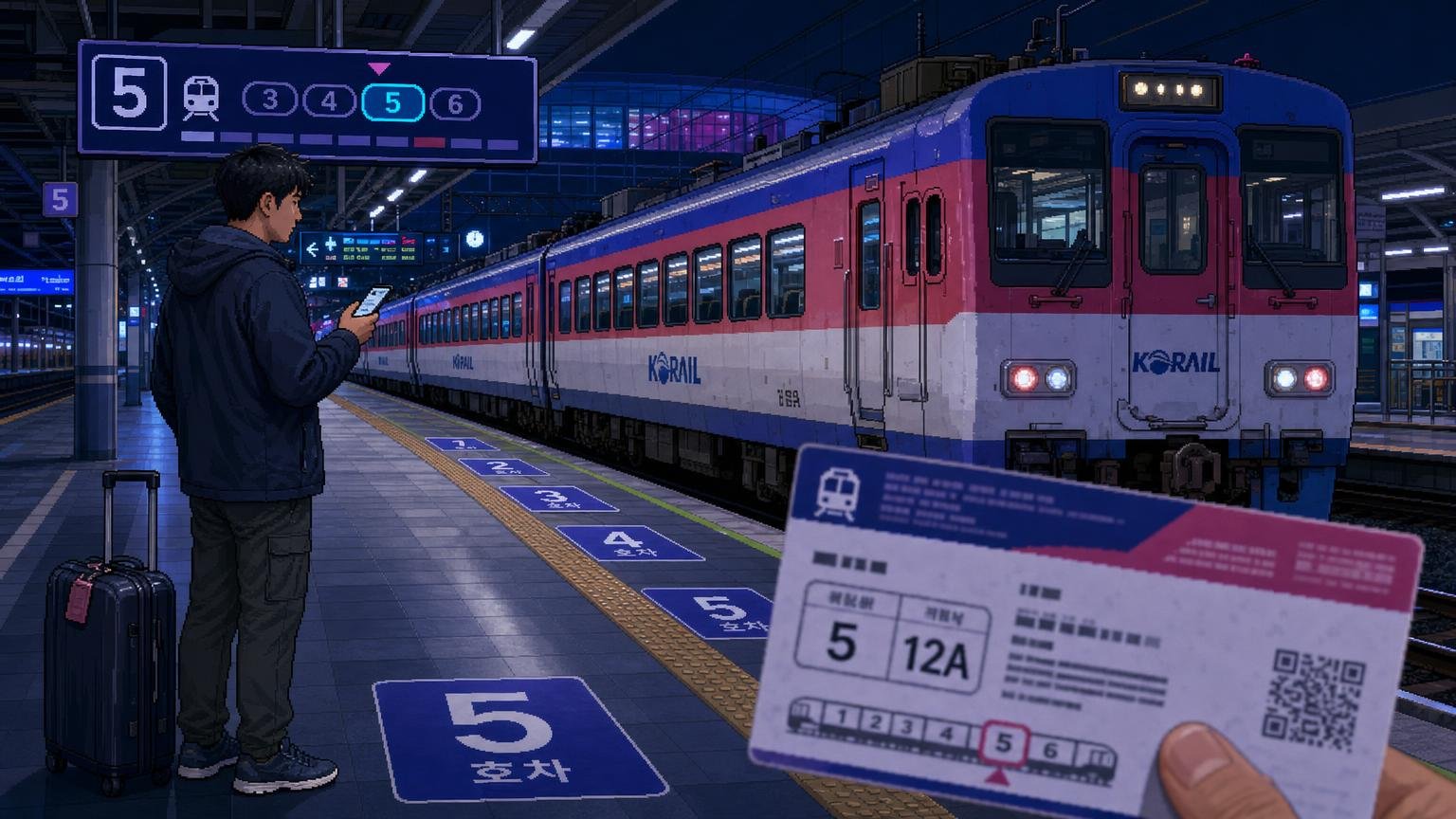
Arrive early enough to find the correct platform, especially at large stations such as Seoul, Yongsan, Cheongnyangni, Daejeon, or Busan. Your ticket normally shows the departure station, train number, departure time, carriage, and seat. Station departure boards may display Korean and English, but the train number is often the safest detail to match.
- Enter the railway station area, not automatically the subway area.
- Check the departure board for your train number and destination.
- Confirm the platform number and the train’s departure time.
- Stand near the carriage position if the platform shows one.
- Board the carriage printed on your ticket and find the matching seat.
Unlike a subway journey, you normally do not tap a transportation card at a regional train gate. Some stations have open platforms or ticket checks rather than a subway-style barrier. Keep your ticket ready for inspection on board.
Can you buy a ticket at the station?
Yes. KORAIL tickets can be purchased through the website, the KORAIL app, ticket vending machines, station ticket offices, and certain ticketing partners. At a staffed counter, show the destination and date on your phone if you do not know the Korean spelling.
For a simple request, you can write down:
- Departure station
- Arrival station
- Date and approximate departure time
- Number of passengers
- Preferred train type, if you have one
For example, you can show “Daejeon to Jeonju, October 20, two adults, around 9:00” on your phone. Station staff may offer a different train if your preferred service is sold out.
How regional trains differ from subway and bus services
Regional KORAIL trains require a journey-specific ticket
Mugunghwa and ITX trains are not normally used by simply tapping a T-money card at the platform. Buy a ticket for the specific journey, train, and seat. This is the most important difference for visitors who are familiar with Seoul’s subway system.
Not every train leaving a major station is a KTX
A large station may serve KTX, ITX, Mugunghwa, metropolitan trains, and other services. Check the train type before following signs to the platform. A ticket for one service does not automatically allow you to board another train departing on a similar route.
“Local” does not always mean unreserved
A slower regional train can still use assigned seats. Do not sit in a seat simply because it appears empty. Match the carriage and seat number on your ticket, or ask the conductor if you are uncertain.
Which option suits your trip?
- You are visiting a small town: Search Mugunghwa and other regular services first because faster trains may skip the station.
- You are traveling between well-connected regional cities: Compare ITX, Mugunghwa, and KTX if available. The fastest train may not leave from the station closest to your accommodation.
- You are traveling on a weekend or Korean public holiday: Book earlier and keep a backup departure in mind. Popular trains can sell out even when slower alternatives remain.
- You are making several long-distance train trips: Compare ordinary tickets with the KORAIL Pass for foreign visitors. The pass covers eligible KORAIL passenger trains but does not cover SRT, metropolitan subway trains, or every special tourist service.
- You only need a short suburban ride: Check whether the route is actually a metropolitan rail service. A transportation card or local transit ticket may be more appropriate than a reserved regional train ticket.
Common mistakes and quick fixes
The station name looks wrong
Some destinations have several stations, and English transliterations can vary. Compare the station on your ticket with the Korean name shown in a map app or accommodation information. If the city has a separate KTX station, make sure you are not booking the wrong one.
Your overseas card is declined
Try the English KORAIL website rather than relying on a Korean-only app flow. If the card still fails, check your bank’s overseas payment setting, try another card, or use a staffed station counter. Do not assume that a failed online payment means the train is sold out.
You are at the wrong part of the station
Large stations combine railways, subways, shopping areas, and several entrances. Follow signs for the railway departure area and check the train number on the board. Allow extra time if you are transferring from a subway line.
Your preferred train is sold out
Search a different departure time, a different train type, or a nearby station. A Mugunghwa service may still have availability when an ITX or KTX departure is full. KORAIL also provides reservation-waiting functions for some sold-out services, but availability and conditions should be checked in the live booking system.
You boarded without a ticket
Do not board first and try to explain later. KORAIL’s passenger information warns that boarding without a ticket can result in an additional fare. If you are already at the platform and the online purchase is not working, go to the ticket office or ask railway staff before boarding.
FAQ
Can foreigners use Mugunghwa and ITX trains?
Yes. Foreign visitors can buy eligible KORAIL train tickets through the English booking service, at stations, and through other available sales channels. You do not need to be a Korean resident to take an ordinary regional train.
Can I use a T-money card on a Mugunghwa train?
Do not rely on T-money for a Mugunghwa or reserved ITX journey. Buy a separate KORAIL ticket for the train and route. T-money is mainly associated with local public transportation and does not replace an intercity train reservation.
Do I need a Korean phone number?
Not necessarily for every booking method. The English KORAIL website is designed for foreign visitors, but verification and payment steps can differ between the website, app, kiosk, and station counter. If one method asks for a Korean verification process, try the English website or purchase at a staffed station.
Are Mugunghwa trains always cheaper than ITX?
Not always in a way that can be summarized with one nationwide price rule. The fare depends on the route and service. Compare the live results for your exact stations and date instead of assuming that every slower train has the same pricing structure.
Can I buy a ticket on the day?
Often yes if seats are available, but popular departures, weekends, and holidays can sell out. KORAIL’s current information lists advance sales beginning one month before departure and different purchase cut-offs for the website, machines, and stations. Booking earlier is safer when your arrival or tour schedule is fixed.
Does the KORAIL Pass cover regional trains?
The KORAIL Pass is intended for foreign visitors and can cover eligible KORAIL passenger trains, including regular services listed by KORAIL. It does not cover SRT, metropolitan subway trains, and certain special tourist services. Compare the pass cost with your actual planned journeys before buying.