
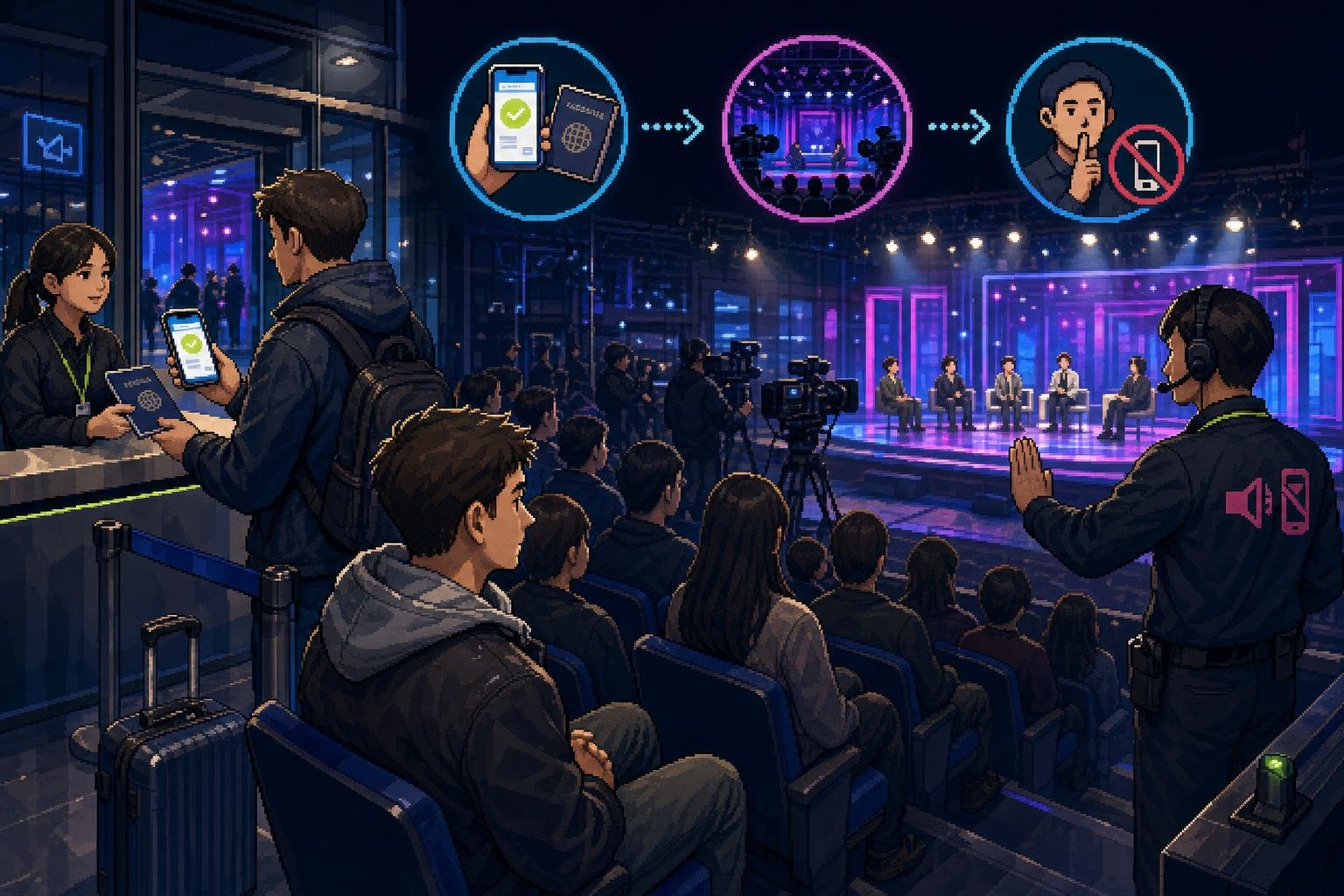
Watching a Korean music show or entertainment program in a studio is different from buying a concert ticket. Many recordings use limited audience places, fan-club allocations, random selection, or program-specific applications. Some tapings are live broadcasts, while others are recorded in several sessions and may involve long waits.
The practical challenge for an international visitor is not only finding a show. You need to confirm that the application route is open to you, understand the Korean instructions, plan for an early arrival, and follow studio rules that may be stricter than those at a normal performance.
At a glance
| Question | What to expect |
|---|---|
| Can foreigners apply? | Sometimes. Eligibility is decided by each program, broadcaster, fan club, or event notice. |
| Where do you apply? | Usually the official program page, broadcaster platform, fan-club notice, or a form linked by the official account. |
| Is a Korean phone number needed? | It may be needed for a broadcaster account, SMS notification, or identity verification. Do not assume an overseas number will work. |
| Is admission guaranteed after applying? | No. Many programs select only a limited number of viewers or confirm attendance individually. |
| What should you bring? | Passport or accepted identification, confirmation message, application details, and any required membership or ticket information. |
| Can you film inside? | Assume filming and photography are restricted unless staff clearly says otherwise. |
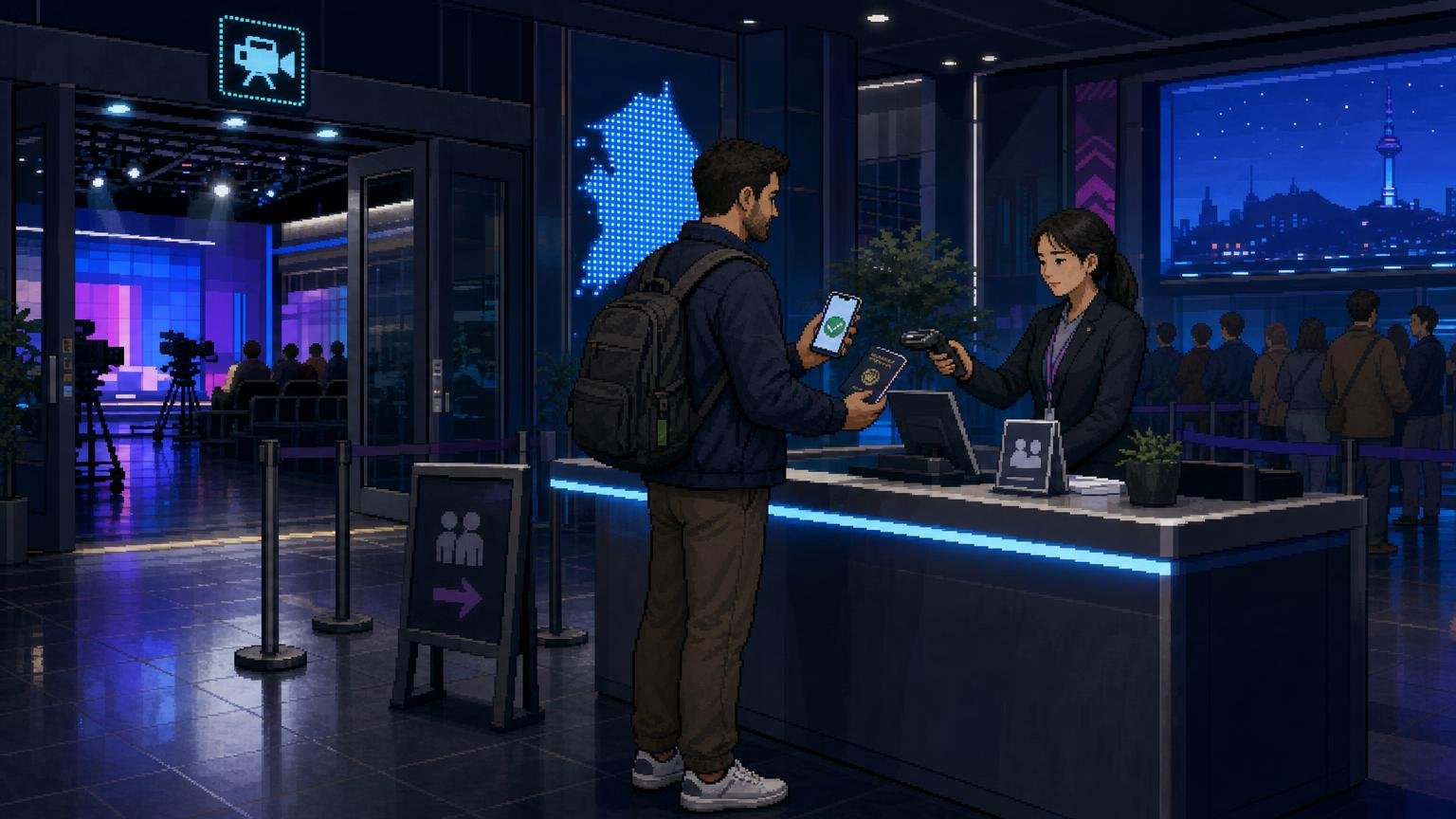
1. Choose the right kind of TV taping
Start by identifying the exact program and the type of audience event. Search for Korean terms such as 방청 신청 (audience application), 공개방송 (public broadcast), or 녹화 (recording) on the program’s official page.
Music shows
Weekly music programs often have the most complicated access rules. Audience places may be connected to an artist’s official fan club, a broadcaster membership, a first-come application, or a random draw. A music-show notice may also specify a particular entrance, an age limit, a maximum number of guests, or a requirement to bring an album, fan-club item, or identification.
Entertainment and talk shows
Variety and talk programs may recruit a small audience through a written application. The form can ask why you want to attend, your available dates, your phone number, and the names of accompanying guests. The recording may last longer than the broadcast episode, and the final studio location may be outside central Seoul.
Special broadcasts and public recordings
Election programs, seasonal shows, award events, and special broadcasts may use a separate lottery or ticketing provider. For example, an official MBC audience notice for a lottery broadcast explains that places are limited, selection is by draw, early closure is possible, and identification is required. Treat this as an example of a program-specific process, not a universal MBC rule.
Before you apply
- Write down the exact program title in Korean and English.
- Find the broadcaster’s current program page or official account.
- Look for the newest notice containing a date, application period, and audience instructions.
- Check whether the notice mentions foreign applicants, passport use, Korean phone verification, age limits, or fan-club membership.
- Save a screenshot or PDF of the final confirmation once you are selected.
2. Apply through an official route
Use the application link attached to the broadcaster or program itself. Avoid social-media posts that do not link back to an official broadcaster page, especially when they request payment, passport scans, or a deposit.
Route A: The official program page
Some programs have a dedicated 방청 신청 page. The form may require a broadcaster login and may ask for the applicant’s name, date of birth, mobile number, preferred date, and a short reason for attending.
Route B: A broadcaster app or membership platform
A broadcaster may move applications into its own app or member area. Registration and notification rules can differ from the public website. If the service asks for a Korean mobile number or a domestic identity-verification method, an overseas visitor may not be able to complete the process independently.
Route C: An official fan-club notice
For music shows, the audience allocation may be managed through an artist’s official fan club rather than the general program page. Read the notice carefully. A fan-club application can require membership, an artist-specific registration number, a local address, or proof of album purchase.
Route D: A broadcaster-linked form
Some public recordings use an online form linked from the official program notice. The form may be hosted by another service, but it should be clearly connected from the broadcaster’s verified page. An official MBC notice, for example, directs applicants to a form and states that selected viewers are chosen by lottery.
3. Check whether the application works for a foreign visitor
Do not interpret the absence of a Korean-language restriction as proof that every foreigner can apply. Look for practical access conditions instead.
- Name format: Check whether the form accepts Roman letters or requires a Korean name format.
- Phone number: Confirm whether the service accepts an overseas number, a Korean SIM number, or only the number registered to the broadcaster account.
- Notification method: Some programs send the result by SMS or contact the number saved in the member profile. An overseas number may not receive Korean SMS messages.
- Identity check: Ask whether a passport is accepted when the notice says 주민등록증, 운전면허증, or another Korean identification document.
- Companion details: If you are attending with someone, check whether both names must be submitted in advance. A different name at the entrance can lead to refusal.
- Age requirement: Age limits are common and can apply even when a parent or guardian is present.
If the notice is unclear, contact the program through its official inquiry board or customer-service channel before submitting sensitive documents. The Korea Tourism Organization’s 1330 Korea Travel Hotline can also provide multilingual general travel assistance, but it cannot guarantee admission to a broadcaster’s private audience event.
4. What to prepare after you are selected
Save the complete confirmation, not only the first message saying that you applied. The final notice may contain the meeting time, entrance gate, studio address, queue instructions, permitted items, and a deadline for cancellation.
- Bring the original passport or other identification explicitly accepted by the notice.
- Use the same spelling of your name as shown in the application and confirmation.
- Keep the confirmation message available offline in case mobile reception is poor.
- Write down the Korean name of the building and the exact entrance, not only the program title.
- Check whether your companion must carry separate identification.
- Do not assume a digital image of your passport is enough.
- Do not give your confirmation to another person unless the official notice expressly permits a name change.
Audience admission is often personal. An official SBS audience notice for a public recording states that the confirmation message must be shown, identification is required for both the applicant and companion, and tickets cannot be transferred or sold. Similar restrictions are common, but the wording for each program may differ.

5. Plan your arrival like a studio call time, not a concert door time
The time in the notice may be a meeting or registration time rather than the start of the broadcast. Staff may check names, arrange the queue, distribute seats, collect prohibited items, and move the audience into the studio as a group.
Arrival checklist
- Check the venue the day before. Confirm the building, district, nearest station, entrance name, and whether the studio is in Seoul or Gyeonggi Province.
- Allow extra time for the final walk. Broadcasting centers can be large, and the audience entrance may be different from the main lobby.
- Arrive before the stated meeting time. Late viewers may not be admitted even if they have a valid confirmation.
- Look for the program name or audience staff. Do not enter restricted production areas or follow a fan queue unless staff confirms it is the correct line.
- Keep your passport and confirmation ready. Avoid searching through a large bag at the front of the queue.
- Expect waiting. Bring water and a small snack for before entry, but check whether food and drinks are allowed inside the studio.
For a concrete example, an official MBC Show! Music Core audience page directs viewers to a specific entrance at MBC Dream Center, warns that late entry may be restricted, and gives a route from Jeongbalsan Station. That page also displays an old dated application example, which is why travelers should use the newest notice rather than copy an old schedule.
6. Studio etiquette for foreign visitors
Audience members are part of the production environment. The studio may be smaller, brighter, louder, and more tightly controlled than television makes it appear.
Follow staff instructions immediately
Staff may ask the audience to stand, sit, move sections, repeat a reaction, remain quiet, or leave temporarily while cameras are repositioned. Follow the instruction even if you do not understand every Korean word. If necessary, show the confirmation and politely ask, 영어로 안내 가능할까요? (“Is it possible to give the instructions in English?”).
Do not record unless permission is explicit
Phones and cameras may be prohibited because of spoilers, copyright, artist privacy, or production security. Keep your phone silent and put it away when instructed. Do not livestream, use a selfie stick, or record rehearsals from the queue.
React naturally and avoid disrupting the recording
Clap and cheer when the staff or program asks you to, but do not shout individual messages during spoken segments. Avoid standing in front of another viewer, waving large banners, or trying to attract an artist’s attention.
Respect restricted areas
A studio is a workplace. Do not approach artists, presenters, staff, security personnel, dressing rooms, loading areas, or nearby private buildings. Do not wait outside a studio entrance to request photographs or autographs unless the venue has created an official public area for that purpose.
Be prepared for long or repeated recording
A televised performance may be recorded more than once. A talk-show segment may pause for camera changes. A live broadcast can also have quiet periods that feel very different from the finished episode. Leave only when staff says it is permitted.
Common mistakes and troubleshooting
“I found a ticket seller online.”
Do not pay for an audience place unless the official broadcaster or authorized ticket provider clearly sells it. Many recordings use named applications, random selection, or non-transferable confirmations. A seller may leave you without admission and expose you to identity or payment fraud.
“The form rejected my phone number.”
First check whether the number must match a broadcaster membership account. If the service requires Korean phone verification, look for a separate foreigner-access route in the official notice. If none exists, choose another program rather than using a stranger’s number.
“My passport name does not match the application.”
Contact the program before the recording date. Do not edit or alter an identification document, and do not assume staff can correct the application at the entrance.
“The program page has old instructions.”
Broadcasters may leave an archive page online after a recording ends. Check the post date, application period, and recording date. An old page can demonstrate how that program has worked before, but it is not proof of the current procedure.
“I arrived at the broadcaster building but cannot find the audience entrance.”
Ask security or reception politely using the Korean program title and the word 방청. Show the confirmation on your phone. Do not enter staff-only doors or cross barriers without permission.
“I cannot attend after being selected.”
Use the official cancellation or inquiry route. Some programs warn that cancellation or no-shows can affect future applications. Never transfer the confirmation informally.
Which approach suits your trip?
- You speak little Korean: Choose a program with a clear English-facing contact route or attend with someone who can read the Korean notice. Prepare key Korean words for application, entrance, passport, and audience.
- You have only one free day: Avoid arranging your itinerary around an application that has not yet been confirmed. Keep a flexible backup plan because selection is not guaranteed.
- You do not have a Korean phone number: Check the notification and verification method before creating an account. A public form may be easier than a membership-only application, but this depends on the program.
- You want a music-show experience: Check fan-club requirements first. General tourist access may be more limited than access through an artist’s official audience allocation.
- You are travelling with children: Confirm the minimum age and companion rules before applying. Do not rely on a guardian exception unless the notice states one.
- You are sensitive to noise or long waits: Ask about the expected recording format if possible, and bring hearing protection that does not interfere with staff instructions.
FAQ
Can a foreign tourist attend a Korean TV show taping?
Yes, sometimes. Admission is controlled by the individual program, and some applications are open to general viewers while others are limited to fan clubs, members, or selected invitees.
Do I need a Korean phone number?
Not always, but it is a common obstacle. Some sites use Korean mobile verification or send the result by SMS. Check the exact application system before planning your visit.
Can I use my passport for entry?
Only if the current notice accepts it. Bring the original passport and confirm whether the name must exactly match the application.
Are Korean TV tapings free?
Many audience applications do not charge an admission fee, but this is not universal. Some special events use separate ticketing, and some programs may have different conditions. Do not assume that a free application guarantees a place.
Can I take photos inside the studio?
Assume no unless staff gives clear permission. Recording, photography, and livestreaming may be restricted during queues, rehearsals, and broadcasts.
How early should I arrive?
Follow the meeting time in the official notice rather than the broadcast start time. Arriving early is especially important when the notice says late entry may be restricted.
Can I buy a ticket from another fan?
Do not do this unless the official organizer explicitly allows transfers. Named confirmations and identity checks are common, and unofficial resale can result in refusal at the entrance.
Official Information
- SBS Inkigayo: Audience application information
- MBC Show! Music Core: Audience ticket page
- MBC Lottery 720+: Official audience application example
- SBS audience application example: Application and contact rules
- VISITKOREA: 1330 Korea Travel Hotline information
These pages demonstrate broadcaster-specific audience procedures and support services. Always follow the newest notice for the exact program and recording date.