
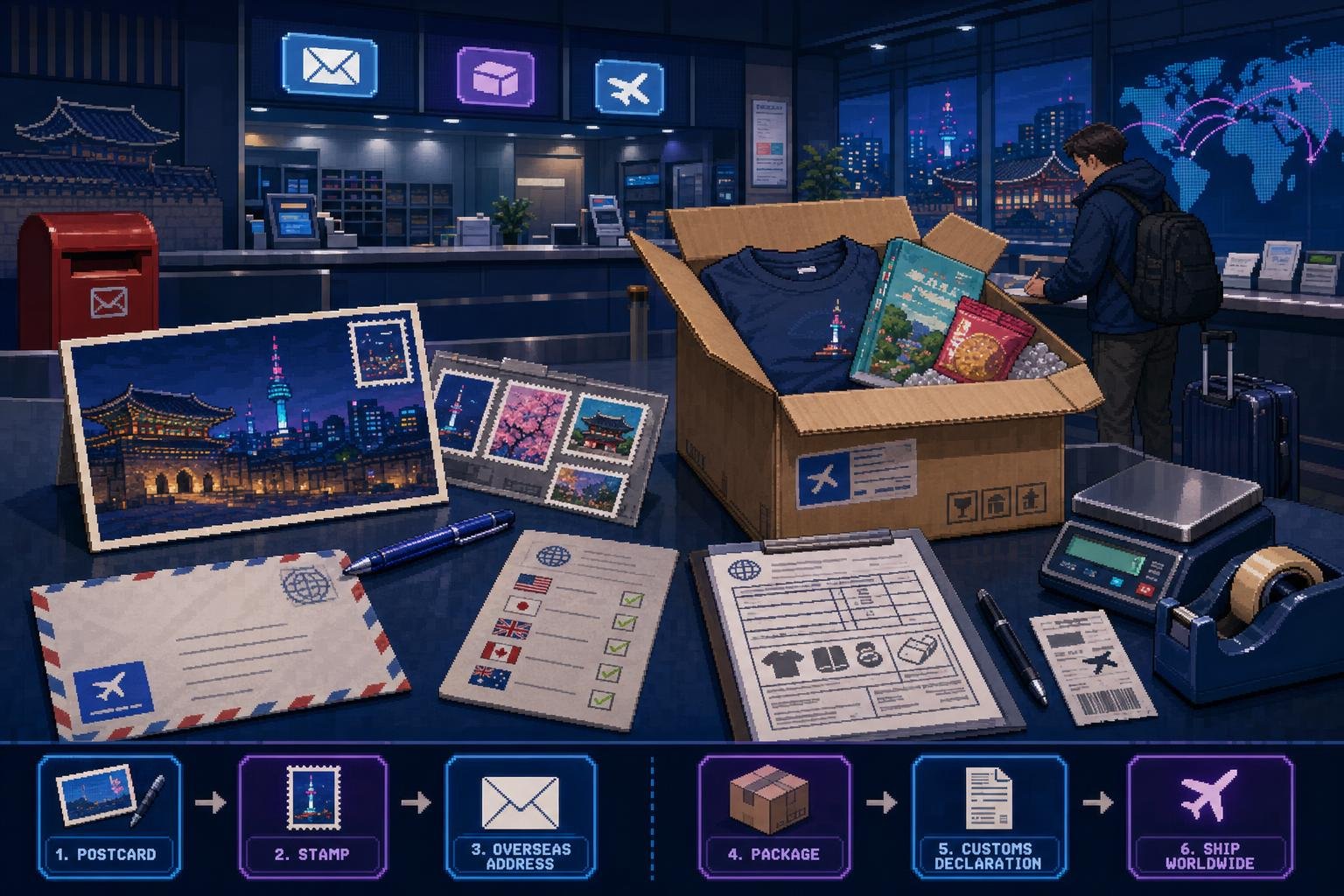
Sending a postcard from Korea is usually simple. Shipping a package is a different process because the item may need customs information, security screening, destination-specific paperwork, and a service that is actually available for the country you are sending to.
The easiest plan is to visit a Korea Post office rather than trying to solve everything at a mailbox. This is especially useful if you are sending souvenirs, clothing, snacks, books, cosmetics, or several different items.
At a glance: postcard or package?
| Your item | Best starting point | What you need | Main warning |
|---|---|---|---|
| One postcard | Post office counter or mailbox | Overseas address and international postage | Do not use a domestic Korean stamp |
| Letter or flat paper item | Post office counter | Address, envelope, postage | Registered options cost more but may provide tracking |
| Small gift or souvenir package | Post office counter | Contents, quantity, value, origin, recipient details | Customs descriptions must be accurate and specific |
| Urgent or higher-value package | Post office with EMS service | Full customs information and identification/contact details if requested | Delivery time and availability vary by destination |
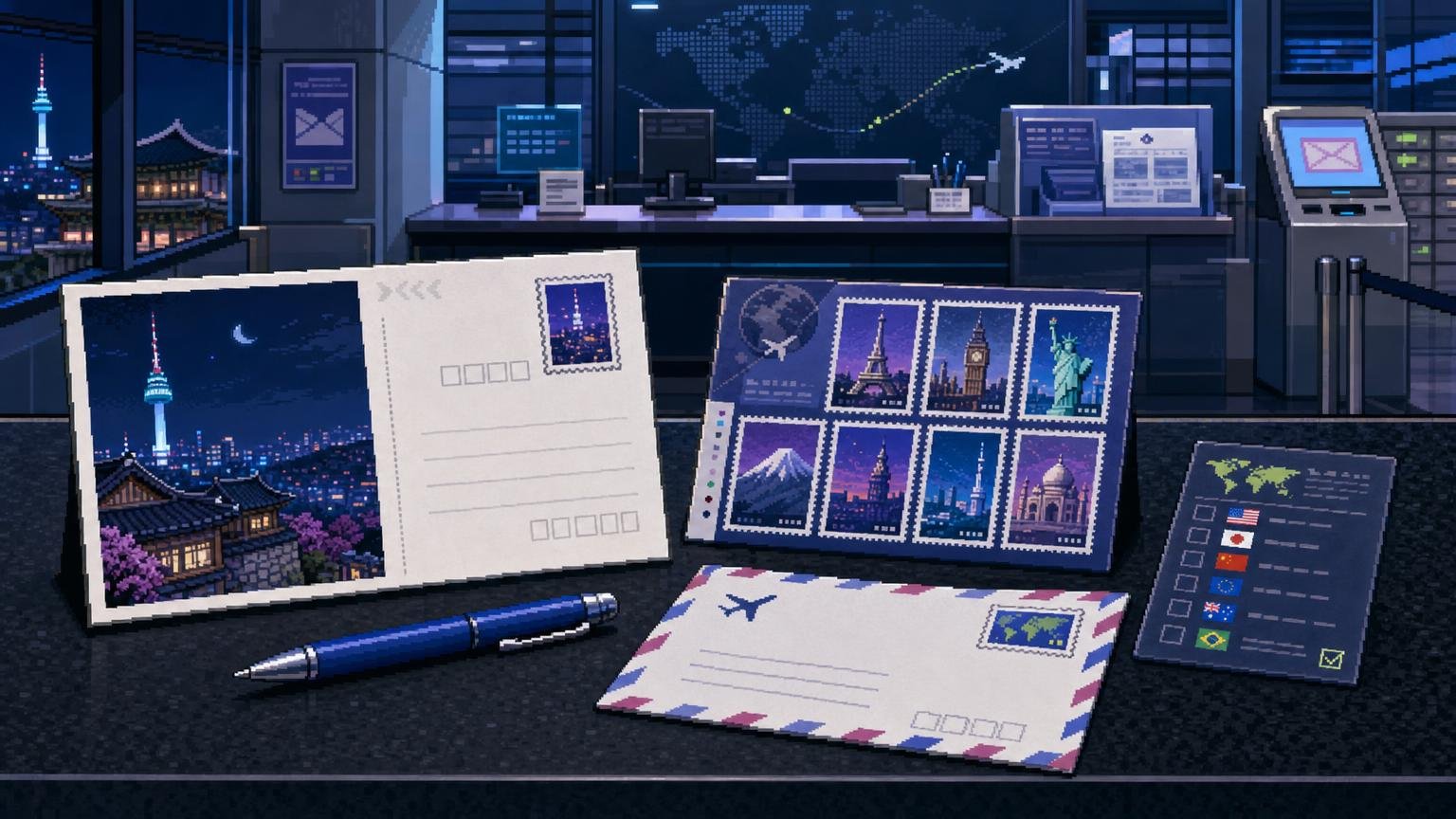
How to mail a postcard from Korea
1. Write the address clearly
Write the recipient’s name, street address, city, state or province where relevant, postal code, and country name in English or the destination country’s standard Roman-letter format. Put the destination country on the last line in capital letters, such as UNITED STATES, CANADA, or AUSTRALIA.
Write your return address if you want the postcard returned in case of a delivery problem. Your accommodation address can be used as the return address if you are still staying there, but add the hotel’s name and your checkout date when space allows.
2. Buy the correct international postage
Ask for an international postcard stamp at a post office. Korea Post’s international-mail rates vary by mail type and route, so the counter is the safest place to confirm the current amount. A postcard sent overseas needs international postage; a regular domestic Korean stamp is not enough.
Useful phrases to show staff include:
- 국제엽서 보내고 싶어요. — I want to send an international postcard.
- 이 나라로 보내고 싶어요. — I want to send this to this country.
3. Send it from a mailbox or post office
After postage is attached, you can ask whether there is a nearby international mailbox. If you are unsure whether the stamp is correct, hand the postcard to the counter instead. Korea’s public mailboxes are less common in some tourist areas than visitors expect, so a post office is often the more predictable option.
How to ship a package from Korea
1. Choose a post office that accepts international mail
Use the official Korea Post location search or ask your hotel to identify a nearby branch. Not every small postal outlet offers exactly the same international services. A larger branch is usually a better choice if you need EMS, customs assistance, packaging, or English-language support.
Visit with enough time before closing. International-mail acceptance may have a separate cutoff from ordinary postal services, and a package that needs inspection or paperwork can take longer than a postcard.
2. Prepare the package, but leave it easy to inspect
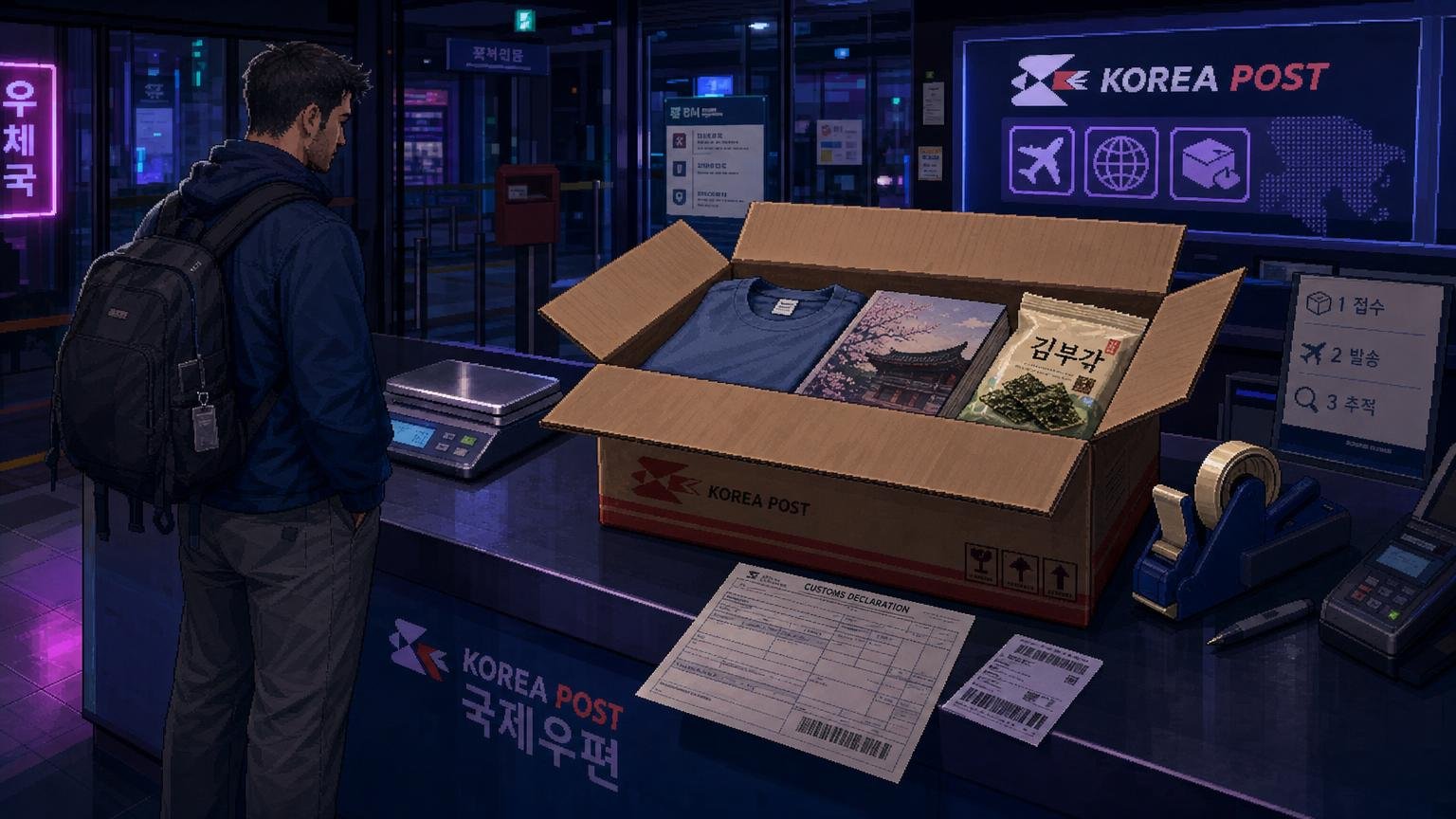
Use a sturdy box and protect fragile items. Do not completely seal the package before the counter checks the contents. Korea Post may need to inspect the item, confirm its weight and dimensions, or attach a customs form.
You can buy a box or mailing materials at many post offices, but sizes and stock vary. If you are packing in advance, keep the items accessible and bring tape or allow time to repack the parcel after inspection.
3. Bring the information needed for the customs declaration
For a package containing goods, prepare the following in English:
- Recipient’s full name
- Complete overseas address and postal code
- Recipient’s phone number or other contact detail if required by the destination
- A specific description of each item, such as “cotton T-shirt,” “printed book,” or “sealed packaged tea”
- Quantity of each item
- Approximate value and currency
- Country of origin when requested
- Whether the shipment is a gift, merchandise, sample, or document
Descriptions such as “gift,” “stuff,” or “souvenirs” are not useful enough on their own. The description and declared value should match what is actually inside.
4. Compare the available services at the counter
Korea Post’s international options can include ordinary international mail, international parcels, EMS, EMS Premium, and other services depending on the destination and item. EMS is generally the service to ask about when you need faster handling and tracking, but it is not automatically available for every country or every type of item.
Ask the staff to compare the current price, expected delivery range, tracking, insurance, and destination restrictions. The online Korea Post calculator is useful for an estimate, but the final charge is confirmed when the parcel is weighed, measured, checked, and accepted.
5. Pay, keep the receipt, and save the tracking number
Payment methods can vary by branch and service. Do not assume that every branch accepts every foreign card. Carry a physical payment card and some Korean won as a backup.
Keep the receipt until the package arrives. If the service includes tracking, photograph or save the tracking number immediately. The recipient may also need the number if local customs or delivery staff contact them.
What you should not pack without checking
International mail is screened, and the destination country may have additional import restrictions. Korea Post’s prohibited-items guidance lists many items that are forbidden, conditionally accepted, or subject to documentation.
- Rechargeable lithium batteries and devices containing them: Korea Post’s current international-mail guidance lists many lithium-battery items as prohibited, including common electronics. Do not assume that a phone, tablet, power bank, or rechargeable gadget can be mailed.
- Liquids, powders, sprays, and cosmetics: Some are restricted or require additional information. Aerosol containers and flammable products are particularly problematic.
- Food, seeds, and plant products: Acceptance can depend on the product, packaging, and destination-country quarantine rules.
- Perfume, fuel, matches, fireworks, and similar flammable items: These are commonly restricted or prohibited.
- Cash, valuable documents, jewelry, and precious metals: International postal rules restrict many valuables, and destination-country rules may apply as well.
If staff say an item needs checking, do not argue based on how another country handled it. Postal acceptance depends on the transport method, the destination, the packaging, and current aviation or customs rules.
Which service suits your situation?
Choose ordinary international mail for a simple postcard
This is the practical choice when you are sending a postcard or a small paper item and do not need a parcel-style customs process. Delivery may take longer and tracking may not be available in the same way as EMS.
Ask about a registered option when you want added proof of posting
Registration can be useful for certain letters or flat items, but the available service and tracking coverage depend on the destination. Confirm what the service actually provides before paying extra.
Choose an international parcel service for a normal souvenir box
This can suit clothing, books, nonrestricted souvenirs, and other items that are not urgent. The final price depends on destination, weight, dimensions, transport method, and any additional transportation surcharge.
Ask about EMS when delivery speed or tracking matters
EMS is designed for faster international postal handling, but estimated delivery days exclude holidays and time held by customs. Korea Post also warns that service availability and delivery conditions can vary by country, so check the destination before packing around an assumed delivery date.
Common mistakes and how to fix them
- Using only the hotel name: A hotel name without the recipient’s full address is not enough for most overseas deliveries. Ask the recipient for the complete address and postal code.
- Writing the destination country in Korean only: Use the destination country’s English or Roman-letter name on the final line.
- Sealing a package too early: Leave it open until postal staff finish the inspection and confirm the packaging.
- Writing an overly vague customs description: Replace “present” or “souvenir” with the actual item and quantity.
- Under-declaring the value: An inaccurate declaration can cause customs delays, penalties, or insurance problems.
- Mailing food without checking: A product accepted in Korea may still be restricted by the destination country’s customs or quarantine authority.
- Waiting until the day of departure: A branch may have an earlier international-mail cutoff, and customs-related services can take longer than expected.
- Assuming a foreign card will work: Bring backup payment because acceptance can differ by branch.
FAQ
Can a tourist send a postcard from Korea?
Yes. A tourist can buy international postage and send a postcard through Korea Post. For a simple postcard, you normally need the recipient’s complete overseas address and the correct international postage.
Do I need a Korean phone number?
A simple postcard does not normally involve the same customs paperwork as a parcel. For a package, postal forms can request sender and recipient contact details, so bring your own reachable phone number and the recipient’s contact information if available. Ask the branch what it accepts for the specific service.
Can I send Korean snacks overseas?
Possibly, but acceptance depends on the exact product, packaging, destination, and import rules. Sealed commercial packaging is easier to document than homemade or unmarked food, but it is not a guarantee of acceptance.
Can I mail cosmetics or skincare products?
Some products may be accepted, while aerosols, flammable products, and items with restricted ingredients can be refused. Check the product against Korea Post’s current prohibited-items guidance before taking it to the counter.
Is EMS always the fastest option?
EMS is intended for express international postal handling, but the practical delivery time depends on the destination, customs, holidays, transport conditions, and current service availability. Ask the post office to confirm the available service for your country.
Can I send a package from a convenience store?
Convenience stores may offer domestic delivery services, but that does not mean they accept international parcels or EMS. For overseas packages, use a Korea Post branch that handles international mail.
Will the recipient have to pay customs charges?
Possibly. Import duties, taxes, and customs charges are determined by the destination country and may depend on the declared contents and value. Korea Post cannot guarantee that a recipient will receive the package without additional charges.
Where can I track my package?
Use the tracking number on the Korea Post international-mail tracking page and, when available, the destination country’s postal service website. Tracking updates can pause while an item is in transit or being processed by customs.
Official Information
- Korea Post: Expected delivery days and international postage calculator
- Korea Post: Items allowed and prohibited for international mail
- Korea Post: International mail smart acceptance and customs declaration information
- Korea Post: International mail tracking and service notices
- Korea Post: Post office and postal-code search
- VISITKOREA: Postal system information for travelers