

Attending a Korean TV taping can look simple from the audience seats, but the process is closer to joining a controlled production schedule than buying a normal show ticket. You may be applying for a place, joining a first-come list, or following a fan-club notice rather than purchasing admission.
For a foreign visitor, the difficult part is usually not finding the studio. It is identifying the correct application route, understanding whether international applicants are accepted, and arriving with the right documents at the right time.
At a glance: which route should you use?
| Route | Best for | What may be required | Main risk |
|---|---|---|---|
| Broadcaster audience page | Public music, variety, and talk-show recordings | Broadcaster account, application form, contact details, ID | The page may be Korean-only or limited to members |
| Official artist or fan-club notice | A specific idol’s pre-recording or live broadcast | Fan-club membership, album purchase, app registration, age requirement, physical ID | Strict conditions and very early roll call |
| Foreigner-oriented booking listing | Visitors who cannot complete a Korean fan process | Passport details, payment, tour or booking conditions | Availability is occasional, and it may not cover your chosen artist |
| Unofficial resale or social-media offer | Not recommended | Varies | Identity mismatch, cancellation, fraud, or refusal at the venue |
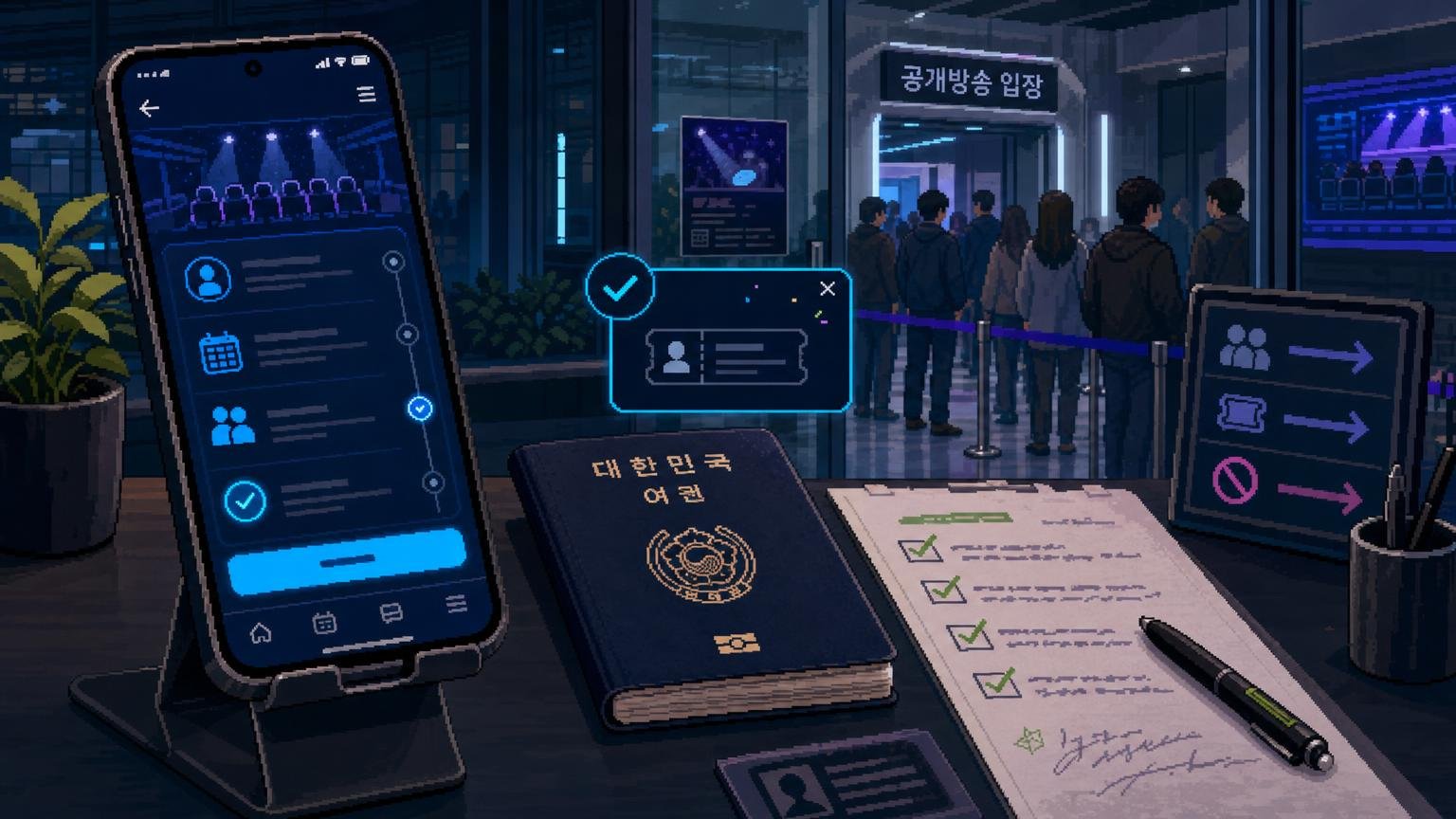
Where to find legitimate audience places
1. Check the broadcaster first
Search the official website of the broadcaster showing the program. Look for Korean terms such as 방청신청 (audience application), 공개방송 (public broadcast), or 방청권 (audience pass).
KBS operates an official audience-ticket service covering programs such as Music Bank and other public recordings. Its current guidance says that applications are made by logged-in KBS members, and that successful applicants can check or print their audience and seat information through the site. KBS also states that applicants should bring identification for on-site verification and that audience passes cannot be sold or transferred.
This does not mean that every KBS program is automatically easy for a short-term visitor to book. Check whether the registration form accepts your contact details and whether the individual program notice gives additional nationality, age, or identification conditions.
2. Check the artist’s official fan notice
For idol music shows, the broadcaster’s general audience page may not be the main route. A group’s agency or official fan community may announce a pre-recording separately. The notice can limit participation to official fan-club members or require several items, such as proof of an album purchase, an artist light stick, an app-based application, or a minimum age.
These notices often contain the real arrival instructions: the meeting location, roll-call time, order number, permitted belongings, and whether the audience is watching a pre-recording, a live broadcast, or both. Read the notice for the exact recording date rather than relying on an older fan guide.
Official Weverse event notices show the level of detail that may be required for international participants. For one recent event, non-Korean participants were instructed to use a passport or residence card for identity verification, while screenshots and photocopies were not accepted. That was an event-specific rule, so treat it as an example of the process—not a universal rule for every TV show.
3. Look for a clearly identified foreigner route
Occasionally, a tourism company or booking platform lists an audience experience for international visitors. Use this route only when the listing identifies the actual program, date, meeting point, inclusions, cancellation conditions, and identity requirements. A paid package may simplify registration, but it does not give you the right to enter a different recording or bypass the broadcaster’s rules.
Be especially careful with listings that say “K-pop show” without naming the broadcaster or recording date. A studio tour, dance class, concert, and TV taping are different products.
How to apply without making a costly mistake
Step 1: Choose the exact program and recording type
Confirm whether you want a live broadcast, a pre-recording, or a public studio audience. The same program may use different application systems for each. A pre-recording can happen very early in the morning and may not include the full televised episode.
Step 2: Open the current official notice
Do not rely on a fan-made schedule image or a search-result snippet. Open the broadcaster, agency, or official fan-community notice for your intended date. Check the application window, age limit, nationality conditions, and whether the application is first-come or lottery-based.
Step 3: Check account and phone requirements before applying
Some broadcaster systems require membership login. Other applications may use a Korean mobile number, an app account, or a verified fan-club profile. Do not assume that a foreign email address or overseas phone number will work. If the form cannot accept your details, look for an official international application route rather than entering false information.
Step 4: Enter every participant’s information exactly
If the application includes a companion, use the companion’s real name and date of birth exactly as shown on the required ID. Do not apply under one person’s name and expect another person to use the place. Name matching is often part of the entrance check.
Step 5: Save the result in more than one format
Keep the official confirmation, application number, QR code, or message available offline. Also save a screenshot in case mobile reception is weak. A screenshot is useful for showing the result, but it does not replace a physical ID when the notice requires one.
Step 6: Recheck the notice shortly before the recording
Confirm the meeting point, roll-call time, permitted items, age rule, and cancellation instructions again. Recording times and meeting locations can change, and production schedules can run late.
What to bring on the day
- The physical ID named in the notice: for a short-term international visitor, this is commonly the original passport. Do not assume a photo, scan, photocopy, or student card will be accepted.
- Your confirmation: bring the official message, application result, QR code, or printed confirmation if the instructions request it.
- Your phone with sufficient battery: fan-club applications and staff announcements may use a mobile app or notification.
- Only permitted fan items: some recordings restrict banners, cameras, food, large bags, or unofficial merchandise.
- Time flexibility: a taping may take longer than the advertised broadcast length, and staff may delay entry while the production is prepared.
KBS’s official audience guide says that audience members may not leave during recording and that on-site circumstances can delay the finish. Plan your evening conservatively rather than booking a tight restaurant reservation or last departure immediately afterward.

Arrival rules: treat roll call as a deadline
Many music-show applications do not work like reserved theater seating. You may first report to a meeting point, confirm your identity, receive an order number or seat information, and then wait for group entry. The location may be outside a broadcasting center, in a lobby, or at a separate meeting point announced by the fan club.
Arrive early enough to find the building and read the signs, but follow the notice rather than creating your own queue. If the notice says that the precise location will be sent by push notification, keep notifications enabled. If you miss roll call, staff may give your place to a waitlisted person or refuse entry.
Do not enter a studio area simply because you can see other fans nearby. Broadcasting buildings may contain several programs and controlled staff-only zones. Wait for the designated staff member or fan-club representative to direct your group.
Audience etiquette inside the studio
Follow staff instructions immediately
Audience members help create the sound and atmosphere of a program, but the production team controls when you may sit, stand, cheer, clap, move, or leave. Follow Korean or English instructions from staff even if the television broadcast makes the process look spontaneous.
Do not film or record unless expressly allowed
Assume that personal filming, photography, audio recording, and live posting are prohibited unless the current notice clearly permits them. Cameras, phones, and bags may be checked or restricted. Never use a flash or hold a device above other audience members.
Cheer without blocking the view
Use only the permitted slogan, light stick, or banner size. Keep signs below face level when the artist is performing, and do not push forward to improve your view. A television camera may be moving through the audience, so remain in your assigned area.
Respect the recording process
A TV taping may repeat the same entrance, reaction, or song several times. Avoid talking during takes, shouting unrelated names, or reacting before the cue. If a staff member asks for a specific response, repeat it consistently so the audio and picture can be edited properly.
Protect artists and other audience members
Do not follow artists, wait at staff entrances, touch performers, or attempt to pass gifts directly. Do not share another audience member’s face, name, seat, or personal information online without permission.
Which route suits your situation?
- You are visiting Seoul for only a few days: choose a clearly confirmed foreigner-oriented listing if one exists for your dates. A broadcaster or fan-club application may close before your trip or require an account you cannot create.
- You already belong to an official fan club: monitor the agency or fan-community notice first. This is often the relevant route for a specific artist’s pre-recording, but the conditions may be strict.
- You want any TV taping, not one particular idol: check official broadcaster audience pages for open applications. This gives you more flexibility than waiting for one artist’s notice.
- You do not have a Korean phone number: do not assume you are excluded from every program, but expect some Korean account systems to be difficult. Look for a stated international route and confirm requirements before paying for a package.
- You are traveling with a friend: check whether the place is individual or paired. Both people may need to arrive together with matching identification.
Common mistakes and what to do
“I found a ticket for sale online.”
Be cautious. Official audience guidance can prohibit selling or transferring audience passes, and a name or ID check can make a resale unusable. Apply through the broadcaster, agency, official fan club, or a clearly identified booking provider instead.
“The broadcast time says 6 p.m., so I can arrive at 5:50.”
That may be too late. Broadcast time, pre-recording time, roll call, and audience entry are different times. Follow the earliest time in the current notice.
“My passport photo should be enough.”
Do not count on it. Some event notices specifically reject photos, printed copies, and mobile screenshots of IDs. Bring the original document required by your notice.
“The show is listed on a broadcaster website, so foreigners can apply.”
Not necessarily. A current MBC audience-related notice for Show! Music Core, for example, describes a viewer committee open to Korean citizens. That is a useful reminder that audience programs can have different eligibility rules. Read the individual notice instead of generalizing from the broadcaster’s name.
“The recording was canceled, but my booking page still shows it.”
Check the official notice and your confirmation messages. Production changes can happen after travel arrangements are made. If you bought a package, use the provider’s stated cancellation process; do not assume a broadcaster will refund an independent hotel or transport booking.
FAQ
Can a foreign tourist buy a normal ticket to a Korean TV taping?
Usually, you should not expect a standard public ticket sale like a concert. Many tapings use applications, lotteries, fan-club participation, or controlled audience invitations. Some occasional foreigner-oriented listings may be available, but they depend on the program and date.
Do I need a Korean phone number?
It depends on the application system. Some official pages require a broadcaster or fan-club account, while individual notices may request a local mobile number or app verification. Check the actual form before planning around it; do not enter inaccurate contact information.
Can I use my passport as ID?
For an international visitor, a passport is often the most practical document, but the notice controls. Bring the original passport if it is named as an accepted ID. A residence card may be accepted for foreign residents when the notice says so.
Can I attend with a friend?
Only if the application and notice allow a companion. Some systems require both people’s information, and both may need to arrive together for identity checks.
Can I leave during the recording?
Do not assume you can. KBS’s audience guidance says audience members cannot leave during recording. Other programs may have their own rules, so use the current notice as the final instruction.
Is the audience shown on television?
You may appear in wide audience shots or be captured by production cameras. Some official event notices warn that audience members’ faces may be recorded and used in later content. Avoid attending if you are not comfortable with that possibility, and check the notice for the program’s privacy wording.
What if I cannot understand Korean announcements?
Save the Korean program name and venue details, arrive early, and use a translation app for written notices. Do not rely only on machine translation for an age, ID, or arrival deadline. If the notice lists an official contact channel, ask there before the recording day.
Official Information
- KBS Audience Application Guide — application steps, identity verification, ticket printing, and audience conduct rules.
- KBS Music Bank Audience Application — current episode listings and application status.
- KBS Events and Audience Programs — official KBS listings for public broadcasts and audience opportunities.
- MBC Show! Music Core Viewer Committee Notice — an example of program-specific eligibility and audience-selection conditions.
- Official Weverse Music-Show Participation Notice — an example of artist-linked pre-recording instructions, roll call, and international ID rules.